PARLIAMENT: Ramaphosa talks reform as GNU partners, opposition parties press on ANC municipal failures
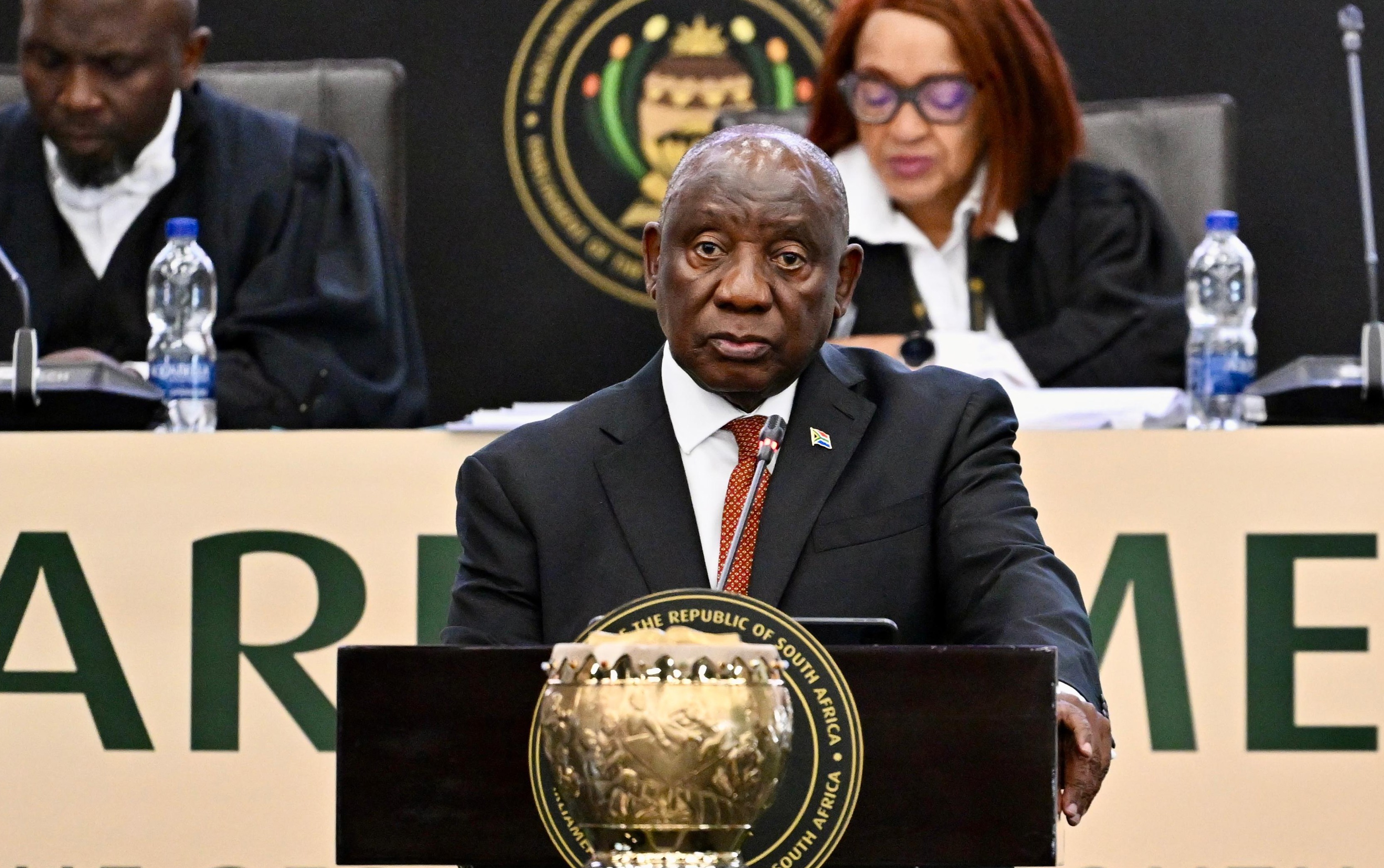
In response to a sweetheart question from the ANC on local government, President Cyril Ramaphosa, speaking during Tuesday’s virtual presidential question time, foreshadowed “far-reaching reforms” to rebuild trust and inclusive economic growth for municipalities as the review of the local government white paper – this document sets out government’s policy – is close to completion.
DA parliamentary leader George Michalakis seemed to get under Ramaphosa’s skin.
“Why did you allow your party, the ANC, to govern municipalities in such a way [that] we got this in the first place?” the DA MP asked after listing ANC-led municipalities’ water delivery failures, such as 65% water losses in eThekwini to sewage spills.
“The honourable member is making a long political speech on a matter that is so important, and completely ignores the measures and interventions that government is making, particularly national government,” Ramaphosa replied, segueing into one of his key themes – partnerships.
“Rather than pontificate, rather than stand with a measure of piousness on pulpits and platforms, requires the involvement of all so that we can solve the problem. We find great cooperation also at local level among people who belong to other political parties… I would rather have him say: ‘How can I support you so that we address this problem together?’”
Michalakis later took up Ramaphosa’s challenge and asked, “How can I help you to fix the mess the ANC caused, leaving South Africans without water, because you clearly need all the help you can get?”
Ramaphosa smiled briefly. “I’m not going to be taking potshots at him and his party at the failures that they are also overseeing… I am willing and able to work with him. The question is, will he come forward with practical plans and proposals?”
/file/attachments/orphans/ED_546146_142902.jpg "DA Chief Whip George Michalakis during the 2025 State of the Nation Address (SONA) Debate at the Parliamentary Dome in Cape Town. (Photo: Gallo Images/Jeffrey Abrahams)")
Infrastructure potential
Ramaphosa looked and sounded tired. Answering questions in the House was only one of several major diary items on Tuesday, alongside the ANC national executive committee meeting in Gauteng. Earlier he had addressed – also via virtual link with the same backdrop – the Sustainable Infrastructure Development Symposium of South Africa (Sidssa), under way in Cape Town.
All this came after a busy weekend for Ramaphosa, wearing his ANC president hat at the jamboree, of announcing short-listed contenders for ANC mayoral nomination in several key municipalities, and launching the 2026 local government manifesto.
Almost two hours into the parliamentary question session, the venue of the ANC local government election launch came in handy in responding to an ANC follow-up question on the impact of government prioritising infrastructure.
Explaining how infrastructure could “change the geography that apartheid bequeathed us”, Ramaphosa said: “We saw that over the weekend at Riverside where infrastructure has been installed in the form of houses, in the form of roads… That’s when it raises the confidence of people, and it also creates opportunities for growth.”
Re-canvassing gross capital formation numbers, Ramaphosa’s messaging to the symposium and the House was the same: infrastructure is key to economic growth, job creation in the short and longer term and attracting private sector investment.
“South Africa cannot grow faster without fixing infrastructure. This is an impossibility. We have allowed infrastructure to decline for far too long. Infrastructure can unlock unprecedented growth in our country…” Ramaphosa told MPs.
At Sidssa, he told the audience, according to his prepared speech, “We know that our ability to grow the economy depends on whether we can secure reliable energy, sufficient water, efficient ports and railways, functioning roads, digital connectivity and cities and towns that work. Infrastructure affects the daily lives of South Africans.”
At the virtual parliamentary Q&A, ANC questions allowed Ramaphosa to remain upbeat.
While local government reforms are being finalised, interventions focused on “building a more capable, professional and development local government system”. It was the hook to introduce progress of the district development model (DDM), which he introduced in his post-2019 election State of the Nation Address to get all three spheres of government working together.
“There is now measurable progress in executing the district development model, but I must say the model has not yet achieved its original ambition to make government operate as one across all 52 districts,” said Ramaphosa, adding that reasonable success in producing plans – all districts now have one – had to translate to the next stage of implementing projects.
Perhaps it was a slip of the tongue when Ramaphosa bemoaned the “always attendant corruption”.
Marikana ‘blood has dried’
Aside from Michalakis, other MPs were easily dealt with.
Ramaphosa gave Build One South Africa (Bosa) leader Mmusi Maimane short shrift over his question on accountability for the 40 deaths in connection with a cholera outbreak and the inadequate and troubled water supply at Hammanskraal outside Pretoria.
“Yes, people should be held accountable,” replied Ramaphosa.
Ramaphosa corrected DA MP Marina van Zyl’s claim that nothing was being done to ensure criminal accountability for sewage spillage by pointing out that the water and sanitation department had laid 96 charges involving 53 municipalities by June 2026, with officials at eMalahleni and Thaba Tshweu already having pleaded guilty.
But he also steered around the MK party’s raising of the Marikana massacre in August 2012, when police killed 34 miners at Lonmin, where Ramaphosa, then a businessman, was a non-executive director.
“The blood has dried from the 16th August massacre, but the taps are still dry”, said MK party parliamentary leader John Hlophe before asking where the national water action plan’s water monitoring portal was.
Ramaphosa replied straight-up-and-down that while the part of the system government used was done, the comprehensive public-facing system was still in development, pointing out other information dashboards including “a water security dashboard that covers Gauteng and eThekwini”.
It wasn’t quite the progress message Ramaphosa may have hoped to deliver, but with a jam-packed diary, ANC electioneering and pesky opposition MPs on Tuesday, the commitment to establishing a fully fledged public water monitoring system would have to do. DM
KioskNews shows a cleaned-up reading view extracted from the publisher’s page — the original always lives on their site, not ours.