SpaceX Starship to attempt first-ever spaceship ‘catch’
Elon Musk’s SpaceX was yesterday poised to carry out its latest test of the world’s biggest and most powerful rocket, the Starship, with plans for a groundbreaking “catch” of the spaceship following a day in orbit.
A successful capture of the Starship upper stage would mark a significant milestone in the space industry’s decades-long pursuit of fully reusable spacecraft that can drastically reduce mission costs and make frequent travel possible.
“If successful, this will mark the first full recovery of an orbital launch system and a breakthrough moment in making Starship a reliable, rapidly reusable rocket,” SpaceX said.
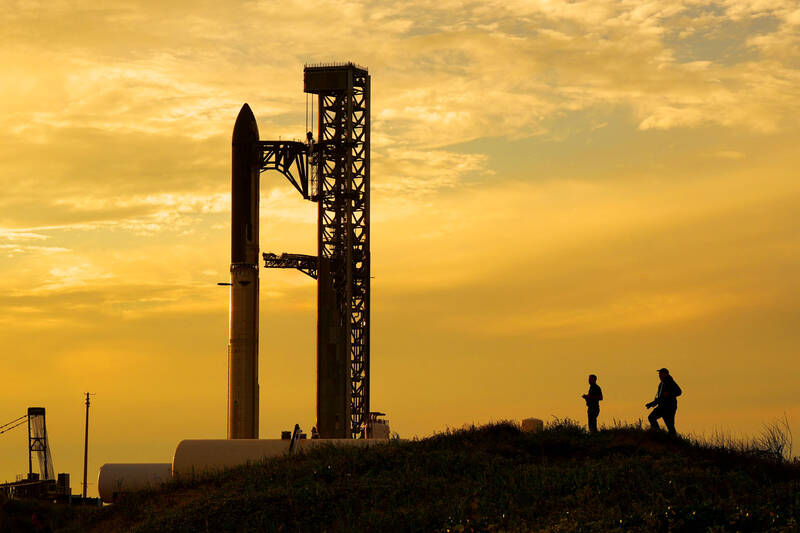
SpaceX’s mega rocket Starship is stacked and prepared for a test flight from Starbase, Texas, on Thursday.
Photo: AP
For the 15th Starship test flight Friday, SpaceX aims to recover both stages of the massive 124-meter launch vehicle.
The company has caught the booster, dubbed Super Heavy, on three previous occasions, with the first stage descending vertically back to the launch site shortly after blastoff and nestling into mechanical “chopstick” arms.
It will now attempt to do the same with the spaceship. Some versions of the vessel are designed to launch Internet satellites and data centers into orbit, while others would be made to ferry people to the moon and Mars.
A spacecraft that can be fully reused is the “Holy Grail” of the space industry, Center for Strategic and International Studies aerospace expert Clayton Swope said.
“No one’s really been able to do that so far,” he said. “People have been trying to do that since the [NASA] space shuttle. But the space shuttle ended up being kind of a compromise because a lot of the vehicle wasn’t reusable.”
Reusing the Starship spacecraft would require the vessel to withstand the extreme heat of re-entering Earth’s atmosphere and then return to service without extensive refurbishment.
Musk has already revolutionized the space sector with the partially reusable Falcon rockets, which are regularly employed to launch satellites and carry astronauts to the International Space Station.
However, the Starship project has been plagued by yearslong delays as SpaceX grapples with novel engineering challenges — even as NASA is counting on the spaceship to serve as a lunar lander for its Artemis program. Other technical challenges include transferring fuel to Starship in orbit — a requirement for any journey to the moon or Mars.
SpaceX carried out the first orbital flight of Starship in September, although the mission was cut short due to an engine issue.
The launch is scheduled to take place at SpaceX’s “Starbase” in southern Texas. Following liftoff and the mid-air separation of the two stages, SpaceX plans to bring Super Heavy back to Earth after six and a half minutes, catching it at the launch site on the Gulf of Mexico coastline.
The spaceship would continue to reach Earth’s orbit, where it would deploy 26 satellites into Musk’s Starlink satellite Internet constellation that has become a major revenue stream for SpaceX.
It would then circle the planet 14 times, before returning 22 hours later and — SpaceX hopes — descending safely into the chopstick arms.
This capture attempt is more complex than that of the booster, as the spaceship will be descending much faster and from a much greater altitude.
SpaceX has said it would proceed with these maneuvers only if conditions are optimal, and in the past has made last-minute changes to test flights under Musk’s “fail fast” strategy of learning through crashes, explosions and other mishaps.
KioskNews shows a cleaned-up reading view extracted from the publisher’s page — the original always lives on their site, not ours.