John Ivison: Russia’s deadly crosshairs could be aiming at the heads of Canada’s defence contractors

When Sentinel R&D, a Hamilton, Ont.-based defence firm, signed a deal with a Ukrainian drone firm, Airlogix, in May, the response from the Kremlin was unusual.
Sign In or Create an Account
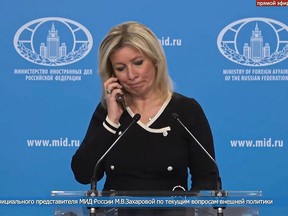
The deal to build ReKam fixed-wing drones in this country drew the ire of Russian Foreign Ministry spokeswoman Maria Zakharova, who called Canada a “war monger” and said Russia reserves the right to “an appropriate response.”
She added spice to the threat by vowing to publish the address of Sentinel’s facility in Hamilton.

Columnist Jesse Kline keeps you up to date with what’s happening in Israel and the effects of antisemitism on life here in Canada. Friday mornings.
By signing up you consent to receive the above newsletter from Postmedia Network Inc.
A welcome email is on its way. If you don't see it, please check your junk folder.
The next issue of Channel Israel will soon be in your inbox.
We encountered an issue signing you up. Please try again
Russia’s ambassador in Ottawa, Oleg Stepanov, said the deal is proof that Canada is seeking to profit from the conflict. Moscow is factoring the deal into its military and political planning, he said ominously.
Sentinel’s CEO Kath Intson maintained that the project would proceed as planned, but quietly took precautions by hiring two private security firms: Atlas Security, which provides national intelligence information and advice, and CyberAGroup, which offers dark web and open-source intelligence collection. The two companies are headed by former senior operatives from Canada’s spy agency CSIS.
Intson’s decision looks prescient in light of a recent story in the Financial Times, which said five European intelligence agencies have warned defence company bosses that Russia is stepping up preparations to assassinate senior executives whose companies supply weapons to Ukraine. In particular, the article said the heads of smaller companies making drones and drone components would be targeted. Earlier reporting highlighted the plight of Stefan Thumann, the CEO of German drone company, Donaustahl Offence Technology, which supplies drones to Ukraine. He is already in hiding, under 24-hour protection, after an assassination plot was unearthed.
A federal indictment in the U.S. revealed another murder plot, this time against a Russian dissident in Washington. The authorities accused five people of being part of a “global assassination network” linked to Moscow.
The two former CSIS operatives hired by Sentinel agreed to talk on the record to National Post about the threats Canada is facing.
Marc Lacroix, the CEO of Atlas Security, is a former director of covert operations at CSIS. Ryan Zorn, CEO of CyberAGroup, was an intelligence operator at CSIS for 28 years and created the agency’s OSINT Cyber Investigations unit (OSINT stands for open-source intelligence).
Zorn said the threat environment in Canada is escalating. “What is particularly significant here is that the Russian Foreign Ministry chose to make its warning publicly, calling Canada a ‘warmonger’ and threatening to identify the Canadian company involved, (not to mention) stating that a drone arrangement would factor into Russia’s military and political planning.
“I wouldn’t claim that this public statement was a direct instruction to Russian intelligence services, because we do not have evidence of that. But it is reasonable to view it as an escalation in Moscow’s posture towards Canada, and a warning that Canadian companies and institutions connected to support for Ukraine may face increased attention and pressure,” he said.
Lacroix said Canada’s defence sector is not immune to what we are seeing in Europe. “What Sentinel faced was a threat to make their address public. That’s a form of intimidation that sits squarely in the information-operations tool kit. It’s a different instrument from the sabotage and assassination cases, but it comes from the same place,” he said.
I asked whether Russia has the capability to assassinate people in Canada.
Zorn said Russia has the capability but it’s not yet clear that it has the intent.
“Canada is considered a legitimate target by the Kremlin and has been the subject of operational planning for potential sabotage,” he said.
Lacroix said that, from a security standpoint, the prudent course is to plan against capability and not wait for a clear signal of intent.
One of Sentinel’s concerns surrounded a guest opinion column that appeared in the Hamilton Spectator at the end of September by activist Ken Stone under the original title: “Hamilton shouldn’t be home to lethal drones.” The author called for an urgent political discussion about a production facility, supported by taxpayers’ money, that he said is putting the lives of the city’s citizens at risk.
The article didn’t mention Russian aggression but did criticize Canada’s support for the “undemocratic and corrupt Ukrainian regime” and NATO’s “provocative” eastward expansion.
Sentinel was concerned that the messaging was aligned with Kremlin propaganda.
Zorn said CSIS has been explicit that Russia uses networks of proxies to influence and amplify Kremlin messaging, and that Canadians can be “wittingly or unwittingly” used to enable those narratives. The goal is to make the activity resemble organic domestic advocacy, he said.
Lacroix did not make any allegations against the author but said foreign states often work through surrogates.
“We’re always mindful of people’s legal right to lawful advocacy and protest … It’s difficult to say with any certainty whether this is an isolated incident or whether it represents something more,” he said.
Beyond assassination and disinformation, the third leg of Russian disruption is sabotage.
Zorn, who led CSIS’ cyber unit, said that Russia is capable of disruptive activity that would yield real-world consequences.
Lacroix referred to the annual report produced by the Communications Security Establishment that described a Russian hacktivist group accessing a Quebec water treatment plant, including its chlorine dosage.
“Water, energy and other systems people rely on every day have become targets in their own right,” he said.
“What we are seeing in Europe isn’t staying in Europe. And it isn’t limited to defence firms.”
With news this week that Ottawa-based Dominion Dynamics has struck a deal with Ukrainian robotics company, Tencore, to build a ground-based drone vehicle in Canada next year, the prospect of more dirty deeds being done dirt cheap by proxies is only likely to grow.
National Post
Join the Conversation
This website uses cookies to personalize your content (including ads), and allows us to analyze our traffic. Read more about cookies here. By continuing to use our site, you agree to our Terms of Use and Privacy Policy.
KioskNews shows a cleaned-up reading view extracted from the publisher’s page — the original always lives on their site, not ours.