Beneath a German lake, above a Nazi bunker: Israeli artist explores buried memory - feature
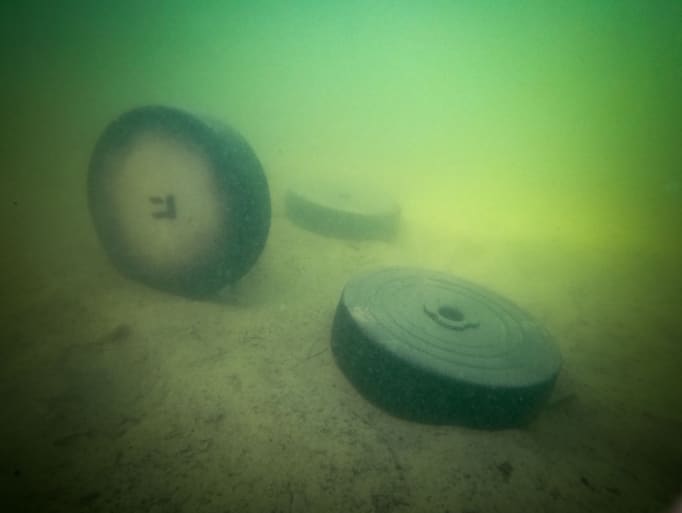
Clay mines inscribed with Hebrew letters and submerged in a German lake above a Nazi-era bunker are at the center of Israeli artist Yehudit Sasportas's video installation Lake of Void, which opened at Jerusalem's Tower of David Museum on October 12.
The exhibition, hosted as part of the Jerusalem Biennale, one of the world's largest platforms for contemporary Jewish and Israeli art, is expected to remain on display until the end of November.
At the opening, Sasportas, Tower of David Museum director Eilat Lieber, and exhibition curator Hillie Wurtman Moyal addressed a small audience atop the citadel's tower, discussing the significance of presenting the installation in Jerusalem, the motivations behind Sasportas's work, and the relationship between archaeology and contemporary art.
The exhibition is housed within Jerusalem's ancient citadel, home to the Tower of David Museum, which preserves and presents the stories of the people and cultures that have shaped the city.
For Lieber, hosting contemporary art in the historic structure offers a chance to add another dimension to Jerusalem's history.

"Alongside being a historical museum, we also want to host art exhibitions here, because it's another layer [of the city's history]," Lieber told The Jerusalem Post.
"It's a layer of our generation that gives more perspective and meaning to the story of Jerusalem, especially Israeli art at its best, dealing with memory."
Memory beneath the surface
Sasportas, who represented Israel at the 2007 Venice Biennale, approaches the preservation of memory differently from traditional archaeologists, Lieber explained.
"Unlike archaeologists, [...] she's creating the remains. She's connecting the memories, sounds, and she creates artifacts, trying to be the archaeologists of the future," Lieber said.
Presenting the installation inside a hall dating back approximately 800 years, to the Crusader or Ayyubid period, creates a dialogue between the ancient structure and Sasportas's exploration of memory.
"To be able to host [the exhibition] inside the original... hall... and contemporary art that thinks about memories, the past and their meaning, is important for us," Lieber said.
Rather than uncovering objects left behind by previous generations, Sasportas creates artifacts intended to preserve traces of the present for those who come after.
In Lake of Void, that idea takes the form of clay sculptures resembling land mines, each containing a concealed message.
From Germany's Black Forest to a submerged Nazi bunker
The installation draws on Sasportas's earlier work in Germany's Black Forest, where she produced hand-drawn seismographic lines inspired by recordings taken from inside more than 138 trees.
The recordings were made near the cabin of German philosopher Martin Heidegger and the approximate location of his historically charged 1967 encounter with Romanian-born poet Paul Celan.
For Sasportas, the trees became "a living archive," their sounds translated into marks made by needles and pencils on drawing paper.
The resulting drawings were rolled, sealed inside black metal boxes, and placed within the clay mines, turning recordings of the natural world into physical repositories of memory.
The mines were subsequently submerged in Lake Bant in Wilhelmshaven, Germany, a lake beneath which lies a bunker constructed during the Nazi era.
Sasportas documented their descent with underwater footage and sound recordings, making the submerging of the sculptures part of the artwork itself.
Lake of Void is set "in a place that was [formerly] a lake, but underneath that lake there was a bunker that was created during the Nazi regime," Moyal explained.
The location reflects the exhibition's broader exploration of what remains hidden beneath seemingly ordinary landscapes.
Moyal described the work as examining the "underlying layers of the unseen reality – all the stories and memories and traumas and conflicts that are beneath the ground."
By bringing these buried histories to light, Sasportas confronts the legacy of places marked by historical violence.
"She deals with traumas under the ground, but through art revealing those stories," Moyal said.
"In her work, she [Sasportas] works through art to kind of change these charged memories and create something [..] to heal these charged places."
In Mine Sentence 3/6, an underwater camera focuses on the Hebrew letters inscribed on the clay sculptures. Their combinations form words, verses, and sentences carrying "intention and meaning," according to a Tower of David Museum press release.
The work forms part of Sasportas's ongoing The Liquid Desert Project, which began in 2013.
Sending a letter to the past
Sasportas's practice frequently takes her to locations across Europe and Israel where traumatic histories have been buried, forgotten, or denied.
According to the museum, her work seeks to bring those histories back into view, using art to connect different periods.
The discovery of the bunker beneath the Banter See was particularly significant to Sasportas, who recalled being struck by the contrast between the lake's peaceful appearance and the history concealed below.
When she "realized that there is an actual underground architecture like this bunker" beneath a lake that appeared "too beautiful," she wanted to "send a letter to the past" and "be able to correspond with the collective subconscious."
Although Sasportas acknowledged that the idea might sound "very abstract" and "very poetical," she described art as a way to communicate across time.
"Through a drawing, through a sculpture, through a mute image, you’re able to correspond with different times, and I think that this defines the quality of art as a timeless thing," she said.
The sculptures remain at the bottom of the lake, forming a permanent underwater installation above the submerged bunker.
According to the museum, the work is the third of six Mine Sentence installations submerged across Europe and Israel between 2020 and 2025.
From 'ani' to 'ayin': Finding meaning in nothingness
Beyond the physical landscape, Sasportas draws on the Hebrew language to explore the relationship between identity, absence, and creation.
Central to the exhibition is the connection between ani, meaning "I," and ayin, meaning "nothingness."
In Hebrew, the two words contain the same three letters, rearranged to produce different meanings.
For Sasportas, that transformation represents an opportunity to move beyond the self and into a space of creative possibility.
"You can also move the letters for a certain... artistic practice, creative practice, spiritual practice," she said.
"The transformation from 'ani' to 'ayin' inspires me a lot, and this is the lake of void, the lake of an ayin."
Sasportas also explored another meaning of ayin through the opening of Psalm 121, Me'ayin yavo ezri, traditionally translated as "From where will my help come?"
While the verse is commonly understood as a question about the source of assistance, Sasportas also interprets it as suggesting that help can emerge from nothingness itself.
"Ayin can be like nothing, nothingness, but ayin is also a space," she said.
She explained that the distinction depends on the viewer's state of consciousness and the meanings they bring to the work.
"I'm very inspired by artistic actions that can activate within themselves those different levels of consciousness," she said.
Sasportas also connected her artistic practice to the Hebrew expression Hashem hakol bizman, which she invoked to describe trust in divine timing.
Working "from a certain space-time," she explained, allows an artist to "open up other dimensions."
For Sasportas, the ability to hold seemingly contradictory states together, the concrete and the abstract, the visible and the hidden, is central to the power of art.
"If an artwork can embrace two states, like a very concrete, recognizable one, and start losing the face slowly into more abstract, but in the same body," she said, it can "activate all dimensions simultaneously."
KioskNews shows a cleaned-up reading view extracted from the publisher’s page — the original always lives on their site, not ours.