10 Greatest Peanuts Strips Of The 1990s

Hannah is a senior writer and self-publisher at ScreenRant. There, she focuses on writing news, features, and list-style articles about all things comics, books, anime, and manga. She works as a freelance writer in the entertainment industry, focusing on video games, anime, and literature.
Her published works can be found on Screen Rant, FinanceBuzz, She Reads, and She Writes.
Sign in to your ScreenRant account
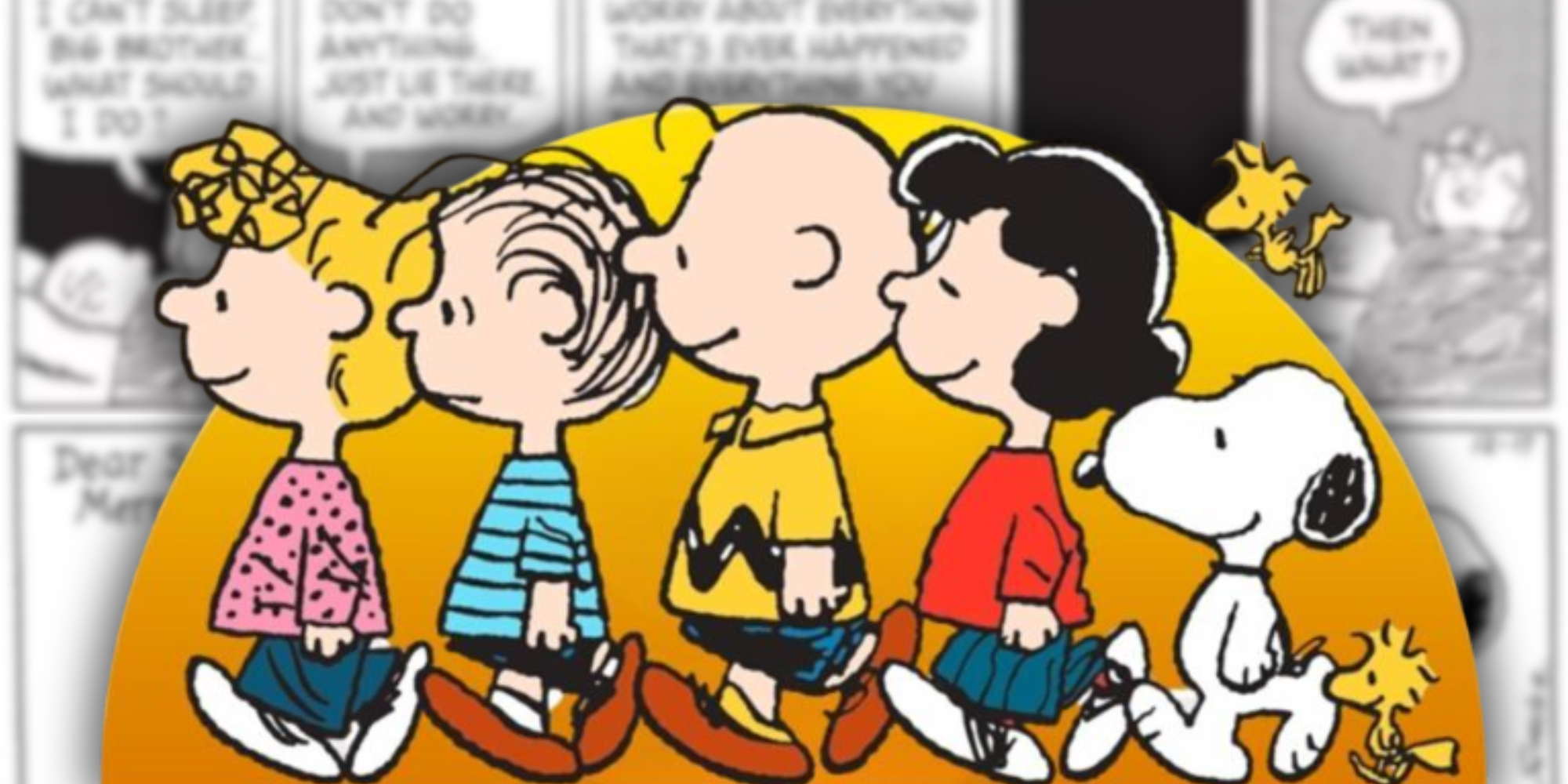
The 1990s are sometimes overlooked when fans discuss the greatest era of Peanuts. By that point, Charles M. Schulz had been drawing Charlie Brown, Snoopy, Lucy, Linus, Sally, and the rest of the gang for more than three decades. Yet the strip never simply coasted on nostalgia. Schulz continued finding new situations for his characters while returning to the insecurities, relationships, and absurd little frustrations that had always defined the series.
That makes the decade surprisingly rich for Peanuts fans. Schulz introduced new developments such as Charlie Brown's relationship with Peggy Jean, gave Rerun more opportunities to shine, and even allowed the perpetually unlucky Charlie Brown to experience an extraordinary baseball victory. At the same time, familiar subjects such as Snoopy's imagination, Lucy's psychiatric booth, Linus' blanket, and Charlie Brown's anxiety remained reliable sources of comedy.
10 Snoopy's Attempt to Steal Linus' Security Blanket Is Classic Peanuts

Linus' security blanket had been one of Peanuts' most recognizable running jokes for decades by the 1990s. Lucy constantly tried to convince her younger brother to abandon it, while Linus remained firmly attached to the familiar object. Snoopy occasionally became interested in the blanket, too, creating another opportunity for Schulz to turn Linus' dependency into physical comedy.
In the June 1990 strip, Snoopy takes the joke further by imitating Linus himself. He carries the blanket and sucks his thumb, essentially transforming himself into a canine version of Linus. When Linus demands his property back, Snoopy offers his own thumb instead. Naturally, Linus has absolutely no interest in that exchange.
9 Rerun's Dream of Having a Dog Makes for a Perfect Peanuts Joke

Rerun was introduced in the 1970s as Linus and Lucy's younger brother, but Schulz continued finding new ways to distinguish him during the 1990s. His fascination with Snoopy was particularly effective because Rerun desperately wanted the sort of canine companion Charlie Brown already had. Snoopy, meanwhile, was hardly an ordinary pet.
One particularly funny sequence involves Rerun asking Charlie Brown about Snoopy and whether the dog can play. The joke mixes a child's innocent curiosity with the increasingly strange idea of treating Snoopy like a normal family pet. Rerun's desire for a dog also became important to his character, eventually inspiring the 2003 television special I Want a Dog for Christmas, Charlie Brown.
8 Sally's Barney Question Is a Perfect 1990s Time Capsule

Few Peanuts strips could be more specifically tied to the 1990s than Sally's encounter with Barney. By 1993, Barney & Friends had become an enormous children's television phenomenon, and the purple dinosaur was nearly impossible for American families with young children to avoid. Schulz occasionally referenced contemporary culture, making this an amusing departure from the strip's usual timelessness.
Sally's response is even funnier because she accepts the strangest part of Barney without question. Instead of wondering why a dinosaur can talk, she wants to know why he is purple. That wonderfully backwards logic is pure Sally. The strip also shows how Schulz could acknowledge a major pop-culture phenomenon without turning Peanuts into a conventional topical comic.
7 Charlie Brown's Sleepless Night Turns Snoopy Into His Best Distraction

Charlie Brown has never needed much encouragement to start worrying, making nighttime one of the most appropriate settings for his neuroses. A March 1996 sequence places him in the familiar position of lying awake while his thoughts race through his head. Instead of allowing the anxiety to build uninterrupted, however, Snoopy repeatedly distracts him.
The joke eventually becomes unexpectedly sweet. Charlie Brown realizes that having Snoopy around gives him something to focus on besides all the things occupying his mind. Snoopy's nighttime noises and restless behavior might normally be irritating, but Charlie Brown recognizes that even these interruptions have value. It is a small example of the emotional warmth hiding underneath Schulz's comedy.
6 Sally Turns to Charlie Brown When She Cannot Sleep

Sally approaching Charlie Brown for advice in the middle of the night sounds like the setup for a sincere sibling moment. Instead, Schulz uses the scene to show just how poorly Charlie Brown is equipped to provide reassurance. When Sally says she cannot sleep, Charlie Brown essentially recommends worrying about everything that has happened and everything that could happen.
Sally dutifully tries his advice, only to return and ask what she is supposed to do next. The circular logic makes the exchange hilarious, but there is also something recognizable about it. Charlie Brown understands anxiety because he experiences it himself. His advice is terrible, yet it comes from a place of genuine familiarity with the problem.
5 Snoopy Turns Charlie Brown's Jury Duty Into a Completely Absurd Adventure

Charlie Brown dealing with jury duty is funny because Schulz takes something associated with serious adult responsibility and places it in the hands of one of the strip's most anxious children. The storyline appeared in 1990, with Snoopy accompanying Charlie Brown and immediately making the situation stranger by wishing he had worn his World War I Flying Ace persona attire.
October 2, 1950 – February 13, 2000 · 17,897 Strips How Well Do You Know Peanuts? “Good grief!”
⚾Charlie BrownGood Ol’ Chuck
🐕SnoopyThe Flying Ace
🧣LinusSecurity Blanket
🏈LucyPsychiatric Help
🐥WoodstockBest Friend
01
Before Peanuts launched in 1950, Charles M. Schulz drew a weekly cartoon panel for the St. Paul Pioneer Press. What was it called?
✓ Correct! Li’l Folks ran from 1947 to 1950. When the syndicate renamed the new strip “Peanuts,” Schulz hated the title for the rest of his life.
✗ Not quite! It was Li’l Folks — and Schulz never forgave United Feature for rechristening his strip “Peanuts.”
02
Which member of the gang is almost never seen without his security blanket — and waits every year in the pumpkin patch for the Great Pumpkin?
✓ Correct! Linus — Lucy’s little brother, the strip’s resident theologian, and the reason “security blanket” entered the dictionary.
✗ Not quite! It’s Linus van Pelt, whose blanket gave the English language the term “security blanket.”
03
Schroeder hammers away at his toy piano in devotion to a single composer — whose bust sits on top of it. Who?
✓ Correct! Beethoven. Schroeder even observes Beethoven’s birthday every December 16 — while ignoring Lucy entirely.
✗ Not quite! It’s Beethoven — the one thing in the world Schroeder loves more than tuning out Lucy.
04
When Snoopy climbs onto his doghouse in goggles and a scarf, he becomes the World War I Flying Ace — forever hunting which nemesis?
✓ Correct! The Red Baron — and the Sopwith Camel doghouse always goes down in flames, sending the Ace off to curse him in a French café.
✗ Not quite! It’s the Red Baron. Snoopy’s doghouse is a Sopwith Camel, and it never once wins the dogfight.
05
Lucy runs a curbside psychiatric help booth out of a lemonade stand. What does she charge per session?
✓ Correct! Five cents, please. The nickel never went up in 50 years — and the advice was never once worth it.
✗ Not quite! It’s 5¢ — “The doctor is in.” Lucy held that price for half a century.
06
Snoopy’s tiny yellow best friend went unnamed for years before Schulz finally christened him. What was he named after?
✓ Correct! Woodstock got his name in 1970, borrowed straight from the music festival held the summer before.
✗ Not quite! He’s named for the 1969 Woodstock festival — Schulz gave the bird the name in 1970, years after he first appeared.
07
The jazz score for A Charlie Brown Christmas — including the immortal “Linus and Lucy” — was written by which musician?
✓ Correct! Pianist Vince Guaraldi scored the 1965 special, and network executives were sure the jazz soundtrack would sink it. It became a permanent holiday fixture.
✗ Not quite! It’s Vince Guaraldi, whose trio gave Peanuts its unmistakable sound.
08
Schulz drew every Peanuts strip himself for nearly 50 years. What made the final original Sunday strip — February 13, 2000 — so haunting?
✓ Correct! Schulz died the evening of February 12, 2000 — and his farewell strip, signed off with “Charlie Brown, Snoopy, Linus, Lucy... how can I ever forget them,” appeared in papers the very next morning.
✗ Not quite! Schulz died on February 12, 2000 — hours before his own farewell strip ran in the Sunday papers.
The Doctor Is In · Five Cents, Please Your Peanuts Report Card
⚾
/ 8
Good grief — or good ol’ Charlie Brown? Either way, the football is still there. Wanna try again?
Charlie Brown is understandably concerned about what jury duty entails and wishes he was taken seriously, while Snoopy seems to regard the whole affair as another stage for his elaborate imagination. The premise perfectly shows Schulz's ability to make mundane responsibilities funny simply by forcing his child characters to confront them.
4 Snoopy's Christmas Card Gets an Unmistakably Snoopy Twist

Christmas has always been one of the most important recurring settings in Peanuts, thanks in part to the enormous popularity of A Charlie Brown Christmas. Snoopy's writing career provides another way for Schulz to revisit the holiday. In this particular strip, Snoopy sits at his typewriter attempting to compose a Christmas card while struggling to remember the recipient's name.
His solution is to address the mysterious woman as “sweetheart,” which immediately gives Lucy something to criticize. The humor comes from Snoopy's complete confidence in his own writing abilities despite the obvious problem with the card. It also brings together two enduring elements of Peanuts: Snoopy's fantasy life and Lucy's willingness to comment on practically everything everyone else does.
3 Charlie Brown's Visit to Lucy's Psychiatric Booth Is Peak Peanuts

Lucy Van Pelt's psychiatric booth is among the most famous recurring locations in comic-strip history. The premise had been around for years by the 1990s, but Schulz continued finding ways to make the familiar setup feel fresh. Charlie Brown visiting Lucy to discuss loneliness gives both characters exactly the sort of interaction readers expect from them.
Lucy questions how Charlie Brown could possibly be lonely when he has a dog, creating an unexpectedly pointed observation about his relationship with Snoopy. Then Snoopy appears nearby and effectively listens in on the conversation. The sequence combines melancholy, character comedy, and physical movement between panels. Charlie Brown's vulnerability, Lucy's blunt analysis, and Snoopy's curiosity all collide in one compact joke.
2 Charlie Brown's Relationship With Peggy Jean Gave the Decade Something New

One of the most important developments for Charlie Brown in the 1990s was Peggy Jean. She first appeared on July 23, 1990, and her arrival gave Schulz an opportunity to explore Charlie Brown in a role readers rarely saw him occupy: someone actually involved in a romantic relationship. Charlie Brown's awkwardness remained intact, but he was no longer simply pining from the sidelines.
His introduction to Peggy Jean also produced one of the decade's funniest recurring details when he accidentally introduced himself as “Brownie Charles.” The relationship continued through numerous strips and eventually included a kiss. Peggy Jean did not erase his insecurities, but she showed that Charlie Brown's romantic life could occasionally move forward, making the storyline unusually significant within the long-running strip.
1 Charlie Brown Finally Becomes a Baseball Hero

Charlie Brown's baseball career is perhaps the ultimate example of a Peanuts running joke. His teams lose constantly, his players make mistakes, and Charlie Brown frequently has to endure disappointment. That is why the March 30, 1993, strip was such a remarkable departure: Charlie Brown actually hit a game-winning home run.
The victory was not treated as though Charlie Brown had suddenly become a different person. Instead, Schulz made the rarity of the accomplishment part of the joke. Charlie Brown celebrated wildly after finally becoming the hero, giving readers a moment they had spent decades waiting to see. The strip is especially memorable because it rewards one of Schulz's oldest characters without abandoning the humor that made his failures so beloved throughout Peanuts.
- TV Show(s)
- The Snoopy Show, Peanuts by Schulz
- First Film
- The Peanuts Movie
- Cast
- Christopher Shea, Kathy Steinberg, Bill Melendez, Sally Dryer, Peter Robbins, Noah Schnapp, Hadley Belle Miller, Mariel Sheets, Lisa DeFaria, Venus Omega Schultheis
- Created by
- Charles M. Schulz
- Movie(s)
- The Peanuts Movie, A Charlie Brown Christmas, A Boy Named Charlie Brown, Charlie Brown's All Stars!, A Charlie Brown Thanksgiving, It's the Great Pumpkin, Charlie Brown, It's the Easter Beagle, Charlie Brown
- Character(s)
- Charlie Brown, Snoopy, Lucy van Pelt, Linus van Pelt, Sally Brown, Pig-Pen, Marcie (Peanuts), Peppermint Patty, Woodstock
KioskNews shows a cleaned-up reading view extracted from the publisher’s page — the original always lives on their site, not ours.