TRC ROULETTE : Declassified document shows ANC were favourable to offering indemnity to apartheid-era crimes
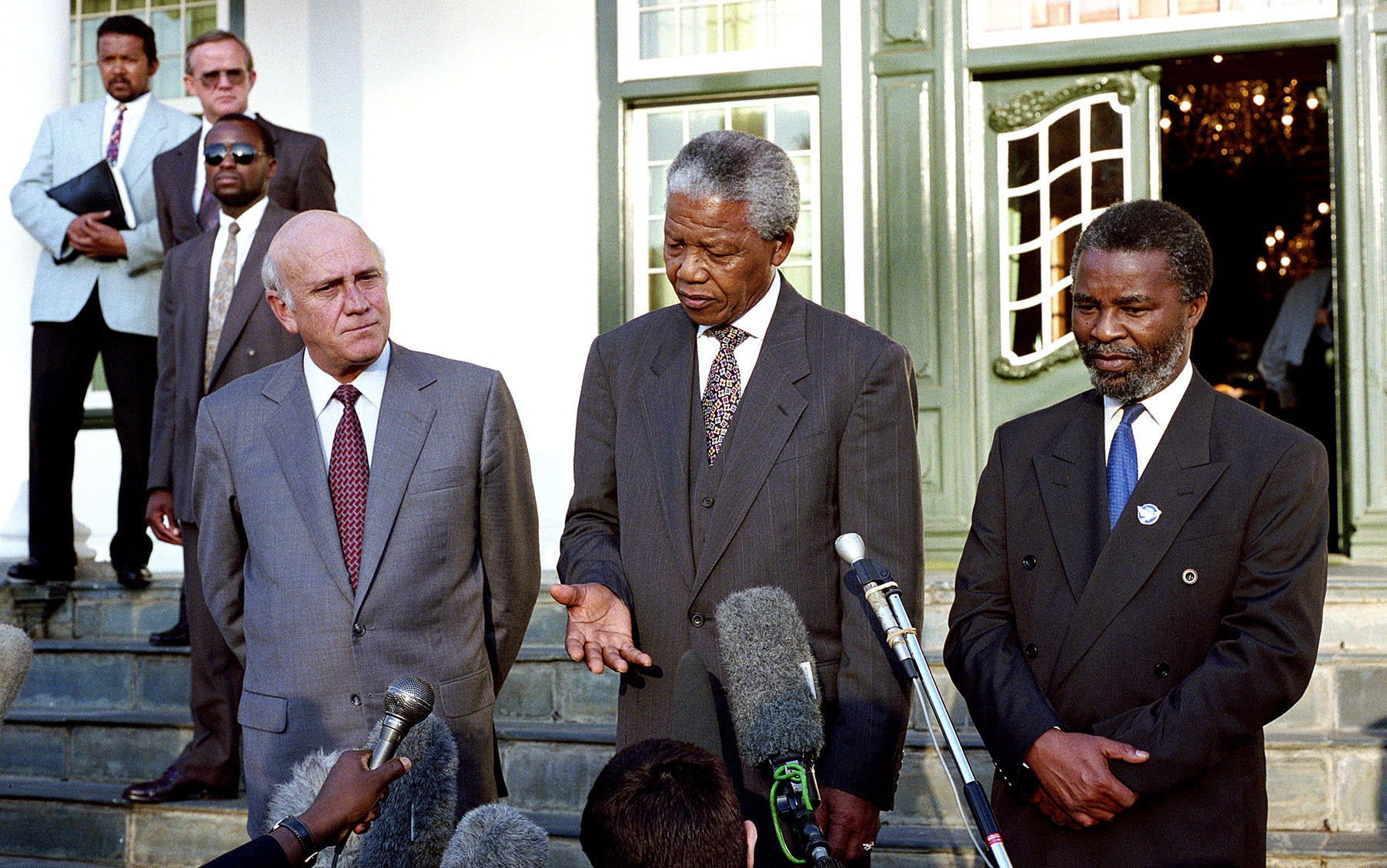
Two days before millions of South Africans prepared to vote in the country’s first historic democratic elections in 1994, then president FW de Klerk and his minister of justice Kobie Coetsee told the Cabinet that the ANC, led by Nelson Mandela, had been in favour of granting indemnity from prosecution for apartheid-era ‘politically motivated crimes’.
At a final special meeting of the country’s last white Cabinet on 25 April 1994, just 48 hours before about 20 million South Africans would queue for hours across the country at polling booths, then president FW de Klerk announced to his colleagues that this “agreement” had been concluded in the interests of “national reconciliation”.
The recently declassified minutes of that meeting, attended by the full Cabinet (apart from Minister of Finance Derek Keys), noted “the President and the Minister of Justice [Kobie Coetsee] informed Cabinet of discussions held with Mr Nelson Mandela regarding the further granting of indemnity from prosecution for politically motivated crimes.
“It appears that the leadership of the ANC, at this stage, are positive about the indemnity process as part of national reconciliation”.
This is a highly significant document as it highlights accusations of early discussions regarding a secret potential “political settlement” or “deal”.
At the time, the clock was ticking. It was five minutes to midnight with tens of millions poised to mark their X on the ballot for the first time in their lives. Political pragmatism had been an early opening gambit the perpetrators of human rights abuses were hoping would be future-proof.
/file/attachments/2996/Screenshot2026-08-14112106_971522.png)
The minutes were declassified only in February 2026, after the Khampepe Commission of Inquiry into possible political interference in the delay of post-TRC prosecutions sought to investigate claims that these early “secret negotiations” set the scene for what witnesses and authors Michael Schmidt (Death Flight) and German scholar Ole Bubenzer have termed a “Pact of Forgetting”.
Political power play
The revelation was made public on Thursday at the inquiry, chaired by retired Constitutional Court Justice Sisi Khampepe, joined on the panel by retired Northern Cape Judge President Frans Kgomo and advocate Andrea Gabriel. It is due to complete its work in December.
It formed part of the evidence handed in during the cross-examination of veteran churchman and activist, Reverend Frank Chikane, who inadvertently became a centrifugal force around which a political power play between old-guard apartheid generals and the new dispensation played out in 2007.
Also declassified by Director-General and Secretary of the Cabinet, Phindile Baleni, were minutes of a 22 June 2005 Cabinet meeting where approval was given for the terms of reference for a review of the South African Criminal Justice System.
/file/attachments/orphans/GettyImages-107142020_971202.jpg "Making of the South African Constitution: Front row: Roelf Meyer, Frene Ginwale, FW De Klerk, Cyril Ramaphosa, President Nelson Mandela, Leon Wessels, Thabo Mbeki, Kobus Coetzee, and Constant Viljoen (far right), in 2006. (Photo: Oryx Media Archive / Gallo Images / Getty Images)")
Mbeki’s directive
This Cabinet, led by then president Thabo Mbeki [Nelson Mandela served only one term], approved new prosecutorial policy and directives relating to the prosecution of criminal matters arising from conflicts of the past for crimes committed on or before 11 May, 1994.
These were the guidelines, Chikane told the panel, he had used as his North Star in an attempt to navigate the explosive legal challenges he faced, and was drawn into the post-TRC process which took place between 1996 and 1998 and again between 2001 and 2003.
Both former presidents Mbeki and Jacob Zuma, who have resisted being called to the commission, have denied any political interference in TRC matters.
Chikane previously appeared before the panel in May and argued that individuals such as Dr Wouter Basson, head of the apartheid state’s covert chemical and biological warfare programme (Project Coast), managed to escape full legal accountability, but should have been held to account for hundreds of deaths.
Also, Military Intelligence operatives who had played a role in the elimination of activists and other “politically sensitive persons” were never held to account.
Chikane said the plea agreement, which had seen the second charge against former minister of police Adriaan Vlok and police commissioner Johan van Der Merwe of colluding with those who procured and manufactured the toxin that poisoned him in 1989, was struck off, enabling perpetrators such as Basson to get away without consequence.
‘Back-door’ manoeuvres
At the time, civil society criticised the new prosecutorial policy, characterising it as a “recipe for conflict and absurdity” and an unconstitutional attempt to grant “back-door amnesty” without the transparency of the original TRC process which had taken place between 1996 and 1998 and again from 2001 to 2003, when the final report was handed to the government.
The families of survivors who have fought three decades for accountability and for the establishment of this commission, and who are known collectively as “The Calata Group”, have argued that political interference and this very “back door” were leveraged to cover up and protect human rights abusers who had not applied for amnesty.
Vlakplaas commander Eugene De Kock, who applied for amnesty in 1997, was the only apartheid-era official in the command structure of the security police who did so, making a full, chilling disclosure.
He was granted amnesty for some crimes, but was later jailed on multiple life terms for multiple crimes. De Kock, known as “Prime Evil”, was released on parole in 2015 and testified recently at the reopened inquest into the killings of the “Cradock Four”.
/file/dailymaverick/wp-content/uploads/2023/01/000065683-1.jpg "Former Minister of Law and Order, Adriaan Vlok, with former Police Commissioner Johann van der Merwe, Gert Otto, Hermanus van Staden and Christoffel Smith on 17 August 2007, after their trial in the Pretoria High Court relating to the attempted murder of Frank Chikane. (Photo: Johnny Onverwacht/Gallo Images)")
The train derails
In July 2007, the imminent arrest by the Priority Crimes Litigation Unit (PCLU) of Vlok and Van der Merwe for the attempted murder of Chikane, as well as two of their underlings and collaborators, security policemen Gert Otto, Hermanus van Staden and Christoffel Smith, derailed the reconciliation and peace train.
Former head of the NPA, Vusi Pikoli, has told the commission that there had been political interference in these prosecutions, a claim corroborated by then prosecutions head Dr Silas Ramaite, who said then Minister of Justice Bridget Mabandla had called and asked for a “moratorium” on all outstanding TRC matters.
Chikane spoke at the commission about his attempt, as a Christian committed to forgiveness, to balance the complexity of dealing with Vlok and Van der Merwe, who had commanded the men who poisoned him in 1989, with his need for truth, for the sake of “national reconciliation”, which had become the political mantra of the era.
He said that PCLU head advocate Anton Ackermann’s approach and threat to force him to provide evidence against Vlok and Van der Merwe had “rubbed salt into his wounds”. At the time, he had not been sure who to trust and had relied on the “Mbeki” regulations.
The justice ministry has submitted arguments to the Khampepe Commission that the Constitution, read with the NPA Act, allowed for consultation between the executive and the NPA on prosecutions policy.
Subsequent heads of the NPA, including Shamila Batohi, have all campaigned for greater independence, noting the law required the authority to act “without fear, favour or prejudice” and not necessarily “independently”.
Researcher and author Ole Bubenzer, in his testimony to the Khampepe Commission, noted that it was Jan Wagener, legal representative of former SADF generals and others in the apartheid security cluster, who had approached Mbeki seeking a suspension of the arrests.
Pikoli earlier told the commissioners it was “quite evident that all these imaginations were aimed at ensuring that no generals of apartheid South Africa would be prosecuted and if they are not prosecuted, then obviously that dossier which was being compiled elsewhere with the collusion of a member of SAPS, [Hennie] Brits, and the former National Commissioner of Police, would then never see the light of day”.
It appears that apartheid generals, believing they had slipped the coils of justice, feared they might be held accountable and were convinced the “promise” by Mandela and the ANC to grant indemnity, and about which De Klerk had informed his Cabinet in 1994, had reached its sell-by caveat, “at this stage”.
/file/attachments/orphans/000075743_558735.jpg "Former Commissioner of the South African Police Service, Jackie Selebi on 8 June 2007. (Photo: Leon Botha/Beeld)")
Selebi’s grapevine
Ten years later, and with advocate Anton Ackermann heading the PCLU, the NPA believed itself to be acting “without fear or favour” in bringing particularly Vlok and Van Der Merwe to book.
However, former police commissioner the late Jackie Selebi, a former exile like Mbeki and steeped in rumour and conspiracies, had been fed information by Wagener and his clique that the NPA was about to arrest 37-high profile ANC government members, including himself and the president.
This triggered, in the end, a further 20 years of instability in the NPA, which has circled back all the way to the Madlanga Commission of Inquiry, which in turn has exposed a historic and deep nexus between the country’s intelligence services, law enforcement, politicians and organised crime.
Presidential pardons
Earlier in the week, human rights lawyer and former TRC commissioner Yasmin Sooka told the inquiry that she had been “deeply disappointed” that Chikane had refused to join a coalition formed in opposition to proposed presidential pardons offered in 2003.
Sooka challenged this refusal in a 2012 interaction with Chikane, she told the Khampepe Commission, urging him to take a public stand against the pardons because the perpetrators had concealed the full truth and protected “higher authorities”.
Chikane said his decision not to support Sooka had been based on his belief in the legal processes that followed the TRC and added that he had obtained a “full picture” of how the poisoning had come about through the 2007 court process.
He stated that because Vlok, Van Der Merwe and their underlings had to put their “deeds on record in court”, his goal had been achieved. Sooka’s affidavit noted that Chikane had believed Vlok and Van der Merwe had already “taken off their masks” and moved away from their “strategic lies”, while this had been far from the truth.
She said the two men had avoided naming anyone living. The only person they implicated was former head of counter-intelligence, Major General Krappies Engelbrecht, now 85 years old, who has denied being involved in the cover-up and murder of Cradock activists, Fort Calata, Mathew Goniwe, Sparrow Mkonto and Sicelo Mhlauli.
Chikane argued that the case against Vlok and others was the “best way post-TRC cases could be finalised”. He publicly praised the NPA guidelines, stating they facilitated a “win-win outcome” and demonstrated how the law could advance national unity.
The unhealed wound
However, Chikane has consistently stated at this inquiry that the TRC Act, as it was finally adopted, was not what those in the liberation struggle had in mind.
“But we realised this was a political project completing our struggle and ending our war. There were conflicting interests at play in the old order and the new order. I think what is more complex is that we set up the TRC not in the way the Act ultimately did. It is a compromise document”.
Chikane recalled how he survived his attempted murder, telling the inquiry he fell ill in Namibia in April 1989 after wearing clothes contaminated with a toxic organophosphate. After his condition improved, he flew to the US to recuperate and attend scheduled meetings. However, he fell ill again, collapsing on two occasions after wearing other items of clothing from his suitcase that had also been laced with the poison.
Chikane, 75, is a veteran who before this ordeal had survived repeated interrogations, detentions without trial and torture by the apartheid state’s Security Branch between 1977 and 1989 due to his prominent anti-apartheid activism and church leadership.
The families of victims have said that this political backrooming between the ANC and the old guard was conducted at the expense of thousands who died at the hands of still-unknown killers and their commanders. DM
KioskNews shows a cleaned-up reading view extracted from the publisher’s page — the original always lives on their site, not ours.