Some organisations in Singapore take haze-related measures as air quality worsens
SINGAPORE – Air quality deteriorated over Singapore on Sept 15, with the Pollutant Standards Index (PSI) reaching unhealthy levels in all parts of the country in the middle of the night before improving slightly.
Previously, bouts of unhealthy haze were only detected in certain parts of the country.
The PSI, a measure of air quality here, registered readings of between 104 and 154 at 6am on Sept 15, before dropping slightly to between 92 and 131 at 6pm.
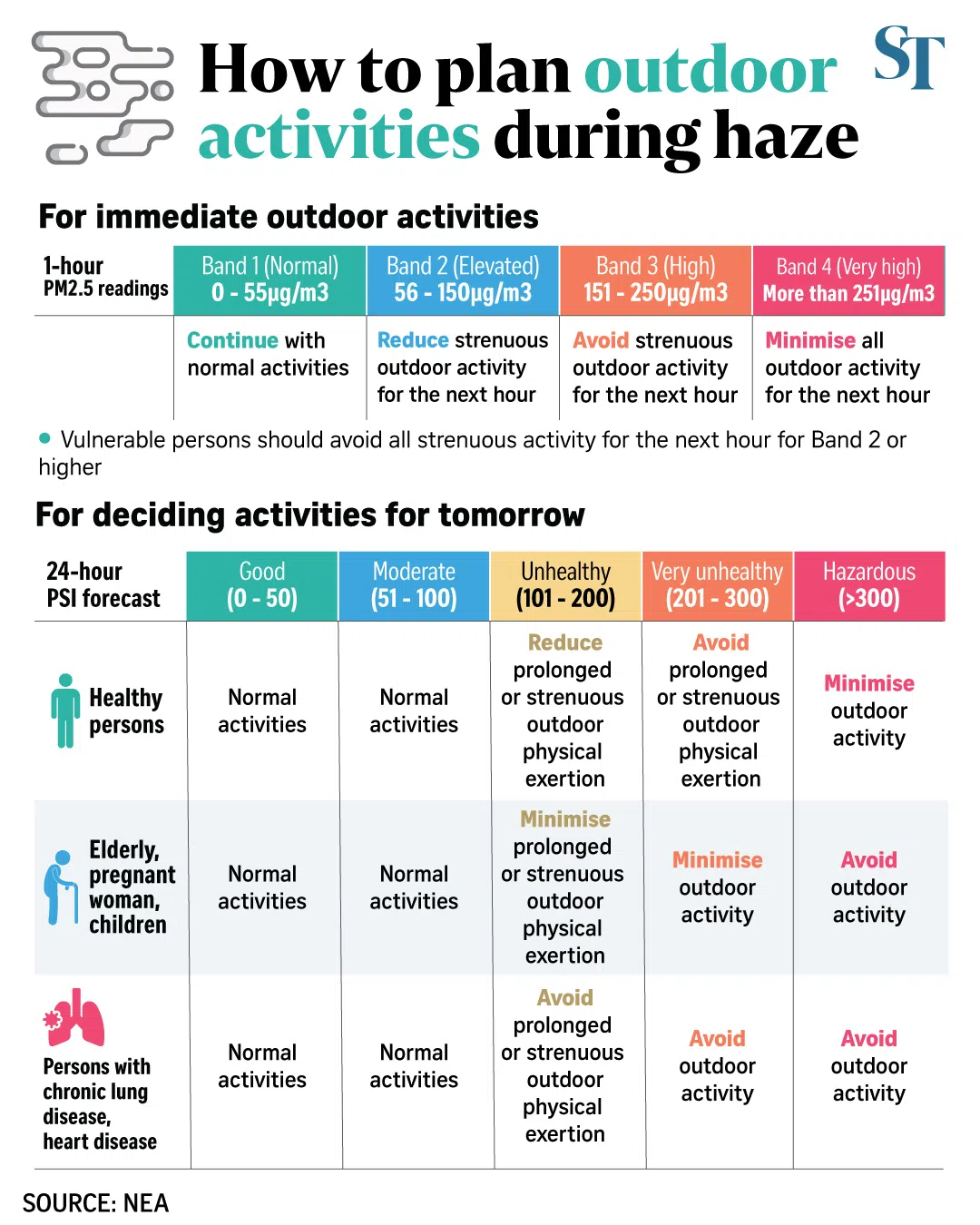
Air quality is considered moderate when PSI levels are between 51 and 100, and unhealthy when PSI readings are above 100.
At that level, healthy people should reduce prolonged or strenuous outdoor activities, while those with chronic heart and lung disease should avoid such activities.
Unhealthy levels of haze were first detected in central Singapore on Sept 4. Since then, hazy conditions have prevailed across Singapore.
The PSI on Sept 16 is expected to be between the high-moderate to mid-unhealthy range, said the National Environment Agency.
Some organisations have implemented measures to protect people against the haze.
ST understands that Outward Bound School, an adventure camp for students, was cancelled for CHIJ St Nicholas Girls’ School students due to the worsening PSI on Sept 14.
The Singapore Hockey Federation (SHF) said it will suspend hockey matches in the men’s leagues if the PSI exceeds 100.
This is according to SHF’s own haze protocol, introduced last week when conditions started worsening. This will be applied to matches in the ongoing Divisions 3 to 5, which started in July at the Sengkang Hockey Stadium. The next round is slated to take place on Sept 19.
The protocol is more stringent than the advisory from national sports agency SportSG, which recommends that programmes and activities in outdoor and non-air-conditioned facilities be suspended when the PSI is above 200.
SHF president Aw Bang Hui said the federation decided on stricter measures as there are players who are in their 50s and 60s.
Aw said: “We are monitoring the situation closely and will actively apply contingency measures, depending on how haze conditions progress over the coming weeks. Players’ health and safety are of utmost importance to us and we do not take things lightly.”
The Football Association of Singapore said two hydration breaks will be introduced in all Singapore Premier League (SPL) and SPL2 matches amid the ongoing haze. Hydration breaks are introduced during football matches as a precautionary measure against conditions such as heat.
The breaks will take place about midway through each half, and last up to three minutes.
The FAS spokesperson added that matches may be delayed, suspended or postponed if the 24-hour PSI reading for the area is above 200. Air quality is considered very unhealthy at this threshold, and healthy individuals should avoid lengthy or strenuous outdoor activities.
Clubs have also been briefed on match-day protocol regarding the thresholds for postponement, delayed kick-off and in-match suspension, said the spokesperson, adding that matches will start no later than 9.30pm, and end by 11.30pm.
The situation will be reassessed as the haze situation
improves
Doctors interviewed by The Straits Times also said they have seen at least a 20 per cent rise in the number of patients with asthma flare-ups, nose allergies, sinus, throat irritation and wheezing. They did not provide actual figures.
Mohamed Baisal, a general practitioner at Shifa Clinic and Surgery, suspects that the number could be higher as some prefer to self-medicate or opt for traditional Chinese medicine.
The Raffles Medical clinics have seen a 20 to 30 per cent rise in haze-related conditions in seniors, children and adults, said its family physician Yak Sin Lin.
Lee Joon Loong, medical director of Paddington Medical Clinic, said: “From our day-to-day experience, the increase has been very noticeable, possibly approaching twice what we would normally see.
“The main things we are seeing are asthma exacerbations, cough and throat irritation, allergic rhinitis and sinus symptoms and eye irritation, as well as eczema and other skin irritation flaring up.” Rhinitis symptoms include a stuffy nose, sneezing and itching in the eyes and throat.
He has also seen asthmatic patients return to his clinic years after being stable.
“Some have not needed their reliever inhalers for months or even years. When the haze triggers their asthma again, they can be caught unprepared,” he said.
At the Thomson Paediatric Centre’s JEM outlet, paediatrician Lim Yang Chern has noticed an increase in children coming in with runny nose, cough, asthma flare-ups and rhinitis.
Telemedicine platform Rexmed.io has also seen a 20 per cent increase in such cases in adults.
Dana Elliott, medical director of Rexmed.io, said: “Everyone including the healthy, should minimise outdoor exposure because PM2.5 (pollutants) can travel deep into the lungs. Prolonged exposure can cause long-term effects such as heart attacks, reduced lung development and asthma.”
PM2.5 refers to micro-pollutants found in smoke haze.
Lim from the Thomson Paediatric Centre urged schools and parents to take preventive steps to minimise haze-related symptoms in children.
These include monitoring students who are more vulnerable to respiratory illness and remind them to carry their inhalers and medication.
He also added that the air quality in school buses must not be overlooked.
“In school buses, keep windows closed but with good ventilation. (Switch the) air-conditioning to recirculate mode rather than allow outside air entry.”
The doctors also urged the public to refer to the one-hour PM2.5 levels to decide whether to do outdoor activities in the next hour.
As at 8pm on Sept 15, only the central region’s PM2.5 levels were elevated at 69 micrograms per cubic m, above the threshold of 56mcg per cubic m.
Lee said: “When you’re exercising hard, your ventilation increases substantially, so you’re potentially inhaling a much greater amount of PM2.5 deep into the respiratory tract.”
During the haze crisis of 2015, when air quality reached hazardous levels, the Ministry of Health activated the Haze Subsidy Scheme.
Under it, the Pioneer and Merdeka generations paid only $5 and other eligible Singaporeans – such as those with blue and orange Community Health Assist Scheme cards – paid $10 at clinics and polyclinics for haze-related conditions.
That was the last time that the subsidy kicked in, and about 50,000 benefited from the scheme.
Ong Guan Hong, chief executive of PanCare Medical Clinic, and Healthway Medical Group’s chief medical officer John Cheng said MOH has not alerted clinics about the scheme in 2026.
KioskNews shows a cleaned-up reading view extracted from the publisher’s page — the original always lives on their site, not ours.