[Column] Korea-Japan cooperation still has a long way to go
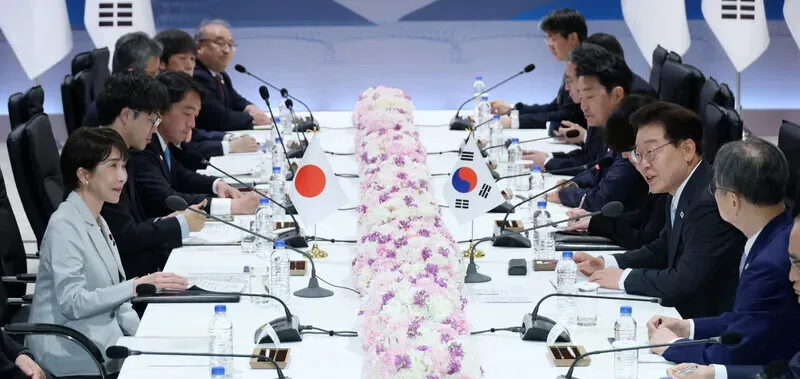
Prime Minister Sanae Takaichi of Japan (left) speaks with President Lee Jae Myung of South Korea (right) during an expanded summit held at a hotel in Andong, South Korea, on May 19, 2026. (Yonhap)
By Chung-in Moon, James Laney Distinguished Professor at Yonsei University
Last week, I attended a high-level strategic forum between Korea and Japan organized by the East Asia Foundation at Keio University in Tokyo. The meeting brought together politicians from both sides of the aisle, former bureaucrats, academics and experts for a vigorous debate about “the Northeast Asian order in a time of transition and new challenges for Korea-Japan cooperation.”
Everyone in attendance was very hopeful about the recent state of Seoul-Tokyo relations, not least because of encouraging poll results. A survey of the two countries jointly organized by the East Asia Institute and the International House of Japan on Aug. 4 found that 53% of Korean respondents have a positive impression of Japan — the highest level since the survey was first held in 2013.
In a poll published in June by Korean newspaper the Hankook Ilbo and Japanese newspaper the Yomiuri Shimbun, 66.7% of Korean respondents and 59% of Japanese respondents described relations between the two countries as positive.
Japanese attitudes appear to be boosted by a favorable view of Korean President Lee Jae Myung. Despite his reputation for taking a hard line on Japan, Lee has restored “shuttle diplomacy” with Tokyo and maintained cordial relations with Japanese Prime Minister Sanae Takaichi.
That has led many Japanese to regard Lee’s pragmatic foreign policy as having a positive effect on bilateral cooperation. Under the theory that Korea and Japan have banded together in the past whenever the US grows distant, some are making cautious but optimistic predictions about the two countries’ relationship.
But on a more granular level, bilateral cooperation faces considerable challenges. There are serious discrepancies between the two countries’ perceived geopolitical threats. For the Japanese, the main threats are China’s growing power, Russia’s military adventurism and North Korea’s advancing nuclear capabilities.
To counter the threat of this “autocratic axis,” the Japanese believe in the necessity of the Free and Open Indo-Pacific (FOIP) strategy grounded in Japan’s alliance with the US. They hold that Korea and Japan, as countries sharing liberal democratic values, need to go beyond the FOIP strategy and consider actively participating in the “Asian NATO” proposed by former prime minister Shigeru Ishiba.
But when it comes to this vision, Japan is unlikely to find common ground with the Lee administration’s pragmatic diplomacy. The Korean government also values its alliance with the US, as well as trilateral cooperation with the US and Japan, but doesn’t want hostile relations with China, Russia or North Korea.
The Lee administration is actively seeking peaceful coexistence with North Korea, a strategic cooperative partnership with China, and a close cooperative relationship with Russia. Seoul also wants to avoid the return of a Cold War-era antagonistic relationship between Seoul, Washington and Tokyo to the south and Pyongyang, Beijing and Moscow to the north. After all, South Korea would be on the front lines of a putative conflict.
So rather than confrontation with those three countries, the Lee administration prefers to ease tensions, build confidence, engage in preventive diplomacy and arrange multilateral security cooperation. As a result, there are limitations on the extent of South Korean participation in Japan’s values-oriented geopolitical strategy.
Differences are also evident on economic issues.
One of the main topics of the debate was SK Group Chairman Chey Tae-won’s proposal for a Korea-Japan economic community. Chey raised the idea in an interview with the Asahi Shimbun newspaper published on the day of the forum.
Together, Korea and Japan would make the world’s fourth-largest economic bloc, with a combined GDP of US$6 trillion. Such a move, Chey argued, would radically increase their bargaining position and influence on the world stage. He also said in the interview that sharing key infrastructure and services could reduce their underlying costs.
The Japanese response to this proposal was circumspect. They noted that the current state of bilateral cooperation is abysmal, especially compared to the steps that would be needed for an economic community, which would require a free trade zone, a customs union, a common market, an economic union and a currency union. The two countries’ negotiations toward a free trade zone, which began shortly after the Asian financial crisis in 1997, have been completely stalled since November 2004.
If Korea and Japan cannot even reach an agreement on a free trade zone, skeptics ask, how could they possibly pull off the much bigger task of creating an economic community? They instead call for focusing on economic security cooperation in such areas as supply chains and energy and starting with more manageable tasks such as Korea joining the Comprehensive and Progressive Agreement for Trans-Pacific Partnership (CPTPP).
Even that task sounds daunting, however. Japan is unlikely to support Korean membership in the CPTPP unless Seoul lifts restrictions on imports of seafood from Fukushima or agrees to an Acquisition and Cross-Servicing Agreement (ACSA).
Another idea raised in the forum was that, to strengthen bilateral relations, Korea and Japan should separate lingering historical disputes from matters of foreign policy, security and economics and adopt a two-track approach grounded in a future-oriented relationship. But practically speaking, could bilateral cooperation materialize without progress on territorial and historical issues such as Dokdo, the comfort women, forced labor, and the Sado mine?
In addition to those areas, there’s considerable disagreement on how to handle North Korea’s nuclear program. While Seoul prefers a gradual approach (freeze, reduction and denuclearization), Tokyo wants denuclearization first, along with a resolution of the Japanese abductee issue.
It sure sounds like Seoul-Tokyo cooperation has a long way to go.
KioskNews shows a cleaned-up reading view extracted from the publisher’s page — the original always lives on their site, not ours.