7 Near-Perfect 'Far Side' Halloween Comics Everyone Forgot About

Shawn Van Horn is a Senior Author for Collider. He's watched way too many slasher movies over the decades, which makes him an aficionado on all things Halloween and Friday the 13th. Don't ask him to choose between Michael Myers and Jason Voorhees because he can't do it. He grew up in the 90s, when Seinfeld, Everybody Loves Raymond, and TGIF were his life, and still watches them religiously to this day. Larry David is his spirit animal. His love for entertainment spreads to the written word as well. He has written two novels and is neck deep in the querying trenches. He is also a short story maker upper and poet with a dozen publishing credits to his name. He lives in small town Ohio, where he likes to watch professional wrestling and movies.
Sign in to your Collider account
There has never been another comic strip like The Far Side. From 1980-1995, Gary Larson used just one panel to say so much. With often dark humor, the cartoonist took twisted satirical jabs at modern society. He was well known for doing this by taking something well known and turning it on its head.
See his many comics, which take a look at the life and impending doom of dinosaurs, or how he mocked the stupidity of supposedly smart scientists. In The Far Side, nothing was off limits. That was especially true during Halloween season or in strips parodying horror. Here, the darkness, and even terrifying imagery, were not only expected, but they were welcome.
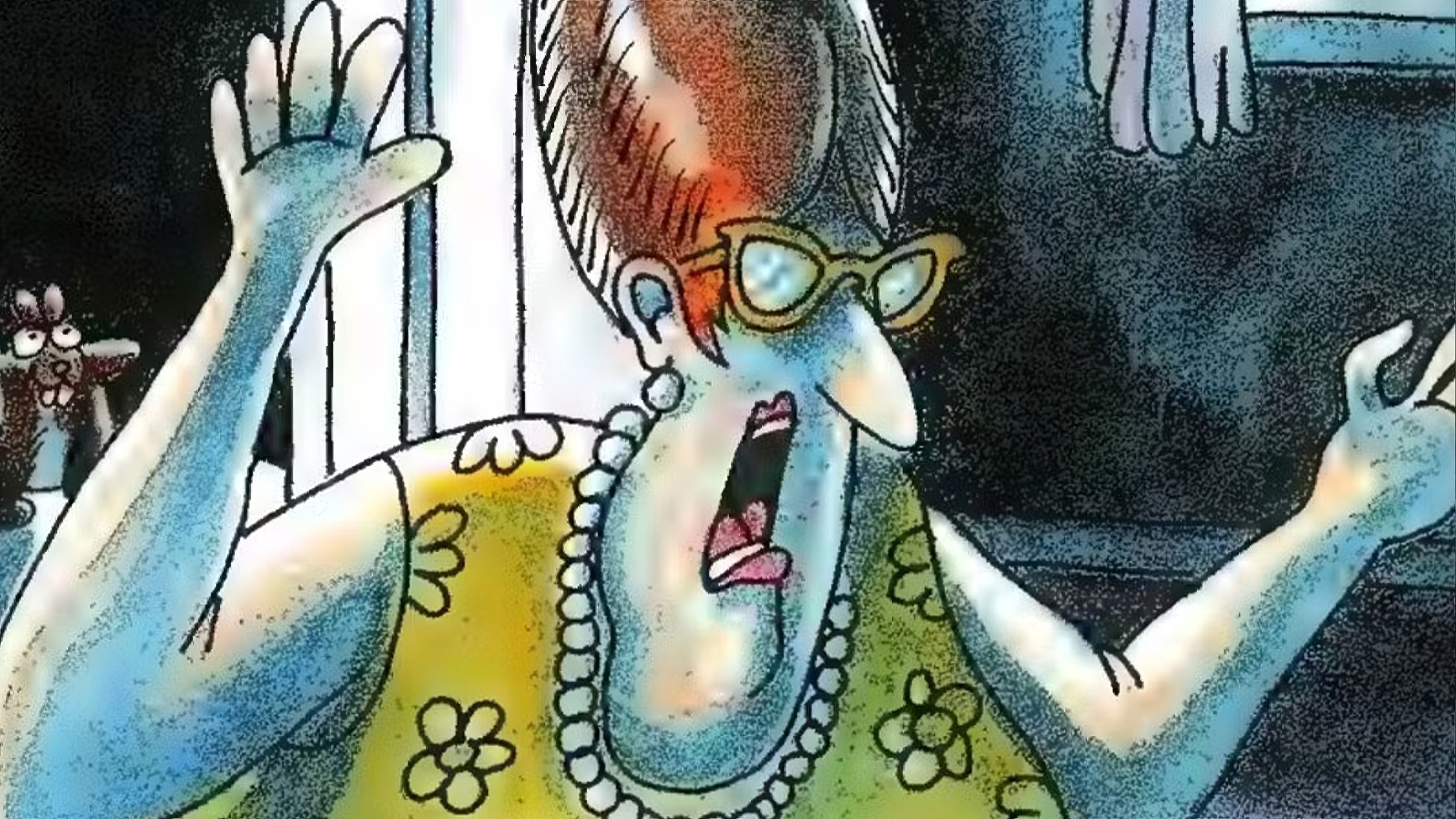
7 There Goes That Eerie Music Again

Steven Spielberg's Jaws was the first summer blockbuster, a film so pervasive in pop culture that it not only launched a franchise, but it had everyone afraid to go into the water. Much of the fear created by the movie doesn't come from the shark itself, which often broke down during filming, but from John Williams' haunting score. The iconic tune that precedes the arrival of the great white is one of arriving death.
In this Far Side comic, two fishermen sit on the water when they hear that eerie music. Larson doesn't have to say what that music is. Just the shot of the shark shooting upward, as it does on the famous Jaws poster, says it all. These guys are goners.
6 Bait Motel

Gary Larson takes on another well-known horror movie in this hilarious strip. If Jaws was the first summer blockbuster, Alfred Hitchcock's Psycho is regarded as the first slasher. This film took the horror genre out of the gothic and terrified audiences with something that felt like it could really happen to us if we took a wrong turn. In Psycho, Marion Crane (Janet Leigh) arrives at the Bates Motel, where the strange owner, Norman (Anthony Perkins), lives with his unseen mother, who sits alone on the home's top floor.
In The Far Side, a simple play on words changes everything. Instead of the Bates Motel, we have the Bait Motel. Who would arrive at such a secluded place in the middle of the night? Why, a car full of worms, of course. As they pull up the drive, the shadow of a woman with a fishing pole sits upstairs. Bonus points for Larson naming one of the worms Anthony as a wink to Psycho's star actor.
5 Sylvia's Spirit of Adventure

Most kids grew up with their first horror stories being passed down urban legends. There's the man in the backseat, the caller inside the house, and the killer with a hook for a hand standing outside your car. These stories not only serve to scare us, shaking our imagination to the core, but they teach us to be safe. How many of us check the backseat before we get in the car now?
It's a lesson these two old women should remember in The Far Side. Here, Sylvia is driving down the street when she spots a scary-looking hitchhiker with a peg leg and a hook for a hand. Just as concerning is that this guy is holding a sign which reads "Anywhere". For him, the journey is not about where he's going but what he's going to do. Sylvia might be suspicious, but her friend isn't. A hitchhiker, no matter how creepy they appear, is a chance to live an adventure. If they pull over, that's what they're sure to get.
4 Frankenstein's Monster and Bride Are Made for Each Other

1931's Frankenstein, based on Mary Shelley's novel, was one of the first game-changing monster movies. Although there have been several iterations of the story over the last century, Boris Karloff's look, with green skin, a flat head, and bolts sticking out of his neck, is how the character is best remembered. As good as that first movie was, the sequel, 1935's Bride of Frankenstein, is regarded as being even better.
Bride of Frankenstein is no sweet romance. The bride, instead of loving Frankstein's monster, is scared of him. In The Far Side, the situation is much worse. The bride and the monster are shown to have nothing in common. Dr. Frankenstein's dream of creating some great couple is falling apart, so there he is to remind them, as they sit far apart on a couch, that they were made for each other. Literally. There's a stack of corpses somewhere as proof.
Collider Exclusive · Horror Survival Quiz Which Horror Villain Do You Have the Best Chance of Surviving? Jason Voorhees · Michael Myers · Freddy Krueger · Pennywise · Chucky
Five killers. Five completely different ways to die — if you're not smart enough, fast enough, or self-aware enough to avoid it. Only one of them is the villain your particular set of instincts gives you a fighting chance against. Eight questions will figure out which one.
🏕️Jason
🔪Michael
💤Freddy
🎈Pennywise
🪆Chucky
01
Something feels wrong. You can't explain it — you just know. What do you do? First instincts are the difference between the survivor and the first act casualty.
02
Where are you most likely to find yourself when things go wrong? Setting is everything in horror. Where you are determines which rules apply.
03
What is your most reliable survival asset? Every survivor has a quality the villain didn't account for. What's yours?
04
What kind of fear is hardest for you to fight through? Knowing your weakness is the first step to not dying because of it.
05
You're with a group when things start going wrong. What's your role? Horror movies are brutally clear about who survives group situations and who doesn't.
06
What's the horror movie mistake you're most likely to make? Honest self-assessment is a survival skill. Denial is not.
07
What's your best weapon against something that can't be stopped by conventional means? Every horror villain has a weakness. The survivors are always the ones who find it.
08
It's the final scene. You're the last one standing. How did you make it? The final survivor always has a reason. What's yours?
Your Survival Odds Have Been Calculated Your Best Chance Is Against…
Your instincts, your strengths, and your particular way of thinking under pressure point to one villain you actually have a fighting chance against. Everyone else — good luck.
Jason Voorhees
Jason is relentless, but he is also predictable — and that is the gap you would exploit.
- He moves in straight lines toward his target. He doesn't strategise, doesn't adapt, doesn't outsmart. He simply pursues.
- Your ability to keep moving, use the environment, and resist the panic that freezes most victims gives you a genuine edge.
- The Crystal Lake survivors were always the ones who stopped running in circles and started thinking about terrain, water, and distance.
- You think like that. Which means Jason, for all his indestructibility, would face someone who simply refused to be where he expected.
Michael Myers
Michael watches before he moves. He is patient, methodical, and almost impossible to detect — until it's too late for anyone who isn't paying close enough attention.
- But you are paying attention. You notice the shape in the window, the car parked slightly wrong, the silence where there should be sound.
- Michael's power lies in the invisibility of ordinary suburbia — the fact that nothing ever looks wrong until it already is.
- Your spatial awareness and instinct to map every room, every exit, and every shadow before you need them is precisely the quality Laurie Strode had.
- You are not a victim waiting to happen. You are someone who already suspects something is wrong — and acts on it.
Freddy Krueger
Freddy wins by getting inside your head — using your own fears, your own memories, your own subconscious as weapons against you. That strategy requires a target who can be destabilised.
- You are harder to destabilise than most. You've faced uncomfortable truths about yourself and you haven't looked away.
- The survivors on Elm Street were always the ones who understood what was happening and chose to face it rather than flee from it.
- Freddy's greatest weakness is that his power evaporates in the presence of someone who refuses to give him the fear he feeds on.
- Your psychological resilience — the ability to stay grounded when reality itself becomes unreliable — is exactly the quality that keeps you alive here.
Pennywise
Pennywise is ancient, shapeshifting, and feeds on terror — but it has one critical vulnerability: it cannot function against someone who genuinely stops being afraid of it.
- The Losers Club didn't survive because they were braver than everyone else. They survived because they faced their fears together, and faced them honestly.
- You ask the questions others avoid. You look directly at what frightens you rather than turning away.
- That directness — the refusal to let fear fester in the dark — is Pennywise's worst nightmare.
- It chose the wrong target when it chose you. You are exactly the kind of person whose fear tastes like nothing at all.
Chucky
Chucky's greatest advantage is that nobody takes him seriously until it's already too late. He exploits the gap between how something looks and what it actually is.
- You don't have that gap. You take threats seriously regardless of how they present — and you never make the mistake of underestimating something because of its size or appearance.
- Chucky relies on surprise, on the delay between recognition and response. You close that delay faster than almost anyone.
- Your instinct to treat every unfamiliar thing with appropriate scepticism — rather than dismissing it because it seems absurd — is the exact quality that keeps you breathing.
- Against Chucky, not laughing is already winning. You are very good at not laughing.
3 Deer Halloweens

Larson often used opposing characters to tell his stories in The Far Side. Dinosaurs meeting cavemen and aliens with their human victims are among them. The cartoonist also loved to humanize animals, which he did regularly with tales of deer and their encounters with the hunters who want to kill and eat them.
Rather than going for cute irony, Larson goes dark for Halloween. In our human world, little kids dress up as scary monsters when they go trick-or-treating. So what would little deer dress up as in their humanized world? In this strip, they knock on a door dressed up as hunters, complete with flannel and those goofy hats. Boo!
2 Scene from Dinner on Elm Street

We return again to another horror movie parody as Larson winks at 1984's A Nightmare on Elm Street. Wes Craven's fright fest, with the knife-fingered, dream-haunting serial killer Freddy Krueger (Robert Englund), was a refreshing spin on the predictable slasher craze of masked, silent hulks. Just as Jaws had viewers afraid to go in the water, a whole generation of teens were now anxious about going to bed.
This might be Larson's darkest strip of them all. Here, the joke is not an exact parody of Freddy. It's the Elm Street name everyone is familiar with. As a family sits down to eat dinner in the dark, the chicken they think they're chewing on walks into the room dressed as their dog. If that's not the chicken they're stuffing in their mouth, what could it be? Their intended dinner hints that they're consuming the family pet. Poor Fifi.
1 Edgar Meets a Familiar-Looking Werewolf

As a kid going through the Far Side collection books, this is the strip I turned to over and over as the one that most got into my imagination and scared me. Larson's strange animation can be highly effective. He has a way of drawing monsters to make them look both creepy and silly at the same time. Put them in the dark in a murderous scenario, and the effect is complete.
Larson cheats and uses two panels of sorts to tell this story. In it, poor Edgar is shooting bullets into the chest of the werewolf who has just burst through his door. As he does, Edgar remembers seeing this same tie earlier when he bought what he thought were real silver bullets from the owner of a gun store. That owner just so happens to be the werewolf. Edgar's attempt to save his life and kill the beast will be for naught. If there were one more panel, we'd see him ripped apart and killed. Hilarious!
KioskNews shows a cleaned-up reading view extracted from the publisher’s page — the original always lives on their site, not ours.