About 60,000 more households to qualify for public transport vouchers after income limits eased
SINGAPORE – About four in 10 households – an increase of about 60,000 households from the previous year – will qualify for public transport vouchers aimed at cushioning the impact of fare hikes.
Lower-income homes with a $2,100 per capita income will be eligible for the vouchers this year, compared with $1,800 previously, said the Ministry of Transport (MOT).
The value of these vouchers will also increase to $80 per household, up from $60 last year.
Households can use the vouchers to top up fare cards or buy monthly passes, after the fare hike kicks in from Dec 26.
From end-December, those who received a voucher during the public transport vouchers exercise in 2025 and continue to meet the income eligibility criterion will automatically receive their vouchers, MOT said.
They will receive their notification letters via post or SMS.
In the second stage starting from early 2027, households that meet the income eligibility criterion but did not receive a voucher earlier can apply for the vouchers online or in person at community centres or clubs.
More details will be announced later, MOT added.
The changes come amid a 7% fare hike of up to 12 to 13 cents more for bus and train fares for adult commuters from Dec 26, due to an increase in energy costs driven by the Middle East crisis.
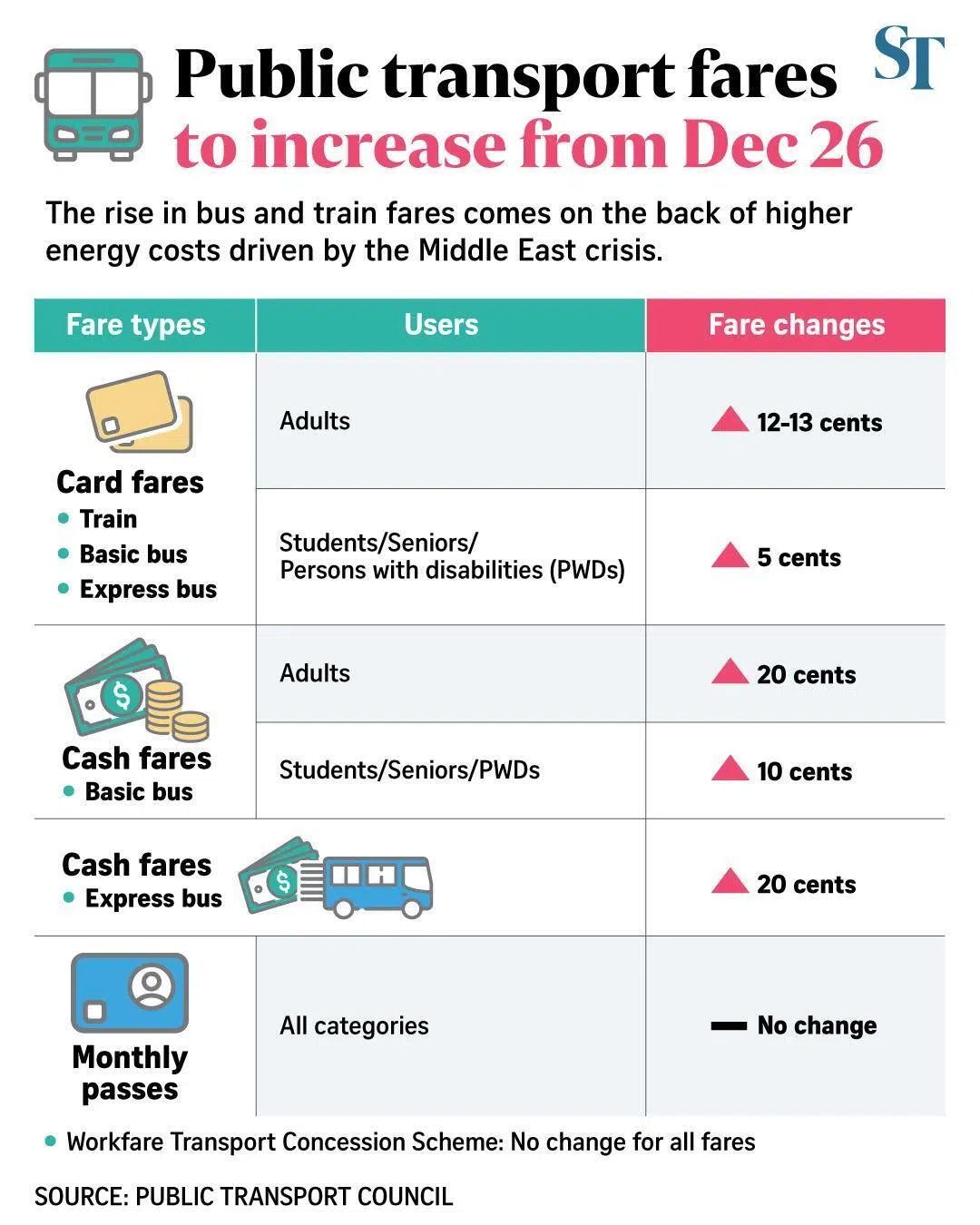
Speaking to reporters at the annual fare review on Sept 29, the Public Transport Council (PTC) said it encourages heavy public transport users to use monthly passes to manage their transport expenses.
Monthly travel passes for adults will cost the same at $122, while senior citizens or people with disabilities will fork out the same price of $55 for a hybrid monthly concession pass that can be used for bus and train rides.
Prices of all monthly passes will stay the same as the previous year, so about 110,000 more commuters – or 4% of all commuters – can benefit from switching to a monthly hybrid pass after the fare hike, PTC said.
The switch can add up to an average of about $26 in savings each month, it added.
There are now 126,000 monthly pass users, which account for 5% of all public transport users.
The cost of travel for Workfare Transport Concession Scheme cardholders will remain unchanged at $92 per month, benefitting about 190,000 such cardholders or 7% of all commuters, said PTC.
PTC reduced the prices of monthly hybrid passes in the public transport fare review in 2025.
For instance, adult commuters now pay $122 for a monthly pass, down from $128 before the fare review in 2025. Seniors and people with disabilities pay $55, instead of $58.
PTC said monthly passes will provide commuters who travel frequently and consistently throughout the month with the option to limit their monthly public transport expenditure.
It added that it is exploring a new function to alert commuters on the SimplyGo app when their monthly expenditure on public transport exceeds the cost of a monthly pass – be it whether they are students, national servicemen, adults, senior citizens or people with disabilities.
When asked about the possibility of rolling out an automatic fare cap, PTC chair Janet Ang said there are difficulties in ensuring the efficiency of a price cap.
For example, if the cap is priced too high, it may not be fair to the different passenger groups.
As for whether monthly passes can be used to cover express bus fares, Ang said PTC is studying it.
PTC chief executive Leow Yew Chin said the inclusion of express bus fares in monthly passes will involve costs that have to be cross-subsidised by other users, including those who do not take express buses.
In line with any fare increase, public transport operators (PTOs) are required to contribute part of their increased fare revenue to the Public Transport Fund.
The Government draws from the fund to disburse public transport vouchers to help lower-income households cope with fare increases.
For the latest fare review exercise, PTC will require SBS Transit Rail and SMRT Trains to contribute 30% of their expected increase in revenue – a total of $23.94 million – to the Public Transport Fund.
That works out to $8.07 million from SBS Transit Rail, and $15.87 million from SMRT Trains.
KioskNews shows a cleaned-up reading view extracted from the publisher’s page — the original always lives on their site, not ours.