Fund Indonesian Films as Portfolios, Not One by One, Former Trade Minister Tom Lembong Tells JAFF Market
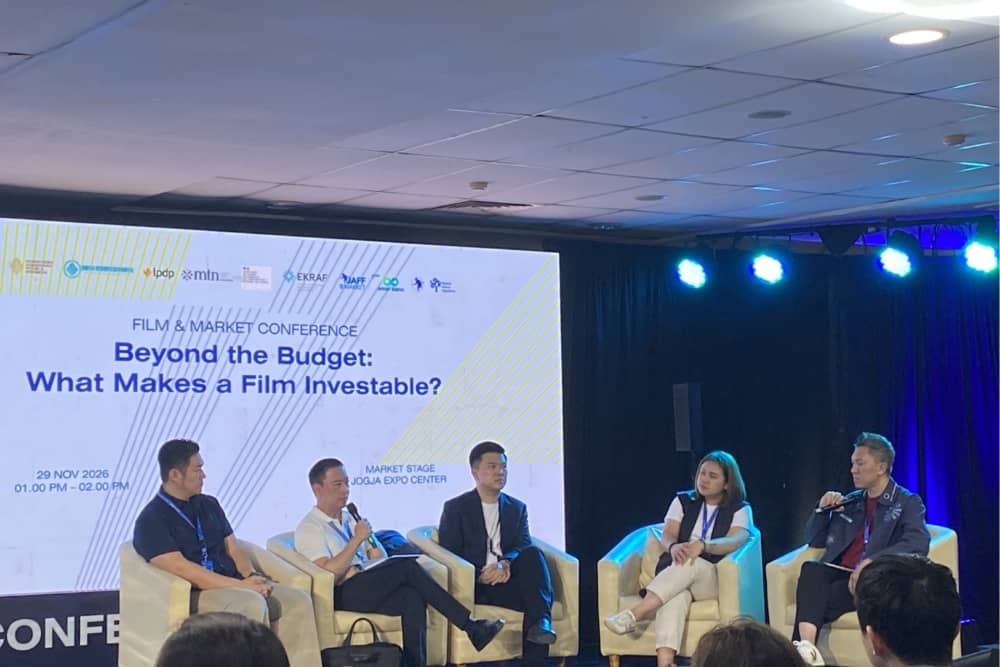
Indonesian films should be financed as portfolios rather than one project at a time, former trade minister Tom Lembong told a JAFF Market panel on what it takes to draw investment into the country’s film industry.
The session, titled “Beyond the Budget: What Makes a Film Investable,” was moderated by Dipa Andika, chief commercial officer and producer at Imajinari. Panelists from Jagartha Group, Ideosource Entertainment and Base Entertainment joined Lembong, who also headed Indonesia’s Investment Coordinating Board.
Lembong said the country’s top 10 production houses have yet to reach a certain economic scale. He put that down to two factors: a lack of access to capital, and the fact that films are still financed one by one.
“In developed countries, films are sponsored in a portfolio. They don’t need to do fundraising in the future 3–4 years, but Indonesian filmmakers are busy spending time fundraising so they cannot fully focus on filmmaking,” Lembong said. “If we bring in investors, we fund a portfolio, not one by one.”
On capital, Lembong noted that film contributes just 0.3% of Indonesia’s GDP. An industry that small, he said, could easily be absorbed by bigger ones, which makes access to capital crucial.
Speaking about Indonesia’s economy more broadly, Lembong said the country is not widely seen as a key player in the booming global AI market, which puts it at a disadvantage in attracting overseas investment.
“The film industry must be ready for a more challenging next year,” Lembong said. The answer, he added, is for Indonesian film to level up and align itself with the international market.
FX Iwan, founder and CEO of Jagartha Group, said the number of screens across different areas of Indonesia could help steer funding, since screen distribution shows how far a film can reach the market.
Linasari Santioso, head of investment at Ideosource Entertainment, pointed to each project’s creative package and the quality of its storytelling. She singled out Gen Z tastes as a trend barometer that should carry real weight.
Santioso said her own approach is to spread a limited fund across as many low-budget projects as possible, since “the success of one film can cover the failure in the others.”
Aoura Lovenson Chandra, producer and co-founder of Base Entertainment, said every story and project has its own match in the market. The Indonesian market does not really have a key popular genre or category, he said, so what matters most is the quality of the storytelling.
“All films we produced, we love them, no matter if they are hits,” Chandra said.
JAFF Market runs Nov. 28–30 at the Jogja Expo Center in Yogyakarta, alongside the 21st Jogja-Netpac Asian Film Festival, which continues through Dec. 5.
KioskNews shows a cleaned-up reading view extracted from the publisher’s page — the original always lives on their site, not ours.