What S’pore’s proposed social media rules mean for young people
In the month before her Primary School Leaving Examination (PSLE), Claudia Teo spent up to six hours a day watching short-form videos of TV shows on YouTube.
Her parents had set a two-hour daily screen-time limit for her phone, a hand-me-down from her older sister when she was 11. Claudia, now 14, has five siblings, aged nine to 22.
Her mother, Lauren Tan, 50, had not realised how much time Claudia was spending online.
But the homemaker noticed changes: the teen was quick to anger when asked to do chores, and refused to join family outings.
Lauren Tan checked her daughter’s phone, which showed just two hours a day on YouTube.
It was only when Claudia’s older sister said she seemed to be on it far more that Lauren Tan dug deeper and found the workaround. Claudia had been switching between devices and browsers to get past the limit.
When the PSLE results came out a few weeks later, they were not what Claudia had hoped for. “She was shocked,” recalls her mother.
They are not alone in their struggles with social media.
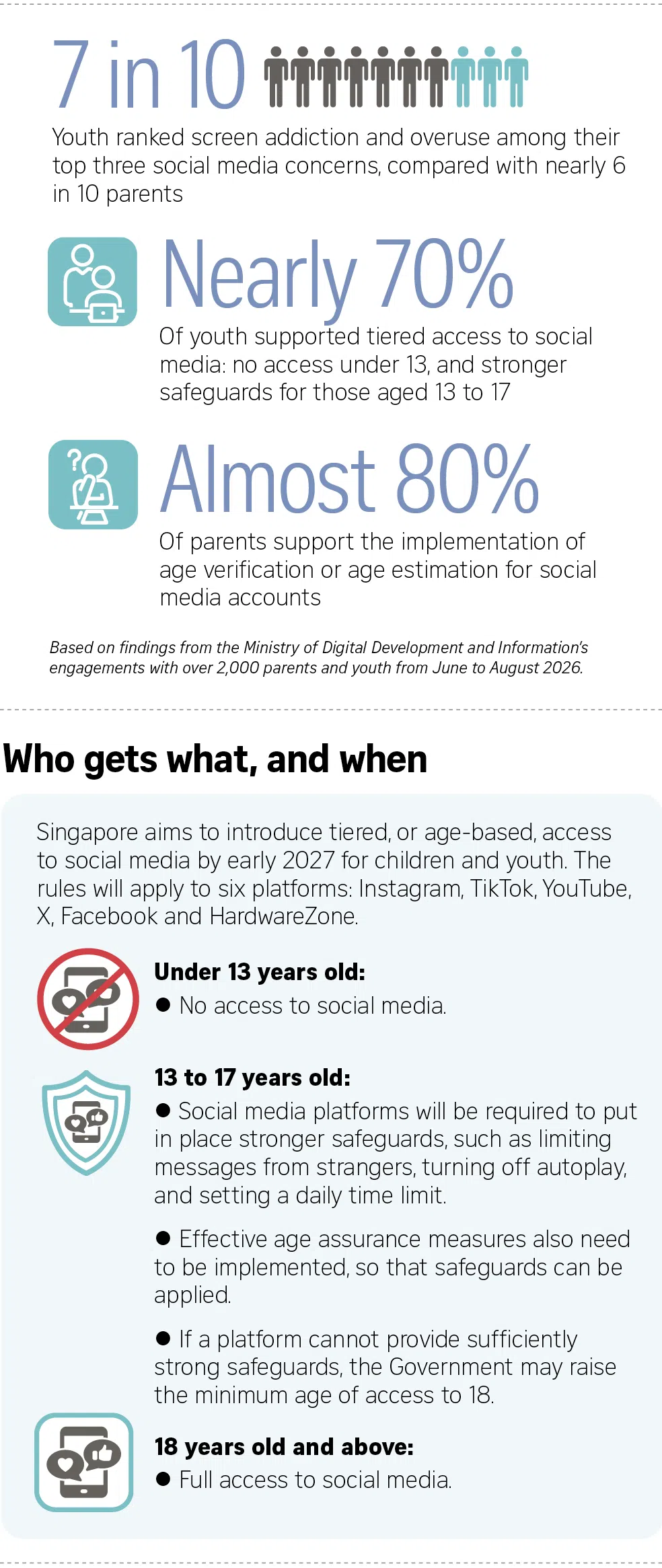
In engagements by the Ministry of Digital Development and Information (MDDI), screen addiction and overuse emerged as the top social media concern among youth in Singapore – ahead of misinformation, fake news and scams, and privacy issues.
It was also parents’ second-biggest concern, after exposure to inappropriate content.
The findings come from MDDI’s engagements with more than 2,000 parents and youth between June and August 2026 on the Government’s proposed tiered approach to social media for young people.
Age-based access and mandatory safeguards for social media platforms were announced at the National Day Rally 2026, with legislative changes to be tabled in early 2027.
Community partners, including social service agency Touch Community Services and youth-led technology charity YouthTechSG, ran additional sessions with the general public.
Steps towards safer social media
But is a ban the answer? No, say most parents and youth who took part in MDDI’s engagements.
Instead, they back an age-based approach.
Parents also showed strong support for safeguards that reduce the risks of addictive use and unwanted contact – like turning off autoplay and direct messaging, and setting daily screen-time limits.
Touch Community Services ran four focus group discussions with 31 parents between July 24 and Aug 5.
Most parents agreed that a ban “may not be practical”, says Wendy Tan, deputy director of Touch Cyber Wellness, a service of Touch Community Services.
“It could backfire and push (older, more resourceful) youth to find ways around the restrictions,” she adds.
Young people say the same. In YouthTechSG’s engagement with 227 youth, 72 per cent said they would get around a ban if they felt it was not proportionate, and 79 per cent did not support one.
The engagement, conducted through street interviews, focus groups and a survey, was co-led by Bryan Ong, 21, deputy head of advocacy at YouthTech Institute, the advocacy and research arm of YouthTechSG.
But that does not mean young people reject safeguards. Many were aware of how much time they spent scrolling, and were “very willing to accept interventions” to help them manage it, Ong adds.
Another concern parents raised, Wendy Tan says, is that restricting social media could leave their children out of conversations and activities with friends.
Lauren Tan agrees. She did not ban Claudia from YouTube immediately when she discovered her daughter’s overuse.
Instead, Lauren Tan worked with Claudia to gradually cut back the hours spent watching short-form videos on YouTube, starting with a limit of two hours a day. These days, the teen is allowed 30 minutes of YouTube a day.
“If you set hard limits, the child will rebel even harder,” Lauren Tan says. “It’s important to get their buy-in.”
Under 13? Off the screen
Under the proposed tiered approach by MDDI, children under 13 will not be allowed on social media.
Platforms would also have to check users’ ages, rather than rely on them to declare their own. Possible methods include verifying age against official records, estimating it through facial analysis, or inferring it from usage patterns.
Parents in Touch’s focus groups felt younger children may not be “developmentally ready” for social media, but recognised its educational value, says Wendy Tan.
“Many preferred to curate what their children are exposed to, so that the content stays age-appropriate.”
MDDI also noted in its findings that parents want to retain flexibility over how safeguards were implemented, tailoring them to their kids’ needs, maturity and family circumstances.
Lauren Tan and her husband, 52, agree. For each of their six children, the couple would individually decide which apps they can use, and for how long.
Claudia’s youngest siblings, Esther, 12, and Matthias, nine, are not allowed to have social media apps on their phones. But they can watch educational videos on their parents’ accounts, under supervision.
Seeing their friends and older sisters online, the two kids often ask when it will be their turn, Lauren Tan shares.
Rather than simply say no, she explains how much inappropriate content is out there, and tells them they will get access when she and her husband feel they are “ready”.
Explaining the reasons behind the rules has made all the difference, Lauren Tan says. “Kids are actually very reasonable if you talk to them,” she adds.
Connecting before correcting
So how can young people navigate social media safely?
It starts at home, says Touch’s Wendy Tan. She suggests parents break the ice by sharing something they enjoyed online, such as a funny video or an interesting post.
“These everyday exchanges help parents understand their children’s online world,” Wendy Tan says, and help youth be more comfortable sharing what worries or upsets them.
To support families in fostering healthy digital habits from young, MDDI launched the nationwide Screen Smart from the Start movement in May 2026.
Families can visit bescreensmart.gov.sg for practical tips on how to manage screen use and have open conversations about online experiences.
These days, Claudia is more careful about how she spends her time online, she says.
In September, her father gave her his old phone, an upgrade from her previous one. They took the chance to talk about screen-time limits.
Claudia asked him to halve her daily allowance on Instagram and TikTok to 30 minutes each.
“I only use social media to text my friends (now)”, says Claudia. She no longer watches short-form videos on YouTube.
With less time on social media, Claudia is much calmer and pitches in at home willingly, Lauren Tan says.
The teen is often busy with crochet and baking. She is also more aware of the harmful effects of short-form videos, such as a shorter attention span.
Rather than waiting for her parents to step in, Claudia decided to set her own limits. “So I asked for less time (allowance for social media),” she says.
In partnership with the Ministry of Digital Development and Information
KioskNews shows a cleaned-up reading view extracted from the publisher’s page — the original always lives on their site, not ours.