Nobel in chemistry awarded for mirror image mystery
Scientists Henri B. Kagan and Kenso Soai yesterday won the Nobel Prize in Chemistry for untangling mysterious mirror images in molecules, a discovery that has been used to develop countless drugs and transformed modern medicine.
Many molecules come in versions that look alike but are not exactly identical, like right and left hands. For example, one mirror image of the chemical carvone smells like mint, while the other has a whiff of caraway, a spice often used in rye bread.
Even life itself prefers one mirror image over the other. DNA twists to the right, and the proteins in human bodies are made of mostly left-handed building blocks.
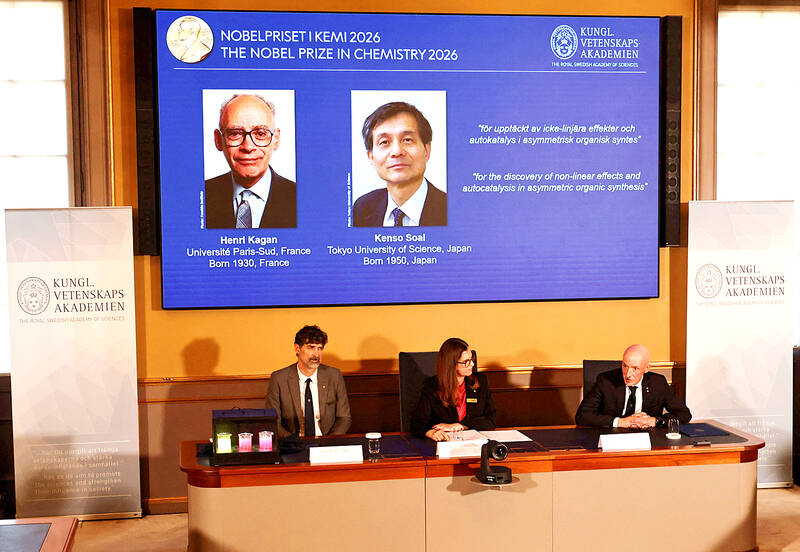
Henri Kagan, left on screen, and Kenso Soai, right on screen, are awarded the Nobel Prize in Chemistry during a news conference at the Royal Swedish Academy of Sciences in Stockholm yesterday.
Photo: Reuters
Versions of the same molecule can behave differently when interacting with other chemicals. When designing drugs to treat diseases, scientists want to be choosy about which mirror image they get.
They want the version of a molecule to treat a cold, not one that will make the sniffles worse.
Kagan, who is from France, and Soai, from Japan, found ways to make chemistry pick a side, designing and manipulating reactions to produce the desired mirror image.
“This is probably the coolest experiment in organic chemistry,” Nobel Committee for Chemistry member Peter Somfai said. “Taken together, the groundbreaking discoveries by Henri Kagan and Kenso Soai have reshaped our understanding of molecular chirality,” a term that comes from the Greek word for “hand.”
Scientists paid tribute to Kagan and Soai’s work, which the Nobel committee described as a feat never previously achieved by anyone “other than life itself.”
“It might be difficult to say that this drug, or that drug, was developed using this,” Somfai said. “I would say all of them, because we use this as a tool, we use this as an understanding, how to develop catalysts, how they function.”
In the 1980s, Kagan’s work showed there might be a way to design reactions to produce one form of a molecule over the other.
Years later, Soai brought that dream to life. He created the first-ever chemical reaction to produce only one of a molecule’s mirror images, in what’s now known as the “Soai reaction.”
“The medicines we have today would not be possible without this chemistry,” American Chemical Society president Rigoberto Hernandez said.
Kagan, 95, is affiliated with the Universite Paris-Sud in Orsay, France.
Soai, 76, is affiliated with the Tokyo University of Science.
KioskNews shows a cleaned-up reading view extracted from the publisher’s page — the original always lives on their site, not ours.