Why is North Korea fortifying its border with South Korea?
A row over a landmine blast and a threat to resume loudspeaker broadcasts has highlighted Kim Jong-un’s military ambitions
By Raphael Rashid / The Guardian, Seoul


Last week North Korea hit the headlines with a vow to fire up its loudspeaker systems to blare propaganda into the South, but the latest dispute comes against a backdrop of militarization of the border by Kim Jong-un that has been years in the making.
Since April 2024, North Korea has been working on building a permanent fortified border through the demilitarized zone (DMZ) that divides the two sides, work that has led to a mine explosion that injured three South Korean soldiers and plunged ties to new lows.
Here’s a brief guide to what is being built, what Pyongyang says it’s for, and why even deciding where the border is has become such a fraught issue.
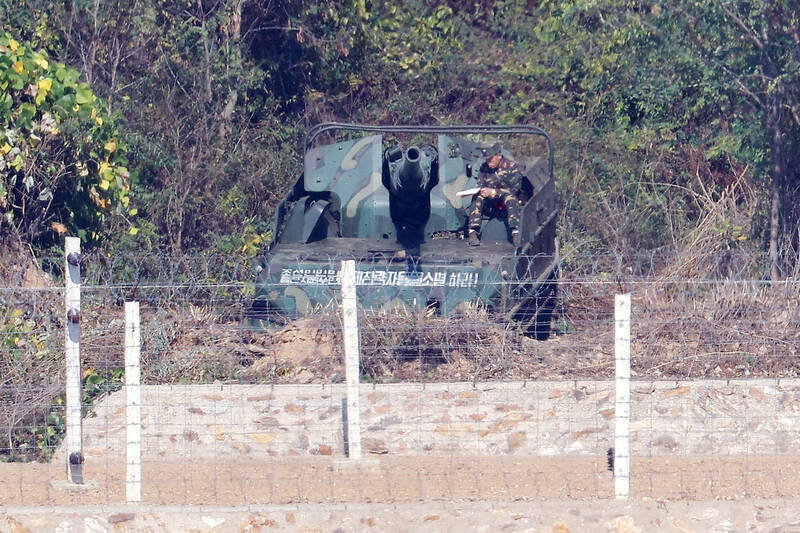
A North Korean soldier on Oct. 27 sits on a self-propelled 122-mm howitzer with the words that read as “Destroy the US imperialist aggressors, the sworn enemies of the Korean people!” and is deployed along the border separating the two Koreas, as seen from an observation deck in Gimpo, South Korea.
Photo: Reuters
WHAT IS NORTH KOREA BUILDING AT THE BORDER?
The 250km border is already fortified but not in the way many might traditionally think. It is more of a buffer than a barrier at the moment, in the form of a 4km-wide demilitarized zone (DMZ) which runs across the Korean peninsula.
Since 2024, the North is thought to have laid about 960,000 mines in the DMZ, close to half of all the mines thought to be in an area that is already one of the most heavily mined places on earth.
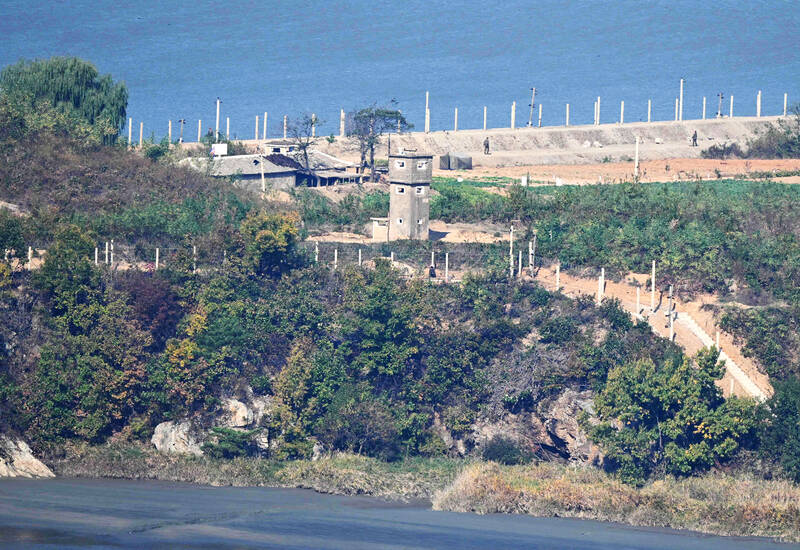
A North Korean guard post and military fences on the North side of the Demilitarised Zone (DMZ) dividing the two Koreas, are seen on Oct. 27 from a South Korean observation deck at Aegibong Peace Ecopark in Gimpo.
Photo: AFP
North Korea has also been constructing a continuous physical barrier on its side of the zone, along the full length of the line. It is made up of wire fencing, alongside minefields, tactical roads, and anti-tank barriers laid on ground stripped of vegetation. South Korea’s joint chiefs of staff say the ground-clearing is nearly finished while the construction work is 40-60 percent complete, and expect it to be finished by the second half of 2028.
Under the 1953 armistice that halted but did not end the Korean war, the DMZ was to be cleared of military forces and equipment.
WHY IS KIN JONG-UN DOING THIS?
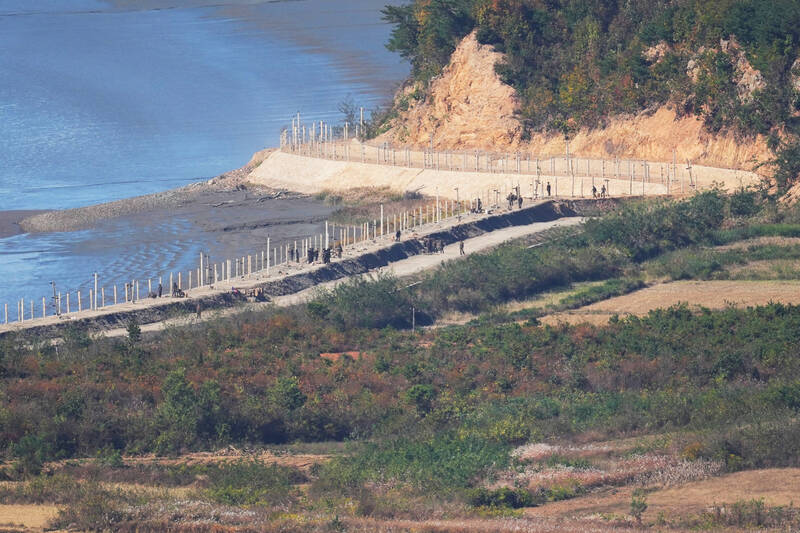
North Korean soldiers on Oct. 27 work near their military fences, seen from the observatory in Gimpo, South Korea.
Photo: AP
Kim Jong-un has abandoned the once-cherished goal of reunification. As recently as 2018, the leaders of the two sides met at the border, and their athletes marched together at the Winter Olympics. But in December 2023, Kim redefined the South as a separate, hostile state, and the construction began a few months later.
Experts in Seoul read Kim’s U-turn as removing the contradiction that lay in threatening nuclear war on people who the North had once called compatriot. When engagement with Seoul collapsed and Moscow emerged as a patron, Pyongyang was left free to press for recognition as a nuclear state.
They also say the construction achieves several goals: stopping North Koreans leaving, slowing any South Korean advance in the event of a return to warfare and turning the frontier into something that works as an international border.
Kim Yo-jong, the powerful sister of the North Korean leader, has said the work will eliminate the danger of a conflict at the border. However, analysts argue the opposite: that the new artillery and missile units being installed make an accidental clash more likely to escalate.
WHY ARE TENSIONS RISING?
On Sept. 21, three South Korean soldiers were wounded by a landmine blast while clearing a path inside the DMZ. One soldier lost his foot.
South Korea’s military concluded the blast was caused by a North Korean mine placed south of the border, and Seoul has demanded an apology. Pyongyang denied any responsibility for the incident and called it a “self-staged farce.”
South Korea says North Korean troops have repeatedly crossed the border during the work to fortify their side of the line, leading to warning shots that Pyongyang says are provocations by “armed rogues.”
Kim Yo-jong has since issued about 10 statements in less than a month criticizing the South, a frequency Seoul’s unification ministry called unusual. She recently said the North’s propaganda loudspeakers would be ready to blast across the border within days.
DOES ANYONE KNOW WHERE THE BORDER RUNS?
No. The armistice drew the military demarcation line (MDL) on maps at a scale of 1:50,000, where a line just a millimeter wide covers about 50 meters of ground. A total of 1,292 numbered markers were then planted to fix it in place, but only about 200 are still identifiable.
So each side has reconstructed it following its own methodology. Seoul works from mapping aligned with the US National Geospatial-Intelligence Agency, while the US-led UN Command (UNC), which oversees the armistice, uses its own survey from a decade ago. North Korea is believed to simply connect the markers it can still see. South Korea’s defense ministry has found that its line and the UNC’s disagree at about 60 percent of the points they have compared, by tens of meters in places. It is unclear how differently the two Koreas read the line.
North Korean troops reportedly crossed the border about 50 times in August and September this year alone, compared with 17 instances in 2025.
IS ANYTHING BEING DONE TO RESOLVE BORDER ISSUE?
Seoul is trying. It has proposed talks to confirm jointly where the MDL runs, restore military communication channels severed in 2023 and agree how to avoid accidental clashes. It is the second such offer in a year. Pyongyang ignored the first.
South Korea’s defense ministry calls the work an armistice violation and has demanded that it stop. The UNC, on the other hand, has said that construction and fortification do not automatically constitute violations, and that each case has to be judged on its facts.
KioskNews shows a cleaned-up reading view extracted from the publisher’s page — the original always lives on their site, not ours.