Donovan’s Deep Dives: 823 and two visions of Taiwan’s sovereignty
Commemorations of the 823 Artillery Bombardment reveal how political leaders invoke the same battle to advance sharply different visions of the ROC, China and peace
By Courtney Donovan Smith 石東文 / Staff Columnist


Every year on the anniversary of the 1958 Kinmen 823 Artillery Bombardment — a central episode in what has become known as the Second Taiwan Strait Crisis — carefully crafted speeches reveal the underlying ideological divide over sovereignty between the Taiwan-centric, pan-green Democratic Progressive Party (DPP) and the pan-blue Chinese Nationalist Party (KMT) stance that Taiwan is ultimately a province of China.
The pan-blue side has the added complication that some are hardcore Republic of China (ROC) nationalists, while others are more accommodating of and willing to work with the People’s Republic of China (PRC) to varying degrees.
Different accounts give varying numbers and duration for the conflict, but there were thousands of casualties on both the ROC and PRC sides and as many as 470,000 artillery shells struck Kinmen during the intensive 44-day bombardment.
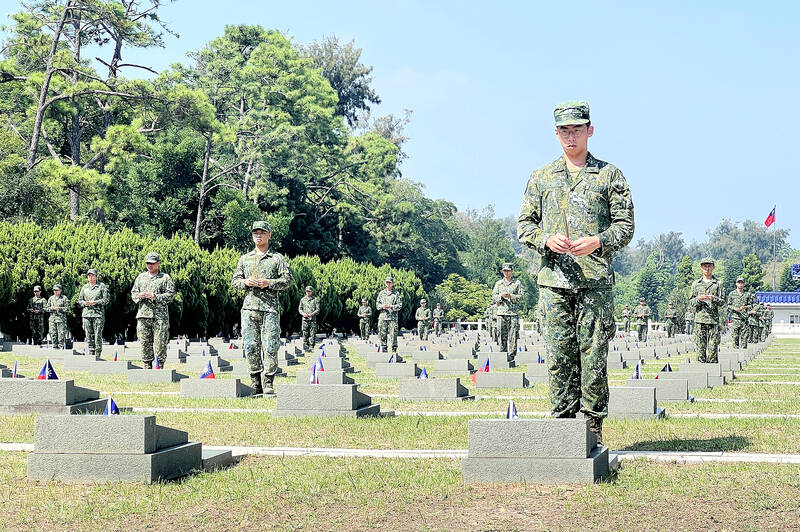
Soldiers on Aug. 23 last year commemorate the 67th anniversary of the 823 Artillery Bombardment on Kinmen.
Photo: Wu Cheng-ting, Taipei Times
For the US, there were fears of a war with the PRC over Quemoy (as Kinmen was then called), with the potential for it to turn nuclear. The US-ROC mutual defense treaty then in force, however, only explicitly covered Taiwan and Penghu. The US Navy provided escort close to Kinmen and provided advanced weaponry, but did not get directly involved in the fighting.
After seizing several islands the ROC held off the coast of China in the years prior, this was the final battle that held off further PRC seizures and preserved the territorial status quo that remains today
This was a pivotal event for Taiwanese in resisting the PRC, and Quemoy became a household name in American Cold War politics.
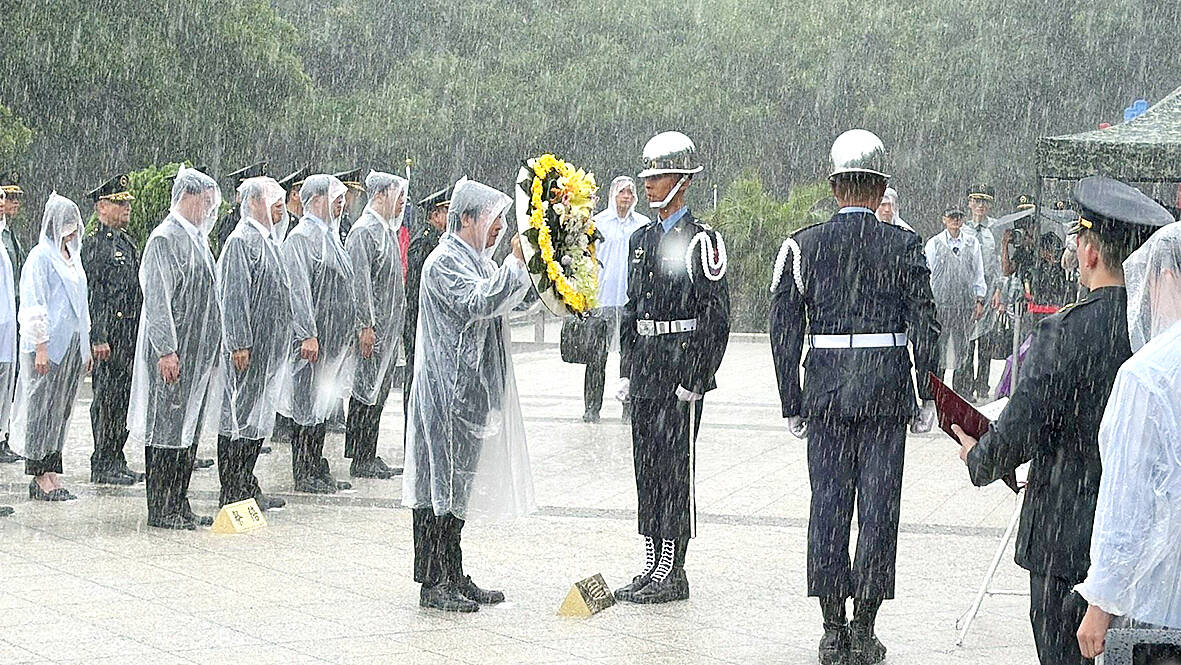
President William Lai, center, on Aug. 23 presides over a ceremony on Kinmen to commemorate the 68th anniversary of the 823 Artillery Bombardment.
Photo: Wu Cheng-ting, Taipei Times
On the surface, both DPP and KMT politicians’ speeches share much in common. They praise the brave soldiers’ sacrifice in defending the nation, lay wreathes and talk about unity. It is in the details of their speeches that the differences are revealed.
WILLIAM LAI’S LINES ON SOVEREIGNTY
In the pan-green view, Taiwan is a settler and colonial society in much the same way as North America or Australia, and shares a similar timeline of several hundred years. Different colonial rulers, especially the Japanese, and different influences, including American, have created a society and culture different from China.
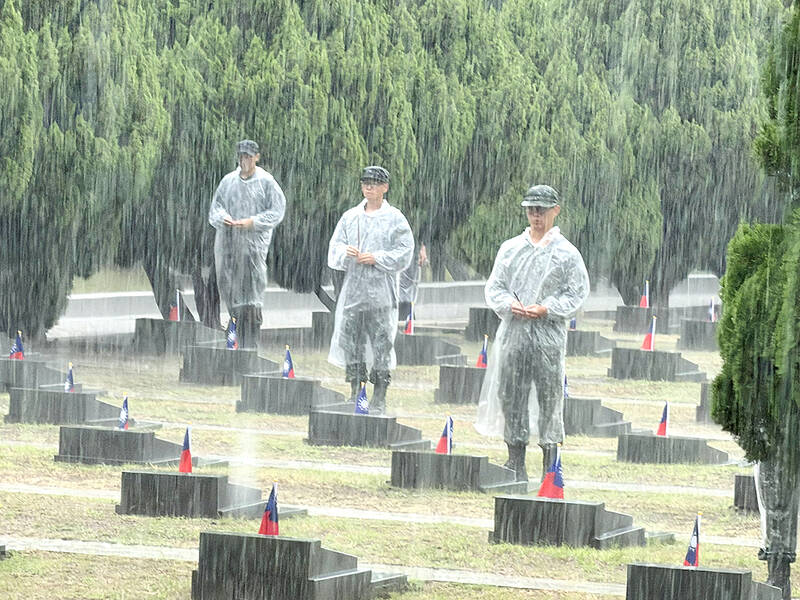
Soldiers on Kinmen on Aug. 23 participate in a memorial ceremony marking the 68th anniversary of the 823 Artillery Bombardment.
Photo: Wu Cheng-ting, Taipei Times
DPP politicians have complicated feelings about commemorating 823 for two reasons. First, the battle was one of the main justifications for the continuation of KMT-imposed martial law. The other is that most on the pan-green side only reluctantly accept the ROC name, constitution and symbols as a way to maintain independence while avoiding a war with the PRC. Kinmen and Matsu have been part of Fujian for at least a thousand years, and did not share in the Taiwanese settler or colonial experiences.
However, as president of the ROC, William Lai (賴清德) is obligated to maintain sovereignty over the islands and to support the troops. He used his speech to rally support for the military and expanding their role and budgets, a dig at the KMT-led opposition over recent controversies and disagreements over defense spending.
Like most DPP politicians, Lai views China as essentially foreign, which comes out in statements like: “For 68 years, China’s authoritarian forces have never stopped pursuing their ambitions for external expansion.”
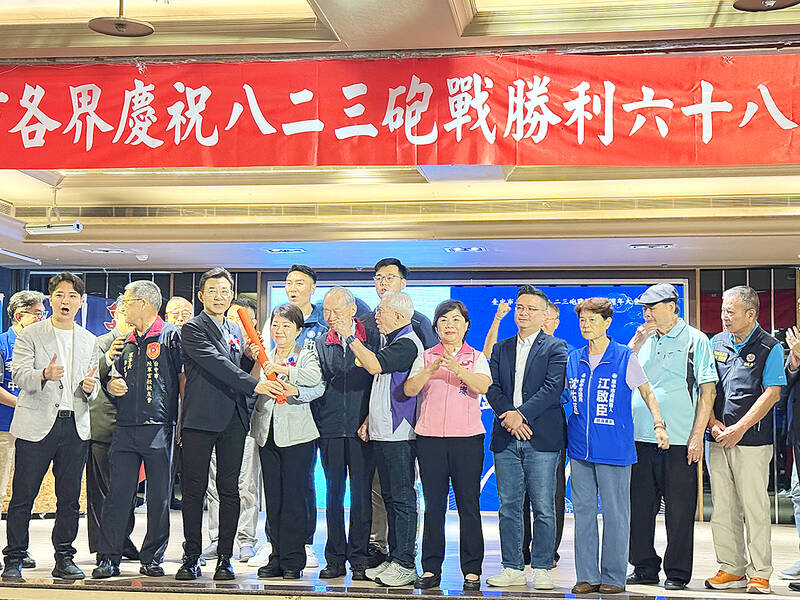
Taichung Mayor Lu Shiow-yen, in front fourth left, attends a commemoration ceremony for 823 Artillery Bombardment in Taichung on Aug. 23.
Photo: Ou Su-mei, Taipei Times
The presidential office readout of Lai’s speech said that Taiwan must uphold “the spirit of ‘not surrendering a single inch of Taiwan, Penghu, Kinmen or Matsu.’”
Curiously, it didn’t mention traditional ROC claims in the South China Sea, which suggests that he is not going to fight over real estate there. It moreover seems unlikely that Taiwan is going to fight over other traditional territorial claims, including with the ROC’s 11-dash line that the PRC’s 10-dash (until recently 9-dash) is based on.
CHEN YI-HSIN PARROTS PRC
In response, the KMT issued a press release titled: “KMT Calls for ‘Not Surrendering a Single Inch’ on Aug. 23, Asks William Lai: ‘Why Won’t You Dare Mention Sovereignty Over Scarborough Shoal?’” referring to one of the islands in the South China Sea.
The press release covers a blistering attack by KMT Culture and Communications Committee Chairman Chen Yi-hsin (陳以信) on Lai’s speech. Chen is quoted as saying: “But when the Philippines establishes territorial baselines around Scarborough Shoal (Democracy Reef) in the South China Sea, which is part of our country, and when Japan and the Philippines negotiate over rights and interests in waters east of Taiwan — actions that seriously harm our sovereignty and maritime rights and interests — where is President Lai’s commitment to sovereignty?”
The specific term in the headline and in the quote for Scarborough Shoal is Huangyan Island (黃岩島), which is the official PRC name for it. Did an editor add the official ROC name — Democracy Reef (民主礁) — into the quote?
Since 2012, the shoal has been effectively controlled by the PRC. Scarborough Shoal is only 198km from the Philippines’ Subic Bay harbor and just 345km from the capital, Manila, and is considered a serious threat to their national security.
Chen’s leading use of the PRC-preferred name “Huangyan Island,” rather than Taiwan’s official “Democracy Reef,” strikingly echoes Beijing’s terminology, although he claimed the feature for the ROC rather than the PRC.
CHENG LI-WUN’S POINTED SPEECH
KMT Chair Cheng Li-wun’s (鄭麗文) comments were more sophisticated. She called on Taiwan, Kinmen, Matsu and Penghu to unite under the ROC constitution, reiterated her call for negotiating peace with China and supported a concept popular in some pan-blue circles of using Kinmen as a starting point for peace with China. The theory being that the physical proximity and historical ties with Fujian make it an ideal place to start.
She put the blame on the president entirely for recent constitutional crises, is highly debatable. She also attacked him for having sworn an oath to the ROC constitution, and chastised him: “Don’t say one thing and do another, and don’t try to distort the spirit of the ROC Constitution through the two-state theory.”
In other words, she rejects treating Taiwan and China as two separate countries and instead places both sides within a one-China ROC framework.
LU SHIOW-YEN’S FIERY SPEECH
Taichung Mayor Lu Shiow-yen (盧秀燕) commemorated 823 with a fire-and-brimstone speech that was clearly directed at the pan-blue base. Formerly, when she was a lawmaker, she was deeper blue, but in recent years as mayor has carefully cultivated a more moderate image.
On the softer side of her speech, she spoke about the sacrifices soldiers must make to defend the nation, including by her own father, and her direct experience growing up in a military dependents village.
The rest of the speech was more fiery, and she kept repeating two themes. She said: “Because of their [DPP leaders] ideology, because of their hatred, their goal is to make the Republic of China disappear. Some people are promoting Taiwan independence, putting our country at risk of war and are willing to destroy peace at all costs.”
She added: “We have only one goal: to protect the Republic of China and safeguard peace. We absolutely must win in 2026 and 2028.”
Typically, Lu delivers serious speeches in a calm but resolute tone. This was anything but.
Until recently, she was the frontrunner to be the KMT 2028 presidential candidate, but has been sliding in the polls. She may be pivoting back towards the base to shore up support in the party as she gears up for a run.
Donovan’s Deep Dives is a regular column by Courtney Donovan Smith (石東文) who writes in-depth analysis on everything about Taiwan’s political scene and geopolitics. Donovan is also the central Taiwan correspondent at ICRT FM100 Radio News, co-publisher of Compass Magazine, co-founder Taiwan Report (report.tw) and former chair of the Taichung American Chamber of Commerce. Follow him on X: @donovan_smith.
KioskNews shows a cleaned-up reading view extracted from the publisher’s page — the original always lives on their site, not ours.