‘Developing nations unjustly blamed’: PM Modi flags climate inequality
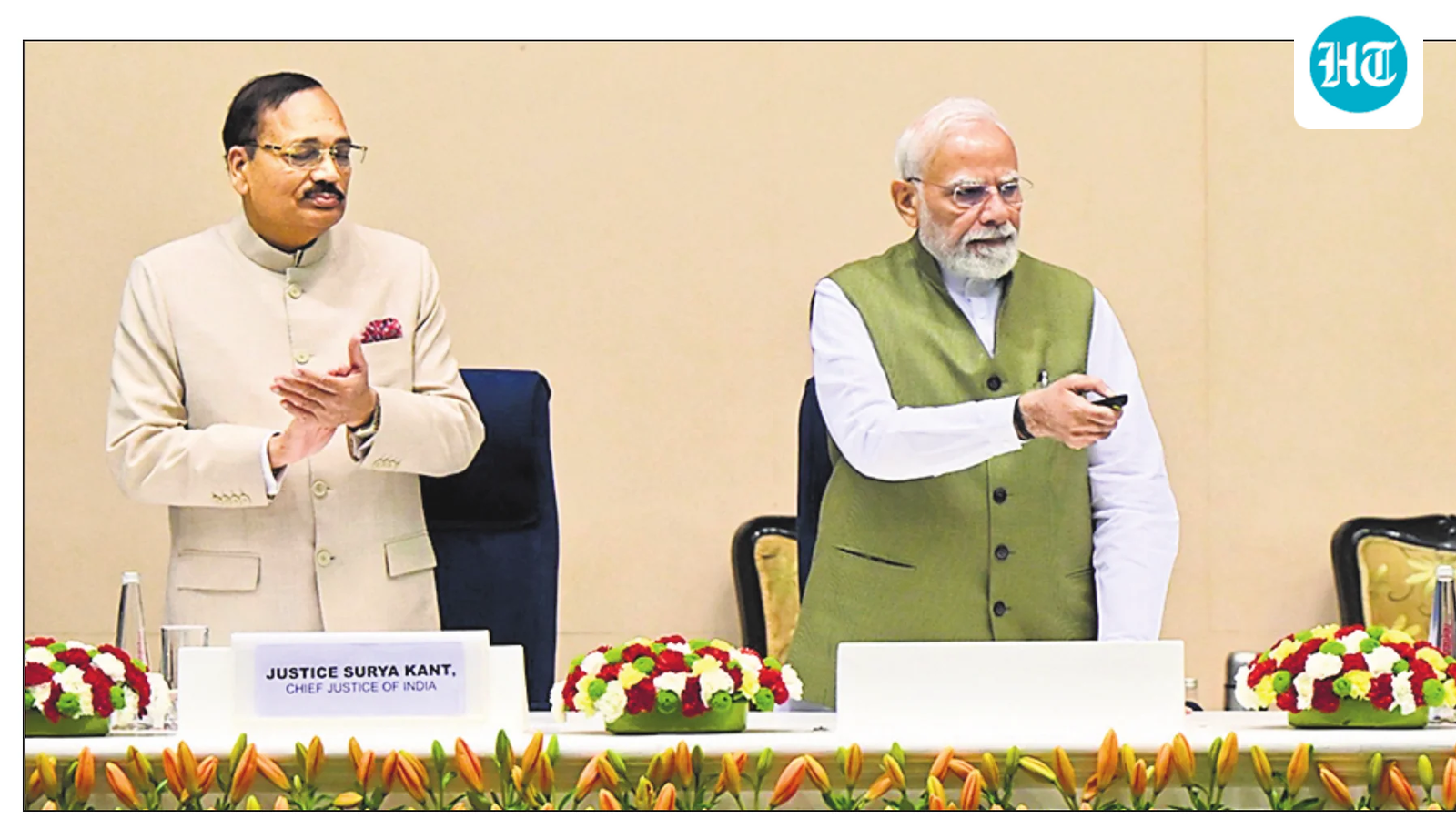
Prime Minister Narendra Modi said on Saturday that developing countries are often “unjustly blamed” for carbon emissions, despite India’s per-capita emissions being “less than half of the global average” and those of developed countries being six times higher.
“Developing nations are unjustly blamed, despite developed nations emitting up to six times more carbon per capita than India,” he said while addressing the inauguration of the International Conference on “The Future of Environment and Climate Dynamics” where he launched the NGT mobile application.
Highlighting that India is the only G20 country that has fulfilled all the commitments made at the Paris COP-21 well ahead of time, while also setting global benchmarks in non-fossil fuels and solar capacity, Modi said: “India’s performance on every parameter is a topic of discussion in the world today.”
He also stressed India’s historical connection to nature, emphasising how ancient cultural wisdom is shaping modern climate solutions. “India is now providing solutions to modern climate challenges,” he said, adding that the global narrative around carbon footprints is flawed.
Also Read | Development amid dirty air and a changing climate
He recalled the launch of the “Convenient Action- Continuity for Change” book at COP-21 and the creation of platforms like One Sun, One World, One Grid, the International Solar Alliance, CDRI, the Global Biofuel Alliance, and the International Big Cat Alliance to assert India’s efforts towards environmental protection. “We are establishing new benchmarks for environmental protection by taking the world along,” he said.
Referring to strong advancements in the renewable energy sector, Modi said that India’s solar capacity had risen from around 2 GWs in 2014, to over 160 GWs currently, primarily through schemes like PM Surya Ghar Muft Bijli Yojana and the PM Kusum scheme for farmers.
Overall, India has seen a threefold increase in wind capacity, significant hydro expansions, and a newly energised focus on nuclear power generation that now welcomes private players, he said, also referring to India’s first hydrogen train which was recently flagged, as the world’s longest such train.
Also Read | Global temperature rise set to cross 1.5°C threshold by end of decade: UN report
“This is the beginning of a new era of clean mobility,” he said, adding that India has also seen 950-fold increase in electric vehicles – from under 3,000 before 2014 – to 2.5 million last year. “India is embracing this opportunity of the EV revolution with full force.”
Pointing to alternative eco-friendly transport modes, the PM also celebrated the operationalisation of approximately 5,000 kilometers of inland waterways across the country. He explained that a single standard inland vessel navigating these routes can carry a load equivalent to dozens of trucks. “This too is providing great help in environmental conservation,” he noted, adding that sweeping changes across the entire mobility sector serve as undeniable proof of the nation’s balanced growth trajectory.
“Our development is speedy as well as sustainable,” he said.
The PM was speaking at the inauguration of the conference, which was also attended by Chief Justice of India Justice Surya Kant, Attorney General for India R Venkataramani and Union environment minister Bhupender Yadav, alongside NGT’s chairperson Justice Prakash Shrivastava.
Addressing the event, Justice Surya Kant highlighted India’s longstanding environmental jurisprudence, noting that the Supreme Court has, over the decades, has recognised the right to a pollution-free environment as a fundamental right and developed principles including the precautionary principle, polluter pays principle, absolute liability and public trust doctrine.
Also Read | CJI Surya Kant urges courts to assess cumulative harm in climate disputes
Yadav said non-fossil sources now account for 54.18% of installed electricity capacity, surpassing the 2030 target of 50 per cent nine years ahead of schedule.
The conference is bringing together jurists, academicians, environmental experts and other stakeholders from 17 countries, along with international organisations United Nations Environment Programme and Asian Development Bank. President Droupadi Murmu will take part in the valedictory session at the conference on Sunday.
KioskNews shows a cleaned-up reading view extracted from the publisher’s page — the original always lives on their site, not ours.