Legislator May Chin indicted on security charges
Independent Legislator May Chin (高金素梅) and three others were indicted yesterday on national security and corruption charges over allegations that they carried out activities on Beijing’s behalf.
Chin, her former legislative office director Chang Chun-chieh (張俊傑), and publicly funded legislative assistants Chen Chih-huang (陳智葟) and Lin Yi-chun (林怡君) were indicted on charges of contravening the National Security Act (國家安全法) and the Anti-Corruption Act (貪污治罪條例) for allegedly accepting bribes, the Taiwan High Prosecutors’ Office said.
Between 2005 and 2016, Chang and Chen allegedly coordinated Chin’s election campaigns, legislative work and outreach to indigenous communities, prosecutors said.
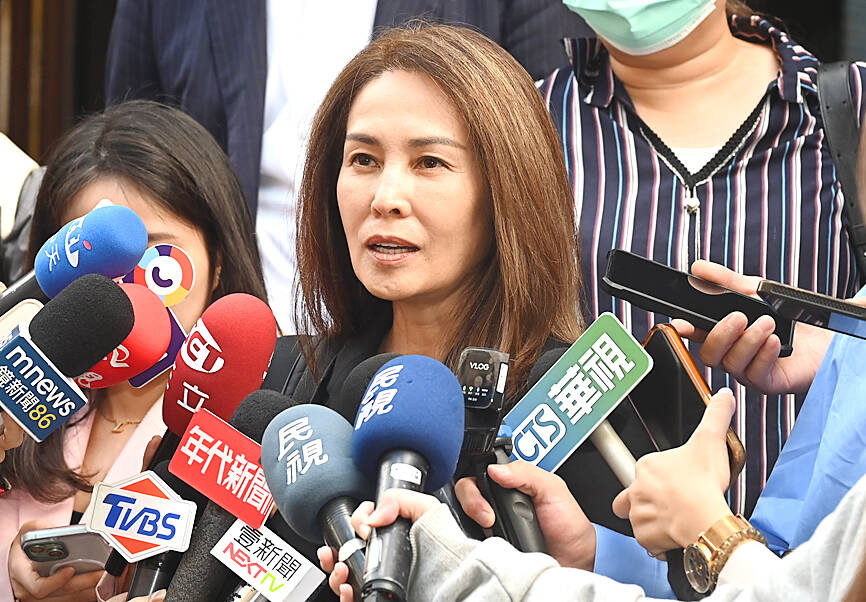
Independent Legislator May Chin is pictured in an undated photograph.
Photo: Taipei Times
Lin allegedly acted as an intermediary for Chin and Chang, traveling between Taiwan and China to receive instructions from Chinese officials and relay them to others, they said.
Chang allegedly accepted Chinese donations for infrastructure projects in indigenous communities while secretly channeling more than NT$170 million (US$5.19 million) in Chinese funding through accounts belonging to relatives and friends, prosecutors said.
The money was allegedly used to develop an organization on behalf of Chinese government agencies and support Chin’s re-election campaigns.
Prosecutors also accused Chin of acting at Beijing’s instruction on major issues involving arms purchases, cross-strait relations, foreign affairs and national defense, using her position as a lawmaker to influence legislative proceedings.
Citing what they described as Chin’s lack of remorse and attempts to evade responsibility during the investigation, prosecutors asked the court to impose a 14-year prison sentence.
They also sought a 15-year prison sentence for Chang, who is believed to have fled Taiwan after being released on bail, citing the seriousness of his alleged offenses and his attempts to evade prosecution.
Meanwhile, Chen and Lin confessed during the investigation, returned their illicit gains and provided detailed accounts of the involvement of other defendants, prosecutors said.
In a separate case in June, the Taipei District Prosecutors’ Office indicted Chin and 23 others on corruption and fraud-related charges involving the alleged embezzlement of public funds and the importation of unapproved COVID-19 test kits from China.
The case is pending trial.
Chin denied developing an organization on behalf of the Chinese government or receiving Chinese funding, saying the allegations were untrue.
She accused prosecutors of rushing to indict her to divert attention from their failure to apprehend Chang after he fled Taiwan.
She also rejected allegations that her opposition to arms purchases and other positions cited in the indictment were taken at Beijing’s direction, saying they reflected views she had long held.
She asked why she would need Chinese funding to secure her re-election after serving seven consecutive terms, and spending 24 years visiting indigenous communities and addressing residents’ concerns.
Chin also asked why, if the alleged offenses occurred between 2005 and 2016, she had been placed under surveillance for more than 20 years, but was only indicted a decade later, shortly before an election.
She said she would present evidence at trial to defend her innocence.
The lawmaker also criticized what she described as growing smear campaigns and online accusations labeling opposition figures as pro-China or spies, asking whether such an environment was compatible with democracy, adding that she would continue to stand by her principles.
KioskNews shows a cleaned-up reading view extracted from the publisher’s page — the original always lives on their site, not ours.