Seoul pushes back on Trump’s Alaska LNG claims, says investment must be commercially viable
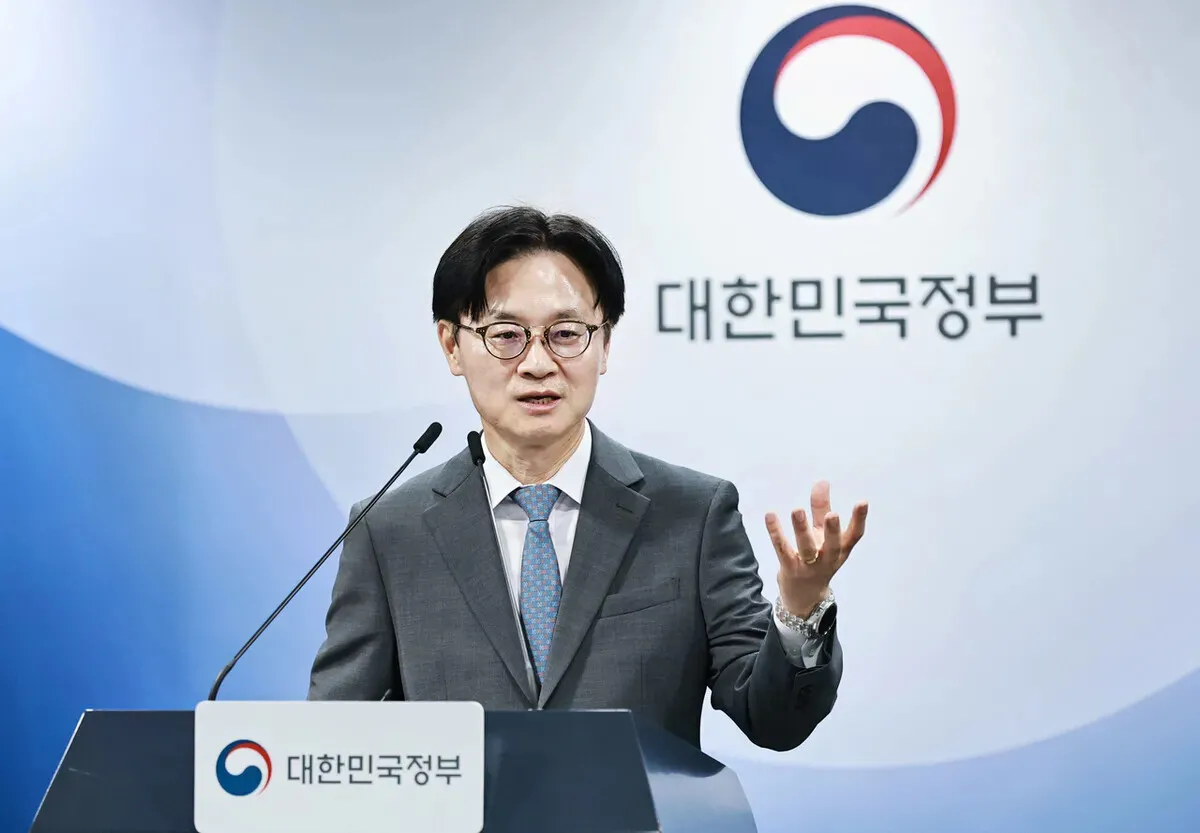
Minister of Trade, Industry and Resources Kim Jung-kwan speaks at a back briefing for the press corps at the central government complex in Seoul on Sept. 22, 2026. (courtesy MOTIR)
On Thursday, Seoul and Washington reached an agreement on the overall framework of a US$142.3 billion strategic investment plan in the US. Their agreement covers around 70% of the US$200 billion of funding that Korea pledged to invest in the US in exchange for lower tariffs in November 2025.
But US President Donald Trump’s unilateral announcement that Korea has committed to invest the remaining US$50 billion in a liquefied natural gas (LNG) project in Alaska suggests that negotiators from the two sides will continue to squabble over the details of each project.
Korea’s government has repeatedly declared that it will not make any investments without being assured of their “commercial reasonableness.”
That day, Trump announced plans to move forward with three projects agreed upon in writing by Korea and the US: the Encinal gas-fired combined-cycle power plant in Texas, valued at US$22.3 billion; the construction of eight large-scale nuclear power plants, worth US$120 billion under a comprehensive agreement; and the Alaska LNG project, for which the budget is yet to be determined.
The announcement was made in the Oval Office at the White House, with Commerce Secretary Howard Lutnick, a US senator from Alaska, and others in attendance.
This comes just nine days after the Korean government reported the same bilateral agreement to the National Assembly on Sept. 22.
“These efforts aim to build stable and resilient supply chains by enhancing cooperation between Korea and the US in strategic industrial sectors, including energy,” a press release on the strategic investment project stated, adding, “The plan announced today [. . .] demonstrates both governments’ shared commitment to implementing the Trade Deal,” the press release read. “Both sides intend to continue working together in good faith to implement the Trade Deal.”
The problem is that Trump’s remarks immediately undermined the principle of negotiating and working together in good faith. He said Korea’s investment would, “at long last,” make the Alaska LNG pipeline a reality. Lutnick, meanwhile, said more than US$50 billion of Korea’s investment would be directed to Alaska.
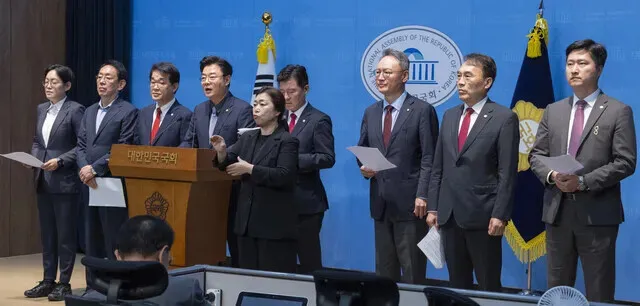
Lawmakers from the opposition People Power Party hold a press conference on Oct. 1, 2026. (Yonhap)
However, that is not specified in the joint fact sheet released by the two countries on the same day.
“The only agreements made with the US are illustrated in three sentences of the joint fact sheet,” said Trade Minister Kim Jung-kwan, who led the negotiations, during a press briefing at the ministry that day.
The two countries have agreed to “commence working” on the Alaska LNG project, “subject to meeting commercial reasonableness.” If the project begins in earnest, the US will “facilitate the favorable involvement of Korean vendors and suppliers,” and “provide assurances, to the extent possible, regarding offtake agreements at economically viable prices granting Korea priority access to the Alaska LNG produced by this project.”
Apart from those three agreements, there have not been any further pacts made on whether the investment was set in stone, or on the amount of the investment.
“The US appears to want to use this part of the agreement for domestic purposes. Following the White House announcement, I strongly raised objections with Lutnick, who responded by saying that he understood our concerns and that he would do his best to ensure the situation is handled properly,” Kim said.
The minister emphasized that “both countries share the understanding that projects will not proceed if they lack commercial reasonableness”
Korean President Lee Jae Myung, who had previously cited national interests and highlighted how only “projects that are commercially reasonable” would be pursued, also cited the wording from the joint agreement when posting to X: “Among the US investment projects announced by the US, we have agreed to commence working on the Alaska LNG project on the condition that its commercial reasonableness is confirmed and it complies with Korean legal procedures.”
However, Trump, who has openly signaled his intention to support Republican candidates in the November midterm elections, reiterated in a Truth Social post that day, “The US and Korea have agreed to commence working together on the 50 Billion Dollar ALASKA LNG PROJECT.”
This has led to speculation that the issue could affect detailed negotiations on projects already agreed upon, such as the Texas plant.
While the joint fact sheet also did not specify the construction sites for the nuclear power plants, Lutnick singled out Ohio, Tennessee, South Carolina, and Kentucky during his remarks that day.
[%%IMAGE2%%]
The National Assembly, which reviews the commercial reasonableness of investments in the US, is expected to focus intensively on this issue during meetings of the relevant standing committee and during the parliamentary audit of the government.
Korea’s ruling Democratic Party emphasized the payoff of the negotiations while stopping short of endorsing the Alaska LNG project.
Democratic Party policy chief Rep. Kwon Chil-seung called the agreement “a meaningful achievement in safeguarding national interest based on commercial reasonableness through intense consultations between Korea and the US.”
However, regarding the Alaska LNG project, Kwon said, “We will continuously monitor whether it is being carried out in accordance with the original agreement and the principles and procedures stipulated in the Korea-US Strategic Investment Management Special Act.”
National Assembly’s Finance, Economy, Planning and Budget Committee leader Rep. Oh Gi-hyoung cited the investment act’s clause on gaining approval from the National Assembly standing committee in a Facebook post, writing, “We will review and make decisions based on whether the project meets the criteria of commercial reasonableness.”
The opposition People Power Party was more critical of the Lee administration than the US. Party lawmakers serving on the National Assembly’s Trade, Industry, Energy, SMEs and Startups Committee and Finance, Economy, Planning and Budget Committee called a press conference.
“In its Sept. 22 report to the National Assembly on investments in the US, the administration explained that it would decide whether to proceed with the LNG project after further review,” the lawmakers said.
“The administration must immediately disclose whether it had been made aware of Trump’s announcement in advance, or whether it had held discussions over or agreed to proceed,” they said.
By Kim Nam-il, staff reporter; Kim Won-chul, Washington correspondent; Yoo Young-jae, staff reporter
KioskNews shows a cleaned-up reading view extracted from the publisher’s page — the original always lives on their site, not ours.