Travel spending changing, Mastercard says
By Jonathan Chin / Staff writer, with CNA


Taiwanese visiting Japan and South Korea are changing their spending patterns and the places they visit, Mastercard’s data and services team said in a statement yesterday.
Data gleaned from Taiwanese travelers in 2024 and last year showed changes in their habits, the team said.
Japan, China and South Korea are the top three tourism destinations for Taiwanese, with 14.5 million people traveling abroad in the first eight months of this year, the statement said, citing Tourism Administration data.
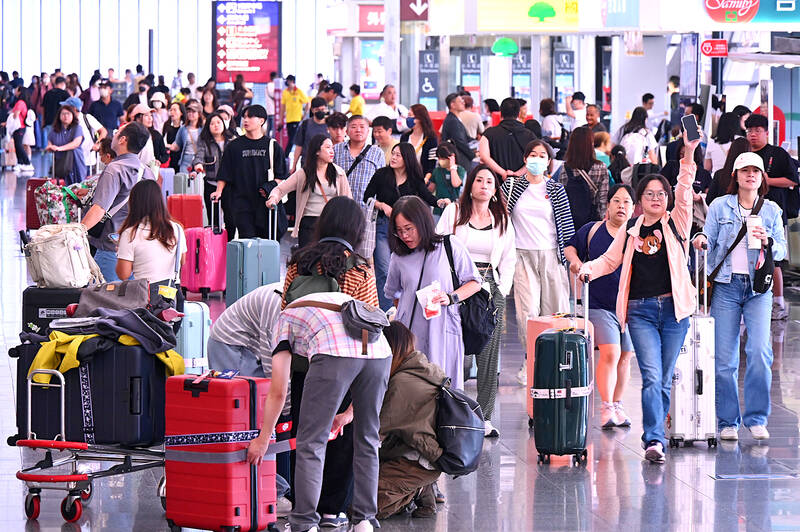
People are pictured at Taiwan Taoyuan International Airport on Sept. 25.
Photo: Liu Hsin-de, Taipei Times
Last year, Taiwan-issued Mastercard holders’ in-person spending grew 39 percent in Japan and 44 percent in South Korea compared with the previous year, Mastercard Taiwan managing director Eva Chen (陳懿文) said in the statement.
The figures outpaced the year-on-year growth in Taiwanese tourists’ spending on consumer goods, which were 16 percent in Japan and 35 percent in South Korea during the period, Chen said.
Taiwanese tourists’ spending continued to grow in major cities, while growth was stronger in several destinations outside those centers, although they also showed more interest in exploring smaller towns and cities, she said.
Tokyo and Osaka accounted for a combined 41 percent of Taiwanese visitors’ spending in Japan, but it increased by 66 percent in Fukuoka, 48 percent in Okinawa and 36 percent in Sapporo, she said.
By comparison, Taiwanese tourism spending in Tokyo increased by just 6 percent, she said.
Taiwanese experience-related spending grew 90 percent and 68 percent respectively in Fukuoka, which broadly reflected trends elsewhere in Japan, Chen said.
Last year, Seoul accounted for 61 percent of total spending by Taiwanese tourists to South Korea, down from 64 percent the previous year, she said.
Experience-related spending by Taiwanese in South Korea “grew 102 percent in Jeju and 73 percent in Busan, outpacing their spending on goods, Chen said.
The reverse was true of Incheon and Gyeonggi-do, where Taiwanese tourists’ spending on goods increased by 132 percent and 120 percent respectively, she said.
Taiwanese visiting Japan and South Korea increasingly planned their trips around local concerts, rather than Taiwan’s national holidays, Chen said.
Taiwanese attending South Korean music concerts outspent those who were vacationing in the country four-fold in terms of average daily spending, she said.
The patterns indicate that Taiwanese increasingly favor experiencing a foreign culture over buying consumer products, she added.
KioskNews shows a cleaned-up reading view extracted from the publisher’s page — the original always lives on their site, not ours.