Delhi pollution worsens: Unfavourable weather, farm fires across border to blame
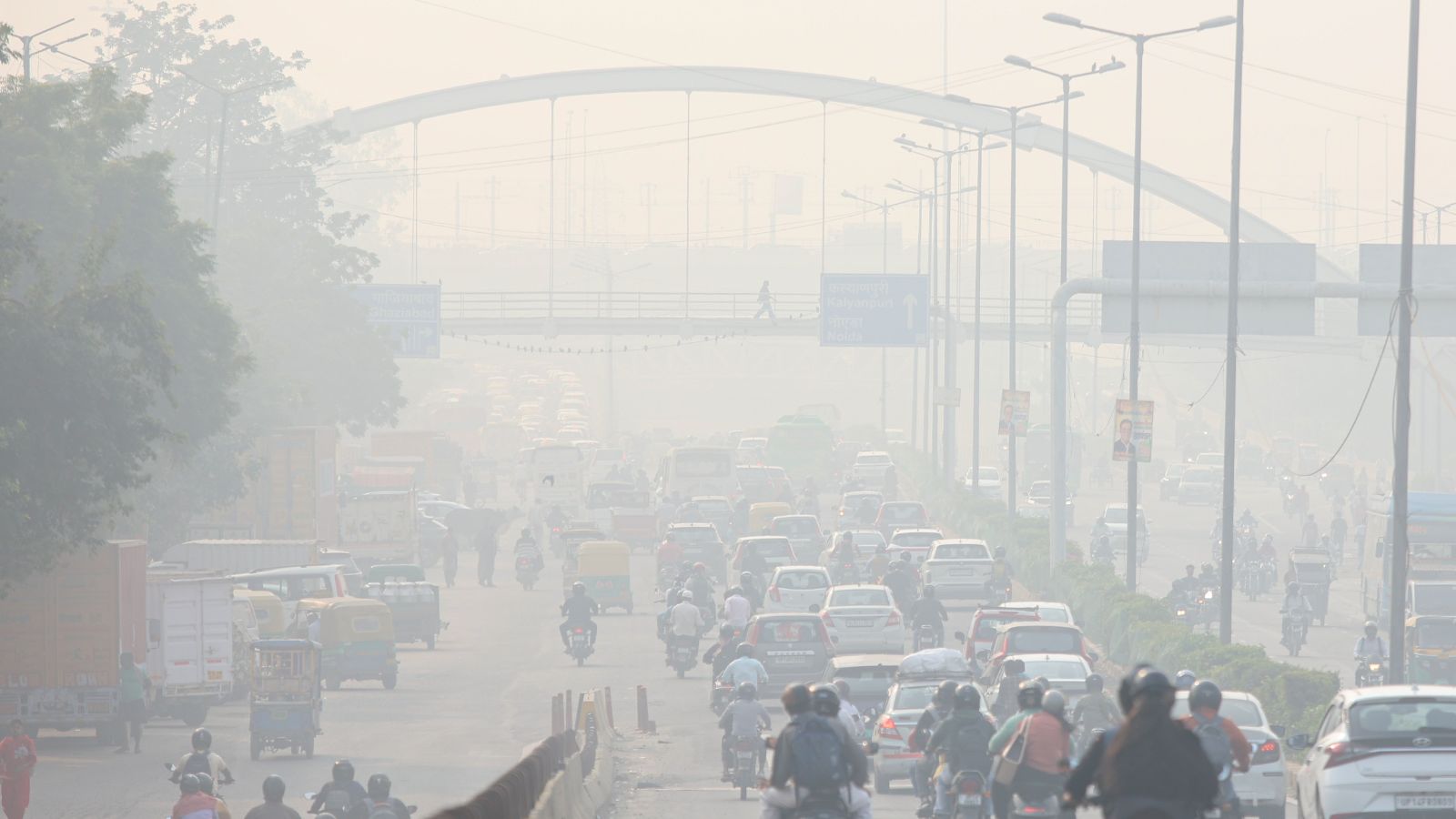
As the air quality in the Capital deteriorated sharply to enter the ‘Very Poor’ category on Monday, the Commission for Air Quality Management (CAQM) invoked Stage II of the Graded Response Action Plan (GRAP) across Delhi-NCR.
Citing a sharp rise in the air quality index (AQI) from 117 on October 31, in the ‘Moderate’ category, to 261 (‘Poor’) on Sunday, followed by a further jump to 324 (‘Very Poor’) on Monday, the watchdog attributed the deterioration to unfavourable meteorological conditions and ordered intensified pollution-control measures. Farm fires across the border, in Pakistan’s Punjab, are also adding to the pollution load in the Capital, data analysed by The Indian Express shows.
ALSO READ | Delhi raises pollution curbs to ‘GRAP-II’ as air quality falls sharply
The Indian Institute of Tropical Meteorology (IITM) has forecast that Delhi’s air quality will remain in the ‘Very Poor’ category from till November 5, with the outlook for the subsequent six days ranging from ‘Very Poor’ to ‘Poor’.
#WATCH | Delhi: Air Quality Index (AQI) in the area around India Gate is 226, categorised as ‘Poor’, as per the CPCB (Central Pollution Control Board).
(Visuals shot at 7:15 am) https://t.co/qObkuxZbnT
— ANI (@ANI) November 3, 2026
Measures under GRAP Stage II
With GRAP Stage II in force, authorities have rolled out a range of anti-pollution measures across Delhi-NCR, alongside restrictions on the entry of non-BS-VI vehicles into the Capital. These include daily mechanical road sweeping, intensified water sprinkling with dust suppressants, and stricter inspections of construction sites to enforce dust-control norms.
To encourage public transport use, parking fees have been hiked, traffic personnel have been deployed at congestion hotspots, and public transport services have been augmented.
The Delhi Metro Rail Corporation (DMRC) has announced 20 additional train trips on weekdays.
ALSO READ | Delhi AQI 300-plus: Asthmatic man develops pneumonia, wife and son suffer breathing problems
The measures also ban the use of coal and firewood in hotels, restaurants and open eateries, while restricting diesel generator sets to emergency and essential services. Resident Welfare Associations and commercial establishments have been directed to provide electric heaters to security guards and other outdoor staff to curb the open burning of wood and biomass.
Story continues below this ad
Separately, the DMRC said it has intensified dust-control measures at its construction sites and adjoining roads, including mechanical cleaning, debris removal, and inspections to ensure construction materials remain covered and wheel-wash facilities are functional. It has also installed over 250 anti-smog guns and misting systems across construction sites, Metro stations and office buildings, officials said.
Farm fires within country, across border
The deterioration comes amid a combination of unfavourable weather conditions and smoke from agricultural residue burning in neighbouring regions, including across the international border in Pakistan’s Punjab province.
Even as the number of farm fires recorded in India remains relatively low compared with previous years, 219 residue-burning events were recorded on Monday, taking the seasonal total since September 15 to 3,535, according to the data from the Indian Agricultural Research Institute (ICAR-IARI). The institute monitors satellite-detected fires by filtering them against specific agricultural land boundaries.
So far this season, Punjab has accounted for 1,612 fires, followed by Rajasthan (738), Madhya Pradesh (614), Uttar Pradesh (349), Uttarakhand (176), Haryana (44) and Delhi (2). This is an all-time low for the three major states: Punjab, Haryana and Uttar Pradesh.
Story continues below this ad
However, farm fires in Madhya Pradesh have picked up and are higher compared to 486 recorded in the corresponding period last year.
Meanwhile, cross-border pollution continues to impact the broader airshed. A week-long analysis by The Indian Express of NASA’s Fire Information for Resource Management System (FIRMS) satellite imagery, up to November 2, showed a dense band of active fires immediately west of the international border in Pakistan’s Punjab province.
This comes amid a weekend spike in fires on the Indian side. Punjab recorded 292 fires on Saturday, its highest single-day count of the season, followed by 175 on Sunday and 98 on Monday. Districts such as Tarn Taran (489 cumulative fires), Firozpur (193) and Amritsar (192) accounted for a significant share of the state’s seasonal total.
Transport emissions add to pollution load
According to the Indian Institute of Tropical Meteorology’s (IITM) Decision Support System (DSS), stubble burning accounted for 8.5% of Delhi’s PM2.5 pollution on Monday. Its contribution is forecast to rise to 22% by Thursday.
Among Delhi’s internal sources, transport accounted for 20.07% of the pollution load, followed by residential sources (5.09 per cent), industries (4.07 per cent), construction (2.82 per cent), waste burning (1.82 per cent), energy sector (1.78 per cent) and road dust (1.5 per cent).
Regional contributions were also significant, with Jhajjar accounting for 7.22 per cent and Gurugram for 6.68 per cent of Delhi’s pollution load. Sonipat contributed 3.43 per cent, Faridabad 2.89 per cent, Gautam Buddha Nagar 2.33 per cent and Bhiwani 2.12 per cent, among other districts.
Story continues below this ad
Unfavourable weather conditions
Meteorological conditions have also been unfavourable for the dispersion of pollutants. North-westerly winds prevailed over Delhi, with speeds reaching 10-15 kmph through the day on Monday, according to the India Meteorological Department (IMD). The wind speed is forecast to decrease to around 10 kmph during the evening and night.
The IMD had also reported shallow fog at a few places in the morning. Safdarjung, the Capital’s base station, recorded visibility of 800 metres between 6.30 am and 7.30 am on Monday, which improved to 900 metres by 8 am.
According to IITM, the ventilation index, which indicates the atmosphere’s ability to disperse pollutants below 6,000 square metres per second, combined with average wind speeds below 10 kmph, is considered unfavourable for pollutant dispersion.
KioskNews shows a cleaned-up reading view extracted from the publisher’s page — the original always lives on their site, not ours.