Kevin Paquette: The CAQ is betraying its conservative roots
It is almost easy to forget now, but before taking power in 2018, the Coalition Avenir Québec was a party that wanted to reform Quebec. François Legault campaigned on the very real frustration of taxpayers who were paying a lot without always feeling they were getting their money’s worth. The CAQ talked about the cleanup that was needed in the Quebec model, the need to cut bureaucracy and the importance of giving families and taxpayers more room to breathe.
Sign In or Create an Account
The CAQ was a party that wanted to challenge the status quo. This was a characteristic it had partly inherited from its predecessor, the Action Démocratique du Québec. Although the CAQ often touted itself as a more sophisticated evolution of the ADQ, notably by bringing together former members of the Parti Québécois, the Liberals, and the ADQ around a vision that sought to move beyond the old debate between federalism and sovereignty. But the reformist spirit remained at the heart of its political identity.

Columnist Jesse Kline keeps you up to date with what’s happening in Israel and the effects of antisemitism on life here in Canada. Friday mornings.
By signing up you consent to receive the above newsletter from Postmedia Network Inc.
A welcome email is on its way. If you don't see it, please check your junk folder.
The next issue of Channel Israel will soon be in your inbox.
We encountered an issue signing you up. Please try again
Of course, governing creates dissatisfaction. That’s the reality for any party that has governed for eight years, especially with a majority government. The CAQ also quickly lost some of the voters who had supported it precisely because it represented a break from the traditional parties. None of that is particularly surprising. What is more striking is seeing just how much the party’s priorities have shifted since then.
The CAQ is no longer speaking to the same electorate. In 2018, it spoke to families and taxpayers who wondered whether they were getting enough in return for what they paid to the government. Today, it speaks more to an electorate seeking reassurance in the face of major economic and geopolitical turmoils and wanting to protect the services and benefits they already enjoy.
This shift is not superficial. It is reflected in the evolution of the CAQ’s political priorities. In 2018, it campaigned on the idea that Quebec spent a lot but rarely got results that matched the level of spending. Today, the CAQ’s message revolves around economic uncertainty, creating stability and “preserving our capacity to act.”
There are still traces of the old CAQ. Leader Christine Fréchette’s campaign has proposed deregulation measures and greater use of the private sector in health care. But what was once at the centre of the party’s message now feels much more peripheral.
Fréchette and the CAQ’s strategy of making a clean break with the Legault legacy has generated a lot of discussion since the beginning of the campaign. It’s understandable to want to rejuvenate a party with an unpopular track record.
But beyond the leadership change and the prominence given to Fréchette in all the party’s communications, there’s a legitimate question worth asking: in its eagerness to make people forget the past, does the CAQ still remember what drove its political agenda before it took power?
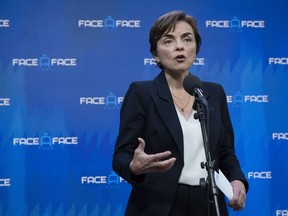
The first leaders’ debate, held last Tuesday on TVA, was particularly revealing in this regard. When asked about the need to reform the Quebec model so that taxpayers get more for their money, Fréchette avoided the question and took the opportunity to praise infrastructure investments to build new schools made by her government…
But perhaps the clearest sign of that shift is Fréchette’s new line of attack against the Parti Québécois. On Sunday, she accused PQ Leader Paul St-Pierre Plamondon of taking a “much more conservative” turn, pointing in particular to his proposals to encourage higher birth rates and shrink the size of government. She even went out of her way to say that the PQ’s new family policy was, in her view, “not progressive.”
There is something striking about that for anyone who remembers the CAQ before it came to power. Encouraging families to have more children, reducing the size of government, questioning the growth of the public service: none of these ideas are exactly foreign to the CAQ’s history. A few years ago, many of those themes would have fit naturally into a conversation among CAQ members or MNAs in a convention. But today, they are being used to define what the party wants to distance itself from.
The CAQ will face an important challenge after the Oct. 5 vote. A change in leadership may make it possible to turn the page on an unpopular track record, but it cannot, on its own, give a party a new purpose.
For a long time, the CAQ’s purpose was fairly easy to understand. It wanted to give families more choices, taxpayers more money, and offer nationalists an option that didn’t involve another referendum.
Eight years later, the CAQ now defends many of the institutions and practices it once sought to shake up. Perhaps this is simply what happens to a party after eight years in power. But if Christine Fréchette truly wants to turn a new page, she will eventually have to answer a question more fundamental than what to do with François Legault’s record.
If Legault’s legacy is to be erased and centre-right ideas are no longer embraced, how does the CAQ intend to define itself going forward?
Kevin Paquette is a consultant at Crestview Strategy. He was a political advisor to Quebec’s Minister of Public Security and president of the Coalition Avenir Québec’s youth wing.
Join the Conversation
This website uses cookies to personalize your content (including ads), and allows us to analyze our traffic. Read more about cookies here. By continuing to use our site, you agree to our Terms of Use and Privacy Policy.
KioskNews shows a cleaned-up reading view extracted from the publisher’s page — the original always lives on their site, not ours.