Martin Guerre review – return of Les Mis duo’s melodrama reveals a surprise new hero

Some revivals overstate their revisionism but Alain Boublil and Claude-Michel Schönberg’s musical, which premiered 16 years after their 1980 hit Les Misérables, has had a radical overhaul here.
The story, set in 16th-century France, has been restructured with new lyrics by Boublil, Annabel Mutale Reed and Paul Hodge and folkier orchestrations. It has been cut down to be performed in an hour and a half without an interval, on the floor of the theatre’s returning show, A Christmas Carol. A miniature Les Mis in spirit, it is filled with the same booming melodrama and preoccupations with crime and disguise.
Based on the real-life story of a Frenchman who fled his home after getting married and returned, years later, to face claims of deception and false identity, it keeps you guessing. There are similarities with the Austrian film Rose, selected for the London film festival, and Anjet Daanje’s novel The Remembered Soldier, published in English last year.
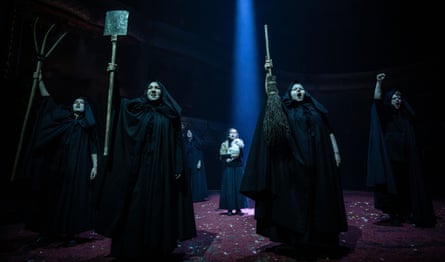
Among the twists and surprises, the real fireworks come from Matthew Warchus’s ingenuity as director. His in-the-round production creates intimacy between Martin and his wife, Bertrande (Liv Andrusier), but also brings a frothing sense of mob rule as the villagers brand her a witch and punish her for his desertion.
Warchus, as deft as he is, cannot override all the problems of the musical and the reworking feels simultaneously fast and slow, the sleeker shape bringing momentum but the songs – operatic, emotional, too tonally similar – slowing everything down again. At least the titular number is distinctive, swooping and swooning infectiously.
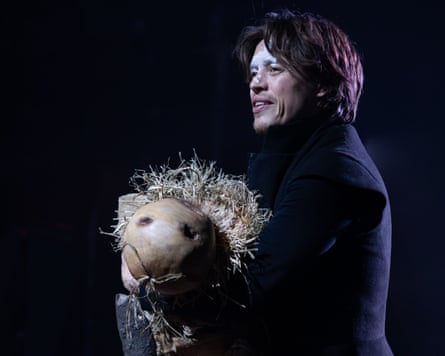
Perhaps the production could do more to flesh out the return of Martin. There are a few scenes from the intervening years, in which we see him take part in France’s religious war to fight the Protestant Huguenots. For these brilliantly quicksilver flashbacks, Rob Howell’s set design transforms from courtroom to battlefield and back so cleanly it leaves you gasping with admiration. But the context is bare-boned, the war vague, some characters indistinct. The village oddball, Benoit (Colin Ryan), carries a puppet representing the scarecrow Louison, an underexplained figure who may create confusion for those unfamiliar with the story. You want more of Guerre’s relationship with a fellow soldier too, which proves key within the deception.
It does develop an emotional pull as the plot speeds up and your sympathies lie with the man the town brands an impostor. There is a keen sense of Christian zeal about curses and demons, captured by Lizzi Gee’s choreography of a baying mob carrying weapons. The melodrama comes with the thunder and rumble of Fergus O’Hare’s sound design and blasts of sharply contrasting lighting, designed by Hugh Vanstone, Luca Panetta and Toby Ison.
The story’s restructuring has a curious outcome on character and the underlying protagonist becomes Guerre’s abandoned wife, who stands unerringly by him. Andrusier is such a powerful performer, her rendition of one of the show’s new songs, Someday, is a blast of such passion, that it is as if a new hero has arisen to take claim of this story.
KioskNews shows a cleaned-up reading view extracted from the publisher’s page — the original always lives on their site, not ours.