Property price dip could restrict Brisbane’s housing supply: minister
Slipping property prices could reduce the number of new homes built in Brisbane, Queensland’s housing minister has warned, echoing his leader’s criticism of federal Labor’s tax changes in the May budget.
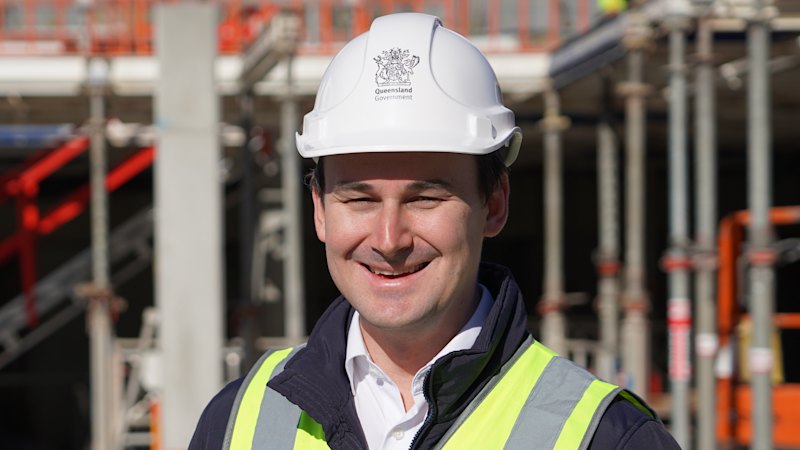
Speaking at the construction site for a new community development in Newmarket on Monday morning, the LNP’s Sam O’Connor pointed to increasing uncertainty in the property market.
“Nothing can be harder than what we inherited with the way construction sites were run across Queensland and the way that the CFMEU was behaving … but the Canberra chaos has certainly added to it,” he said.
“It’s the last thing that we need to see in a really difficult sector where there is such a high demand … the last thing you need to see is uncertainty and changes that really rattle investors.”
Asked if falling house prices after years of explosive growth in Brisbane would spook investors and result in fewer homes being built, O’Connor said he believed it would be a “particular factor” for apartment construction.
“It’s a factor … It is very expensive to build high rises at the moment. It is a very, very challenging environment to deliver density, so we are absolutely aware of that.”
Apartments are central to Brisbane City Council’s plan to increase housing supply in the city under its “tall-not-sprawl” policy, but economic factors have pushed many developers towards the luxury end of the market.
O’Connor declined to say whether lower house prices were ultimately a good thing for Queenslanders, but said the state government remained committed to its promise to deliver one million new homes by 2044 despite forecasting a building slump.
“The million homes target is ambitious, but we’re not shying away from being ambitious,” he said.
The comments came a day after Premier David Crisafulli took another shot at federal tax changes as he announced housing construction figures for the state, saying possible future declines in building rates would be the fault of Canberra.
“There’s no doubt that some of the changes out of Canberra [have] changed that trajectory, and I do believe that, into the future quarters, we are going to see that come off the boiler a little bit,” he said.
“I still believe that Queensland is in a better place than anywhere else.”
Dr Andrea Blake, a senior lecturer in property economics at QUT, said failures in the Brisbane property market were the result of a convergence of complex factors.
“I think that the changes to the tax structure will have long-term benefits of levelling out the housing market to allow greater accessibility by young people and first home buyers,” she said.
“There’s obviously a problem in the transition for investors because I think a lot of the incentives to invest in property have been taken away, and I think we need to remember that investors still make up a substantial portion of the investment stock.”
Blake added she believed a downturn in prices was largely driven by interest rates, and significant supply constraints would likely continue to push property values up across Brisbane in near term.
“I don’t see a way out of it in the next short while … we just don’t have enough skilled tradespeople and skilled labor to actually construct the stock that we need.
“I don’t see property as becoming affordable in Brisbane anytime soon.
“I’m not sure what will happen post-Olympics, but I think in the lead-up to the Olympics …. I don’t see it dropping to a point that it’s accessible.”
Start the day with a summary of the day’s most important and interesting stories, analysis and insights. Sign up for our Morning Edition newsletter.
KioskNews shows a cleaned-up reading view extracted from the publisher’s page — the original always lives on their site, not ours.