Danielle Smith’s dream: A post-uncertainty Alberta
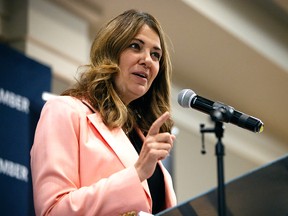
Premier Danielle Smith has taken plenty of flak for putting independence on Alberta’s Oct. 19 ballot. She has no regrets. She is betting the vote will show that support for a binding separation referendum is already losing steam.
Sign In or Create an Account
“This is what citizens wanted,” she said in a telephone interview. “Four hundred thousand signed a petition saying they wanted a vote to remain; 300,000 signed a petition saying they wanted to vote on an option to leave. And we have legislation that obligates us, if you get the required signatures, to put it to the people. So I want to see what Albertans have to say about it on October 19th.”
The first nine questions on the referendum are the government’s. The 10th, the remain-or-proceed question, is there because of that citizen-initiated process. More than 650,000 Albertans ordered special ballots, more than 10 times the usual provincial election volume. Smith reads that as engagement, not alarm. “People want to tell us what’s on their mind.” Those who requested mail ballots, she adds, “had more time to digest it and have a thoughtful response.”
Current polling puts remain at about 72 per cent and the option to start a binding process to separate at 22 per cent. “I’m glad to see that number has come down,” she says. “After Carney got elected, it was as high as 45 per cent. The fact that it has come down is a demonstration that both myself and the prime minister are working on the things that matter to people.” She would like the leave number to be zero; that would mean people feel like the country’s working.
She points to Stephen Harper’s recent Postmedia column: He wrote that separatist sentiment sat near 25 per cent after the Chrétien years, and by 2015 it was at “a big fat zero,” because Ottawa had dealt with the irritants the West actually cared about. The other spike came in 1982, when Albertans elected Gordon Kesler, a Western Canada Concept MLA; the momentum faded after Brian Mulroney arrived and the National Energy Program was dismantled.
“We have had separatism go down to single digits, or imperceptible. That really should be the target,” Smith says. “If people are feeling confident that their country is working for them, and that they’re a valued part of the country, I think that’s possible again. We’ve got more work to do, but that’s what I’m hoping for.” Many grievances have been addressed in the last 18 months, she said, and she’s identified a few more that require attention.
Quebec’s election makes the timing sharper. Paul St-Pierre Plamondon’s Parti Québécois won a minority on a promise of another independence referendum. Smith has not spoken to the premier-designate and expects the relationship to run formally, through the Council of the Federation and first ministers’ meetings. If she does get the call, one subject is ready: “I am greatly encouraged and enthusiastic to work with him on weaning Quebec off equalization payments. I’m very pleased to hear that he said that, because guess what, it’s a priority for Alberta.”
She is equally interested in another result: Éric Duhaime’s Conservatives took about 21 per cent of the vote and 19 seats, enough to matter in a minority legislature. “A party that got almost as much of the popular vote” as the winner, she says, “has some constructive things we can talk about together, and hopefully be able to focus on the economy.”
On Ottawa, she is more upbeat than her critics expect. Carney, she says, “is genuinely interested in bilateral agreements and finding out what the issues are in each province and working with each premier to address them. That is a refreshing change of pace. I think that’s the way our country was always intended to work.”
She is confident the Pacific Link pipeline, newly designated a project of national interest, will be built. From her perspective, Indigenous consultations are going well. “Part of our joint agreement to do the southern route was because we had fresh environmental reviews and fresh negotiations with First Nations.” She discounts advocacy groups “that are actually funded by American foundations.” The conversations that count, she says, are with “the real First Nations who are going to be getting real dividend cheques to address real priorities… I think that’s going quite well.”
She is also confident Alberta can now build a natural gas power industry that federal rules previously blocked. “The federal government heard our grievances, addressed them in a meaningful way and we’re beginning to see the outcome.”
But no one in Ottawa should relax; other irritants remain. The federal gun law, she warns, “is going to turn our citizens into criminals, unless they give an amnesty for those who currently own those firearms that they bought legally.”
Property rights are another. The Alberta Bill of Rights is the “highest law of the land in our province,” she asserts. “I know B.C. made a different choice about what the highest law of their land would be, but that’s part of the reason why you need these matters of property and civil rights to be determined by the provinces under the Constitution.”
Free speech is a third. Influencers are fielding calls from new federal agencies telling them they are being blocked. “I don’t think Albertans appreciate having a federal government leaning over their shoulder watching podcasts to see if they said something that’s going to hurt someone’s feelings.”
Immigration is next. Carney curtailed numbers, then began talking about raising them again. “He can’t do that without working with the provinces. We need to make sure that we’re getting economic migrants who have jobs in our economy, and the skills that we need. So I suspect there’s going to be some robust conversations after October 19th on that too.”
Smith intends to keep the pressure on long after the vote. Keeping the separation option alive as leverage is not the plan. She wants the referendum to deliver certainty: “I want businesses to have confidence when they invest in Alberta. I want when people move here to have confidence … they’re going to be able to put down roots and live here for decades and be able to have an excellent quality of life. That’s the kind of certainty that I’m looking for on October the 19th.”
A separatist party emerging from the result is a risk she acknowledges, then minimizes. “We’ve always had separatist parties.” More than one was on the ballot in the last provincial election. “There’s always been a place to put that vote, and it’s incumbent upon those of us in government to understand why.”
If the country has drained this sentiment before, she said, it can do it again. “If we’ve been there before, we can do it again.”
Our website is the place for the latest breaking news, exclusive scoops, longreads and provocative commentary. Please bookmark nationalpost.com and sign up for our newsletters here.
Join the Conversation
This website uses cookies to personalize your content (including ads), and allows us to analyze our traffic. Read more about cookies here. By continuing to use our site, you agree to our Terms of Use and Privacy Policy.
KioskNews shows a cleaned-up reading view extracted from the publisher’s page — the original always lives on their site, not ours.