In a shifting world order, will Korea be at the table, or on the menu?
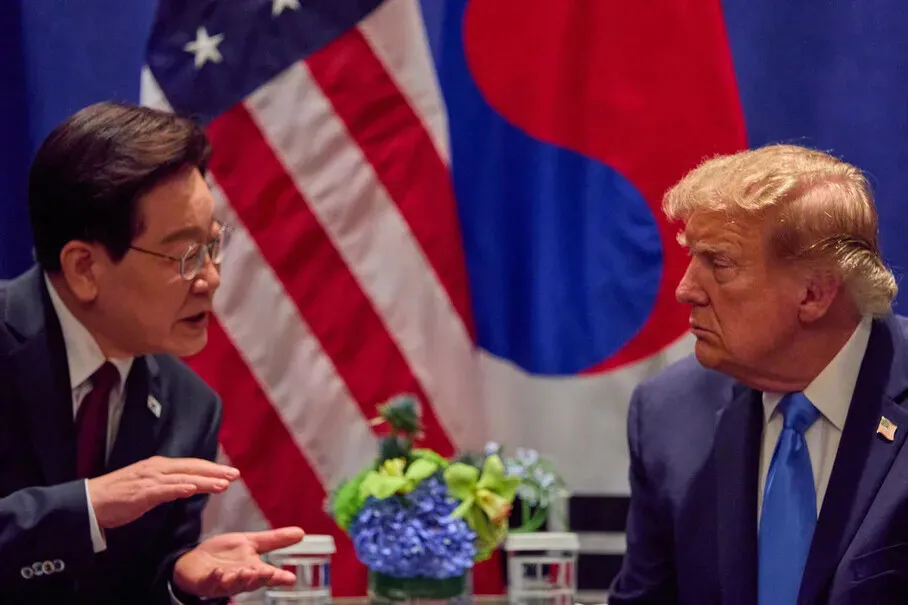
South Korean President Lee Jae Myung speaks to US President Donald Trump at a hotel in New York on Sept. 22, 2026. (pool photo)
In July 1905, Japanese Prime Minister Taro Katsura and US Secretary of War William Taft held secret talks in Tokyo. The result of the meeting was Washington’s recognition of Japanese control over the Korean Empire in return for Tokyo’s recognition of American rule over the Philippines.
Governed at the time by the Joseon dynasty, the Korean Peninsula had no seat at that conference table. Four months later, the Eulsa Treaty that stripped the country of its sovereignty was signed.
In January this year at the World Economic Forum in Switzerland, Canadian Prime Minister Mark Carney warned that “if we’re not at the table, then we’re on the menu,” referring to the harsh reality of the global order. His words still hold true today.
Russia’s invasion of Ukraine, America’s interventions in Venezuela and Iran alongside Washington’s bid to secure a military base and exclusive investment rights in Greenland, and Chinese ambitions to dominate the South China Sea and Taiwan are pushing the world into an era of survival of the fittest, where territory and advantages are seized through military force. So what does this mean for the world over the next decade or two?
Six worlds, two paths
Hal Brands, a professor of foreign policy at Johns Hopkins University, has classified the potential post-Trump world into three categories: a “two-worlds” scenario of Sino-US conflict reminiscent of the Cold War, with each side leading its own alliances; a “several empires” world where major powers divvy up spheres of influence; and a “self-help” world marked by Hobbesian chaos following the collapse of alliances.
Paradoxically, Brands called the two-worlds scenario the “best hope.” But the former diplomat Kurt Campbell, chairman of the Asia Group who led the Biden administration’s Indo-Pacific policy, and the Georgetown University professor Rush Doshi hold a different view.
They outlined five possibilities: global multipolarity, division into spheres of influence, a cooperative framework of a “great power concert,” partial Chinese eminence and a US-centered “allied scale.”
Campbell and Doshi said the partial Chinese eminence outcome is highly probable, as China has a manufacturing capacity double that of the US, an economy with 30% greater purchasing power and the world’s largest navy.
To reverse this trend, they proposed an allied scale strategy that harnesses the collective strength of the US and its allies. Combined, they possess a combined GDP, measured on a purchasing power parity basis, and military spending totaling more than double China’s, while accounting for half of global manufacturing.
Blending these two analyses yields six distinct worlds. In terms of the broader international order, they comprise a world of “everyone for themselves,” a division into spheres of influence and a cooperation framework among major powers. Centered on the Sino-US dynamic are the scenarios of Chinese partial eminence, a two-worlds system and a US-led bloc dominance based on the allied-scale strategy.
Based on the assumption that Chinese President Xi Jinping remains in power, the US has two possible paths. If a successor to US President Donald Trump aligned with the Make America Great Again movement maintains Trump’s transactional approach, this will effectively neutralize the alliance system. Amid a mix of divided spheres of influence and a world in which every country fends for itself, partial Chinese eminence could be the most probable outcome.
If a Democratic White House opts for a strategy centered on allied scale, this is highly likely to ignite a new Cold War, namely a confrontation between two sides of roughly equal strength under the two-worlds scenario. Should this strategy succeed and China be hobbled by excessive debt, low growth and a shrinking population, the US-led bloc could secure a decisive lead.
US-China: Lulled but continuing conflict
The US-China rivalry is not a sprint, but a closely contested battle marked by alternating periods of detente and confrontation. The series of Sino-US summits held in Busan (October last year), Beijing (May this year) and Washington (September) reflects a lull in tension.
The fragility of that foundation, however, was shown when the Sept. 24 summit resulted in only the extension of the trade war truce by two months. The period from next year to the early 2030s represents a window of vulnerability.
The US could face domestic political turmoil around the November midterms and the 2028 presidential election. Chinese President Xi Jinping’s longevity in power will be tested at the Chinese Communist Party’s congresses in 2027 and 2032.
While the US holds an economic edge, its military presence in Asia is less favorable. Washington needs three to five years to replenish its ammunition and missile stockpiles depleted by the war with Iran. In the interim, Beijing could test the US alliance system in the South China Sea and Taiwan, while Moscow could do so in Europe.
Another factor fueling uncertainty is that Trump, Xi and Russian leader Vladimir Putin all harbor expansionist ambitions.
The outlook is not bright for the next 20 years. The US and China have fallen deep into the Thucydides Trap, in which an established hegemonic power and an emerging one head toward conflict fueled by mutual distrust and fear.
The most likely scenario is that both superpowers get locked into a prolonged stalemate with neither achieving a decisive victory, with each side holding the advantage in specific domains and regions. This deadlock will not be a peaceful standoff, but rather an intense contest for hegemony with recurring lulls and clashes.
The strength of a superpower ultimately stems from economic and military might. Economically, the Sino-US competition in the 2030s will see China ahead in manufacturing and the US in artificial intelligence computing and finance, with the winner unlikely to emerge until the 2040s.
Militarily, American global dominance will persist into the 2030s but China could solidify a regional advantage in Asia. By the 2040s, the deciding factor will be the ability to translate economic and technological strength into military power.
Survival equation for Korea
In a world where the eagle (the US) and the dragon (China) clash while the bear (Russia) waits to pounce on an opening, the survival equation for Korea hinges on five variables: Survival Capacity = Chokepoints × Self-Reliance × De-Risking × Managed Coexistence × Solidarity Among Middle Powers.
The greater the value of each variable, the higher the survival capacity, but if even one collapses, the entire structure is shaken.
A chokepoint refers to a gateway or a critical asset indispensable to the global economy. A nation that controls such a commodity commands respect and can use it as a tool for its survival and prosperity. Korea’s chokepoints could include semiconductors, AI infrastructure, shipbuilding and nuclear plants.
The country’s memory semiconductors have shown their formidable strength. Samsung Electronics and SK Hynix control more than 80% of the global market for high-bandwidth memory. While Korea still lags behind when it comes to AI models, few countries match it in the expertise, power equipment and tacit manufacturing know-how required for AI infrastructure and applications.
Shipbuilding is a bottleneck in naval capacity that the US cannot overcome on its own, and American capacity in the construction and operation of nuclear power plants could also pose a similar obstacle.
But chokepoints alone are insufficient. As Korea’s US$350 billion investment in the US illustrates, a faltering empire first tends to prey on its allies. To leverage chokepoints into bargaining chips, a second variable is required: self-reliance.
Middle powers and smaller states are constantly haunted by the twin fears of abandonment and entanglement — being forsaken by allies or dragged into unwanted wars. Only with the strength to defend themselves can they avoid being left behind or forced into conflicts.
They must advance independent defense capabilities, secure the early transfer of wartime operational control and obtain the right to enrich uranium for civilian use.
Third, the core of de-risking lies in reducing Korea’s reliance on foreign sources for energy, raw materials and food. Last year, 70% of crude oil imports came from the Middle East, with the vast majority passing through the Strait of Hormuz.
Korea is also 100% dependent on foreign sources for lithium, nickel and cobalt, while its reliance on China for rare earth materials and components exceeds 90%.
Food is the most overlooked strategic variable. As of 2024, Korea’s self-sufficiency in this sector was 48%, while grain self-sufficiency, including grain used for animal feed, was just 22%.
As the 2021 crisis in diesel exhaust fluid showed, pressure begins with the most seemingly trivial items. Should a country get embroiled in a war, its first concern is having enough to feed its people.
Diversification of import sources, expansion of stockpiles and reinforcement of the domestic production base are all urgent tasks. The European Union is considering a limit on sourcing key components from one country to 30%-40%. Korea’s dependency must be reduced below this threshold to prevent coercion.
Fourth is managed coexistence between the US and China. The goal is neither to align with one side nor to walk a tightrope between them. Instead, the idea is to set clear principles while responding flexibly to each issue.
Korea must remain an ally of the US but without being subordinate to it. Demands for participation in conflicts must be met under the three principles: a basis in international law, a role limited to noncombat missions and legislative approval.
Exchanges with China must be maintained while preparing to withstand coercion driven by China’s dominance over supply chains. In periods of relative calm between Washington and Beijing, Seoul should expand the scope for exchange and cooperation and in times of confrontation, it must stand firm on its principles and weather the shock.
The final point is solidarity among middle powers. The eagle, dragon and bear might differ in their methods but can similarly show a predatory nature at any moment. A middle power coalition can act as a safety net to restrain such behavior. Member states must unite to prevent the US and China or the US and Russia from striking deals at the expense of middle and small countries and deciding their fates.
Carney, a proponent of a middle power coalition, said on Sept. 22 at the United Nations General Assembly in New York that such an alliance should be “formed around problems rather than geography or size.” Korea also needs to develop overlapping layers of issue-based solidarity with Europe, Japan, Canada and Australia.
In 1905, the Korean Empire had no chokepoints, self-reliance capacity, strategies for de-risking and coexistence, or allies to stand with. Consequently, the Korean Peninsula ended up as a bargaining chip in deals between global powers.
The situation in 2026 is different. The global AI industry cannot function without Korean memory chips, the US Navy’s modernization relies on Korean shipyards and Korea exports weapons to 16 countries.
But these assets are only a source of strength when Korea knows how to use them through self-reliance. The country must evolve into an indispensable nation regardless of whatever happens in the world, build the resilience to withstand even the worst-case scenarios, uphold its principles while navigating the space between two superpowers and move forward in solidarity with states facing similar circumstances.
Only then can Korea avoid ending up as an item on someone else’s dining table as it did 121 years ago, and instead take its rightful seat as a principal party to the negotiations.
KioskNews shows a cleaned-up reading view extracted from the publisher’s page — the original always lives on their site, not ours.