Katie Zacharia and Mao Ning – a study in contrasts in US and China media strategies
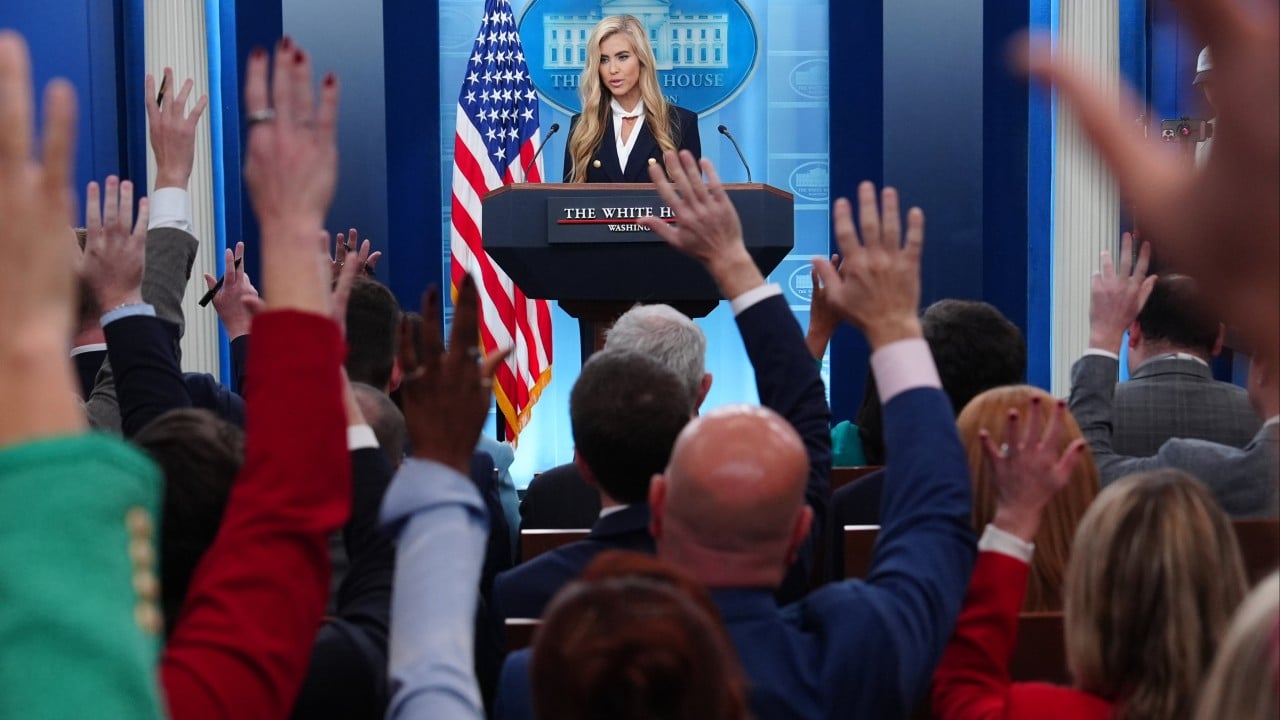
Like Mao, Zacharia was – if only for less than a week – the highly visible public face of her government, speaking on issues that could shape how her country was perceived.
But Mao and Zacharia are the products of vastly different systems and took contrasting paths to the podium, using very different ways to tell two very different stories.
Worlds apart
Zacharia’s debut – and final – official White House briefing lasted fewer than 15 minutes on Tuesday, with much of her presentation delivered from a prepared script.
By then, questions had surfaced about her legal credentials after she had presented herself as a lawyer in media appearances.
According to her LinkedIn profile, Zacharia worked as an associate at Zhong Lun Law Firm, one of China’s biggest, in Beijing from 2011 to 2013.
Before joining the White House, she was a frequent commentator on conservative networks Fox News and Newsmax, where she defended US President Donald Trump and his agenda. She had also briefly held a communications role at the Department of Homeland Security.
01:42
Trump’s new press secretary Katie Zacharia raises eyebrows over legal credentials
As she stepped into one of the most visible communications positions in the US government, Zacharia found herself becoming the story.
Asked about her legal credentials, she said she had received them “when I moved to China”, before later saying she had misheard the question.
SCMP Plus is a new premium news platform that gives you an
all-inclusive edge to stay ahead on China news.
To access our exclusive content you’ll need to subscribe.
Already a subscriber?
LOG IN
By the weekend, she was no longer in the White House job.
In China’s foreign ministry spokesperson system, officials generally have extensive diplomatic experience and undergo substantial preparation before taking on the position.
Another difference is in the scope of their roles.
A foreign ministry spokesperson is among the Chinese government’s most prominent and regular public-facing representatives, communicating Beijing’s positions on diplomacy and international affairs.
By contrast, the White House press secretary’s responsibilities extend beyond explaining domestic and foreign policy.
As a presidential appointee, the spokesperson is also expected to defend the president’s agenda and respond to political criticism on their behalf.
Zacharia was appointed to the role just three weeks before the midterm elections, at a politically sensitive time with Trump’s approval ratings at near-record lows. Her debut briefing on October 13 combined praise for Trump and his “America first” agenda, taking questions from just three reporters before wrapping up.
She left a question about Ukraine unanswered, saying she would have to return to it, prompting further doubts about her readiness for the position.
Her predecessor, Karoline Leavitt, had also used her first briefing to frame a major development involving China through the lens of US domestic politics.
Describing the emergence of Chinese artificial intelligence (AI) company DeepSeek as a “wake-up call” for the US AI industry, she blamed the previous Joe Biden administration for allowing China to develop the technology so rapidly.
Different paths
China’s foreign ministry formally established its spokesperson system in March 1983, during the country’s reform and opening-up drive.
A year earlier, Qian Qichen had held what is regarded as the ministry’s first press conference. He later rose through the diplomatic ranks to become foreign minister and vice-premier.
The ministry’s spokespersons are career diplomats who typically gather years of experience in foreign affairs before taking on the high-profile role.
01:26
Trump’s Golden Dome shows US ‘obsessed with absolute security’, China says
Mao became the ministry’s 33rd spokesperson in September 2022 and was appointed director general of its information department in January 2025.
Before taking on the chief spokesperson role, Mao had spent more than 27 years in diplomatic service, focusing mainly on Asian affairs. She had also briefly served in a local government position as deputy mayor in 2020.
Qin Gang, who was later removed from office, also served two stints as a ministry spokesman before rising to become foreign minister in 2022.
By contrast, White House press secretaries often come from political communications, campaign work or media backgrounds.
Leavitt, for example, worked in Trump’s first administration, served as communications director for Republican congresswoman Elise Stefanik and was national press secretary for Trump’s 2024 presidential campaign before taking the White House job in January 2025.
The contrast reflects the different institutional functions of the two positions.
The White House press secretary speaks mainly for the president and his administration, defending its policies while responding to domestic political scrutiny.
China’s foreign ministry spokesperson, by comparison, communicates the government’s positions on international affairs through regular briefings, which have been held each weekday since 2011.
Method and manner
For Beijing, public communication is part of a broader effort to shape how China is understood abroad, with the foreign ministry enlisted to “tell China’s story well”.
To this end, Chinese spokespersons’ comments are measured and carefully scripted, sometimes using subtle and indirect language.
A 2022 commentary in Shanghai news outlet The Paper defended this style of communication as a strategic buffer, saying that avoiding definitive statements left room for manoeuvre without boxing officials into a position that could prove difficult to defend.
That is poles apart from the more combative style associated with some US White House press secretaries. Leavitt, for instance, became known for her sharp retorts and rapid-fire responses, which also won praise from some Chinese social media users impressed by her verbal agility. Her language was direct and combative, consistent with the political messaging that had defined her work on Trump’s campaign.
But the Chinese spokesperson is usually more measured – something Mao in particular is known for.
Nevertheless, China’s roster of spokespeople has also included more controversial figures, most notably Zhao Lijian, who became a prominent face of the Wolf Warrior style of diplomacy.
The style, named after a Chinese nationalist action-film franchise, is commonly used to describe an assertive and confrontational approach to defending China’s interests and responding to foreign criticism.
Critics argue that such confrontational messaging risks damaging China’s diplomatic relationships, while supporters see it as a forceful response to Western criticism.
KioskNews shows a cleaned-up reading view extracted from the publisher’s page — the original always lives on their site, not ours.