Israel Election: 4 Possible Scenarios That Can Decide Who Leads Country Next
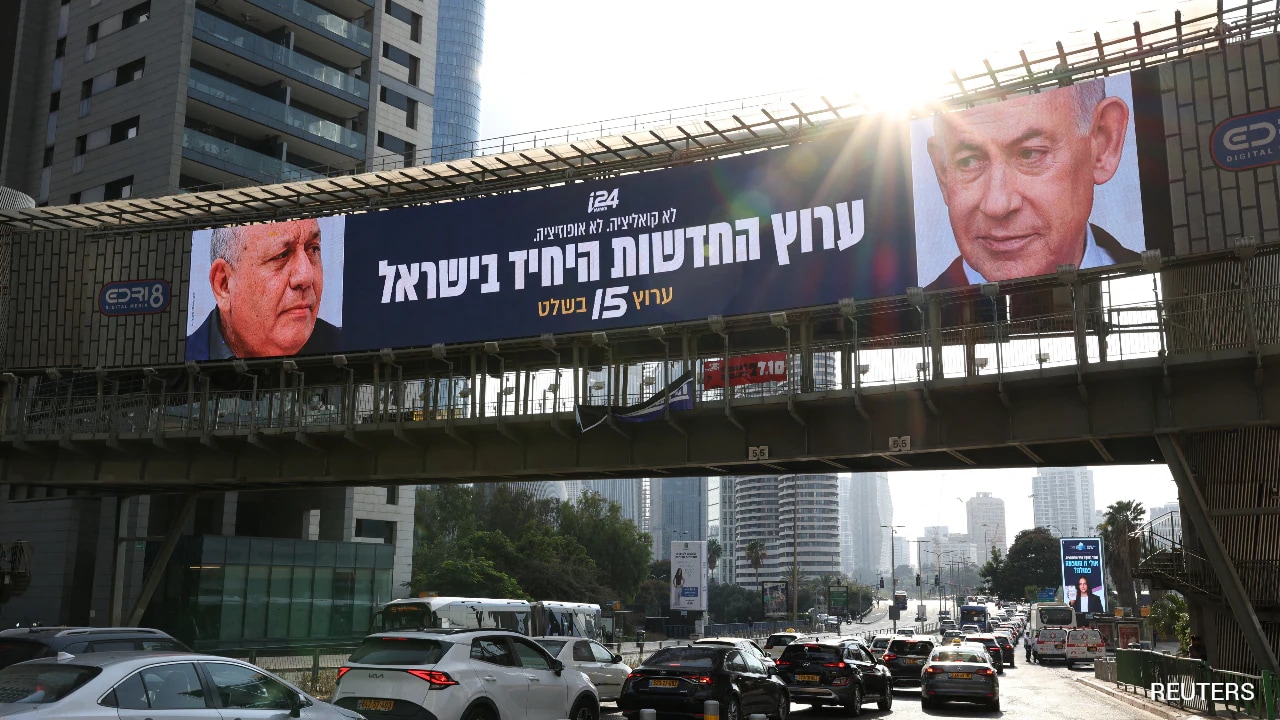
The people of Israel are set to vote on October 27 in the country's first national election since the Hamas-led attack on October 7, 2023, and Benjamin Netanyahu's war on Gaza. The election comes at a time when the country is divided over the Prime Minister's leadership.
Winning the most votes may not be enough to become prime minister. Israel's Parliament has 120 seats. A party or alliance needs at least 61 seats to form a government with a majority. Neither Netanyahu nor his main challenger, former military chief Gadi Eisenkot, is expected to win enough seats on their own, according to opinion polls.
Both leaders will need the support of smaller parties to form a government. Here are four possible outcomes of the election.
One possibility is that Eisenkot joins hands with other parties that want to remove Netanyahu from power. These parties include politicians from the centre, the left and the right. Although they disagree on several issues, they all want to end Netanyahu's rule, according to the NY Times.
However, such an alliance may not be easy as the parties would need to agree on who becomes prime minister and what policies the government should follow.
The second possibility is that Netanyahu and his allies win enough seats to form a government without depending on opposition parties.
A third possibility is a political deadlock, in which neither Netanyahu's alliance nor the opposition gets the 61 seats needed to form a government.
Even if the opposition wins more seats, its parties may not agree to work together. Some right-wing parties may refuse to cooperate with Arab parties, while others may disagree over who should become prime minister. The country held five elections between 2019 and 2022 as parties struggled to agree on a government.
The fourth possibility is a minority government, which would take office without having the support of at least 61 lawmakers through its governing alliance.
In such a situation, Eisenkot or another opposition leader could try to form a government with support from Arab parties without officially including them in the coalition.
Once the votes are counted, Israeli President Isaac Herzog will meet political party leaders and ask them whom they support to lead the next government. He will then choose the candidate he believes has the best chance of forming a coalition.
The chosen candidate will have to hold talks with other parties and gather enough support to form a government. These discussions could take weeks or even months.
KioskNews shows a cleaned-up reading view extracted from the publisher’s page — the original always lives on their site, not ours.