Hong Kong vs Singapore in tackling bad behaviour
Singapore is doing something about uncivilised behaviour on public buses. The city state has started enforcing new regulations that carry an immediate fine of up to S$500 (US$390) if you put your feet up on seats, play loud audio on your phone or make a nuisance of yourself in other ways such as eating, drinking and littering.
Did you know we have long had similar regulations for Hong Kong’s MTR network under its own by-laws? Probably not, because nobody cares, but they do exist.
For instance, playing audio loudly on trains is punishable by a fine of up to HK$2,000 (US$250). The same penalty applies for uncouth behaviour such as placing your feet on seats and for ignoring eating or drinking bans.
Not only that, using profanity and language deemed offensive carries a fine of HK$5,000. If the MTR actually enforced this particular by-law, it would collect a revenue bonanza.
Rushing the train doors when they’re already closing, with the warning beeps going off, should earn you a penalty of HK$2,000 as well. It should but it won’t because the difference between Hong Kong and Singapore is that many of these rules are just there for lip service. Nobody bothers to follow or enforce them in one jurisdiction, while they are taken more seriously in the other.
05:13
A behind-the-scenes look at Hong Kong’s MTR, the city’s transport lifeline
You can resurrect the usual tropes about personal freedoms and repression in this comparison, in which we’re somehow supposed to take comfort in the assumption that at least it feels less controlling here than in Singapore. But if it’s about curtailing the freedom to behave badly in public and shared spaces, then bring on that Singaporean-style repression.
There is the concept of liberty, which is the freedom to act responsibly within an accepted legal and social framework without being a nuisance to others. Then there is licence, which is the entitlement to do whatever you want with zero regard for societal norms and the rights of others around you.
Millions of people in this city can’t be bothered with basic courtesy and social graces. These include holding the door open for someone right behind you, resisting the urge to furiously jab the “close door” button to deny someone entry into a lift even as you’re making eye contact, waiting for people to alight first before storming onto trains and many other daily acts of incivility and social ineptitude.
There is a lot of pent-up rage out there. This is reflected in a whole lot of honking in Hong Kong as rude and impatient drivers blast perceived irritants such as fellow motorists slowing down or getting stuck in front of them, children, cardboard-collecting grannies and even wheelchair users who fail to get out of their way in time.
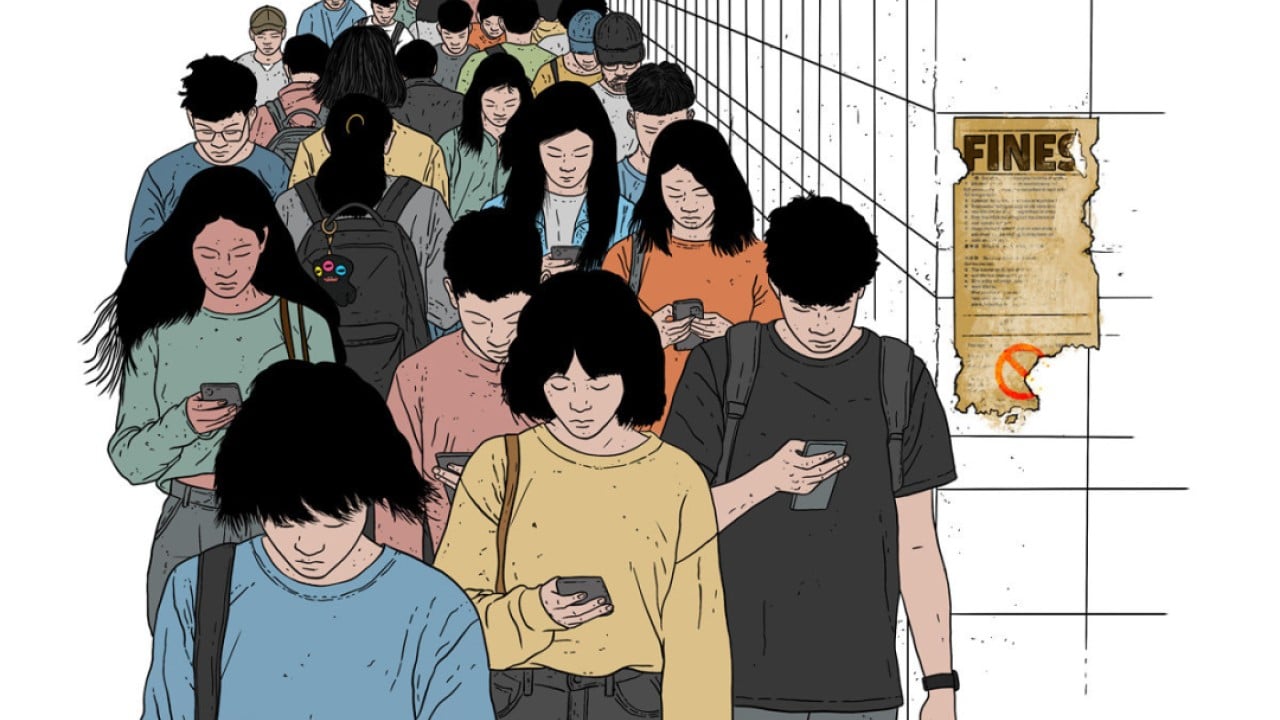
Also in their way, as well as everyone else’s, are the mobile phone zombies. These people have their noses buried in their electronic pacifier while sauntering along the most crowded streets and walkways in the world with infuriating apathy and total disregard for the natural flow of human traffic.
The cocooned self-indulgence of these sidewalk narcissists and human roadblocks everywhere we go is as exhausting in its nonchalance as it is frustrating in its main-character syndrome. They expect the entire sea of humanity to conveniently part and warp around their immovable bodies like ignorable background noise.
02:16
Video of Hong Kong hedge fund manager wiping ‘licked’ finger on MTR handrail outrages internet
This is not a problem unique to Hong Kong, but there is a difference that makes it all the more egregious here. While most of the world measures population density per square kilometre, Hong Kong’s 7.5 million residents are crammed into just 25 per cent of its total land area – the rest is uninhabitable or designated as protected areas and country parks.
That means when we talk in terms of volumetric hyper-density – how people actually fit into public space – we are in a different league. Vertical urbanism accommodates us, but when we pour out of our anthills to go about our daily business on the ground, the congestion is next-level.
On the streets of Mong Kok, for example, academic studies have shown that the population density can be up to 600,000 people per square kilometre, even though the figure for the wider district is 130,000 people, which is still one for the record books.
On an average footbridge or elevated walkway in Mong Kok, density can be up to 3.5 people per square metre. This is insane, and it is also why people who make it worse should not be dismissed as harmless manifestations of first-world problems. These miscreants with mobile phones are directly and constantly escalating stress levels in an already high-strung society.
Why can’t we have a law against it, just like we have one penalising the misuse of mobile phones while driving?
Should you feel the urge to pause in mid-stride to check your phone while walking elbow-to-elbow with 1,000 fellow humans at any given time, pull over to the side and get your dose of instant gratification without obstructing the rest of us.
If that sounds unrealistic, remember that people said something similar about banning smoking in public spaces some decades ago. Look how we pressed ahead with it and prospered.
Comparisons to Singapore bring to mind what the late Lee Kuan Yew said when he was accused of infringing on personal liberties by micromanaging public behaviour: “I say without the slightest remorse, that we wouldn’t be here, we would not have made economic progress, if we had not intervened on very personal matters – who your neighbour is, how you live, the noise you make, how you spit, or what language you use. We decide what is right. Never mind what people think.”
What a splendid man, unafraid and unapologetic about putting facts before feelings to get things done for the greater good. And what a pleasing thought, imagining what he would have done about the mobile phone menace if he were still around today.
Sure, pearls would be clutched and token noises sounded, but most of us would appreciate the net improvement in the quality of life. I’m not advocating the introduction of caning in Hong Kong, mind you, but perhaps a bit of a spanking is long overdue.
KioskNews shows a cleaned-up reading view extracted from the publisher’s page — the original always lives on their site, not ours.