China’s leader Xi pushes Trump to ‘oppose’ Taiwan independence during U.S. visit
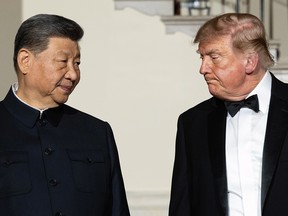
Chinese leader Xi Jinping pressed the U.S. to outright “oppose” Taiwan independence, marking his first public call for Donald Trump to change Washington’s decades-old stance on the self-ruled island.
Sign In or Create an Account
During their inaugural White House summit on Thursday, Xi urged the U.S. leader to “adhere to the correct position of opposing Taiwan independence,” according to the official Xinhua News Agency. Washington has long maintained it “doesn’t support” the independence of Taiwan, the island Beijing claims as its own.
Since coming to power in 2012, Xi has made bringing Taiwan under China’s control a key goal and vowed to achieve it someday, by force if necessary. As the Chinese leader heads toward an expected fourth term in office, he’s ramping up diplomatic pressure to isolate the democratic chip hub and block future weapons sales from Washington.

Get a dash of perspective along with the trending news of the day in a very readable format.
By signing up you consent to receive the above newsletter from Postmedia Network Inc.
A welcome email is on its way. If you don't see it, please check your junk folder.
The next issue of NP Posted will soon be in your inbox.
We encountered an issue signing you up. Please try again
The U.S. still hasn’t released a readout from the meeting, which lasted less than two hours, meaning it isn’t clear how Trump responded to Xi’s request. China privately asked the Trump administration to declare it “opposes” Taiwan independence back in 2025, a person familiar with the matter said at the time.
The White House didn’t respond to a request for comment.
“While this may appear a semantic shift, the impact would be meaningful,” said Bloomberg Economics’ Jennifer Welch, who served as director for China and Taiwan on the National Security Council under the previous Biden and Trump administrations.
China would use any switch in language from Trump to undermine Taiwan’s confidence in U.S. support, she added. “Opposing Taiwan independence implies an active effort to contain what Beijing sees as pro-independence forces,” Welch said.
Trump has already delayed a planned US$14 billion arms package for Taiwan for months. After his last meeting with Xi in Beijing, Trump described that deal as “a very good negotiating chip” for the U.S. — remarks that rattled Taipei. Any change in wording would fan concerns that Washington’s position on the democracy of 23 million people is becoming a bargaining chip in U.S.-China ties.
Xi has rarely made such an explicit call to an American leader. The last time came in November 2024, when he told outgoing President Joe Biden if the U.S. wanted peace it should “oppose Taiwan independence,” during their final face-to-face.
Chinese state media released Xi’s remarks on Taiwan hours before its full readout on Thursday, throwing a spotlight on Beijing’s top red line issue. That followed a similar pattern to the last Trump-Xi summit in May, when China warned mishandling the Taiwan issue could lead to “clashes ” between the superpowers in a statement issued while talks were ongoing.
Xi entered his first state visit to America in 11 years emboldened after last year exposing U.S. reliance on China’s rare earths, a move that enabled Beijing to push back against Trump’s triple-digit tariffs. Those minerals are critical for making everything from missiles to mobile phones and have been key in keeping a lid on further U.S. export controls.
Trump has given Xi an unprecedented welcome, becoming the first U.S. president to greet a Chinese counterpart on the tarmac. Tonight, the Republic leader will host his second state dinner of this term for Xi — one of America’s biggest economic and military rivals.
Trump’s comments on Taiwan have marked a departure from Biden, who claimed he’d defend the island from any invasion by China. The Republican leader has urged officials in Taipei to step up their ability to defend themselves.
Handling the Taiwan question with prudence will “lay a solid foundation for strategic cooperation between China and the U.S.,” Xi said on Thursday.
Ryan Hass, director of the China Center at the Brookings Institution in Washington, said Xi was trying to link the concept of “constructive strategic stability” to opposing Taiwan independence. That slogan was unveiled by Chinese officials at the leaders’ summit in May to define a new era in ties.
“The key acid test will be what Trump says on Taiwan,” Hass added. “Not just what Xi urges Trump to endorse.”
Our website is the place for the latest breaking news, exclusive scoops, longreads and provocative commentary. Please bookmark nationalpost.com and sign up for our daily newsletter, Posted, here.
Join the Conversation
This website uses cookies to personalize your content (including ads), and allows us to analyze our traffic. Read more about cookies here. By continuing to use our site, you agree to our Terms of Use and Privacy Policy.
KioskNews shows a cleaned-up reading view extracted from the publisher’s page — the original always lives on their site, not ours.