MAP: Vacant barangay, SK posts after 2023 polls
Already have Rappler+?
to listen to groundbreaking journalism.
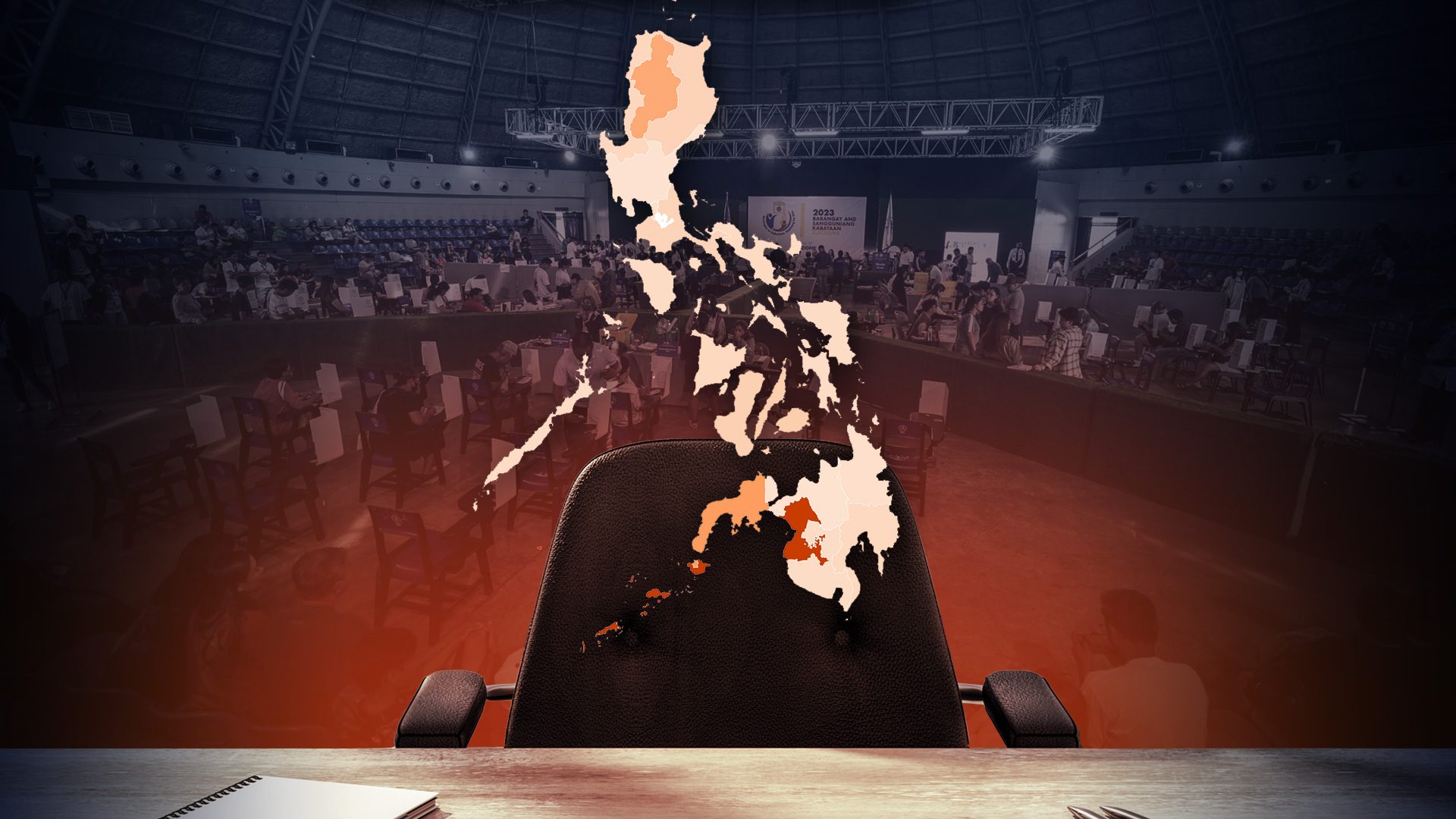
Quezon City cast their votes for the barangay and Sangguniang Kabataan elections at the Skydome voting precinct at North Edsa in Quezon City on October 30, 2023. The Commission on Elections authorized some voting precincts to hold polling at malls and other venues to help decongest crowding in public schools.
Photo by Jire Carreon/Rappler, graphic by Nico Villarete
There are currently 73,731 seats vacant as of September 29. With the postponement of the next election to 2028, these seats will either remain empty for two more years or be filled by mayoral appointees.
AT A GLANCE
- The barangay and Sangguniang Kabataan elections have been postponed to 2028, leaving 73,731 seats vacant since the 2023 elections due to resignations, deaths, removals, or absences.
- The Bangsamoro Autonomous Region in Muslim Mindanao has the highest vacancy rate at 46.54%, with most empty seats being from SK councils, which make up 77.21% of the total vacancies.
- Vacant seats can be filled through special elections, mayoral appointments, or during Katipunan ng Kabataan assemblies, but past attempts at special elections have faced delays, and assemblies often fail to convene as required.
This is AI-generated. Read the article for full context. Report any errors.
The barangay and Sangguniang Kabataan elections (BSKE) were again postponed to 2028. What happens to the thousands of seats that have been vacant since the 2023 elections?
According to data from the Department of the Interior and Local Government (DILG), there are 73,731 seats vacant as of September 29. The officials who filled these seats were elected in 2023 but have either resigned, died, been removed from office, or been absent without leave during their term.
Now, nearly 9% of the 840,200 barangay and SK positions nationwide are empty. They will remain so for two more years, unless local chief executives appoint new officials to fill the gaps.
But such appointments would again deprive voters of their right to choose their public officials. That means millions of Filipinos — especially in regions where the concentration of empty seats is relatively high — will either be left without elected barangay and SK officials or have no say in who leads them.
Here’s a map showing which regions have the most vacancies.
Which region has the most vacancies?
The Bangsamoro Autonomous Region in Muslim Mindanao (BARMM) has the most vacancies, with nearly half or 46.54% of all its barangay and SK seats empty.
The region has had a long and bloody history of electoral violence. The Peace Research Institute Frankfurt said such incidents were particularly prevalent at the barangay level. Even before it became the BARMM in 2019, it was standard practice in the region to “negotiate” the elections as a way to avert violence stemming from heated political rivalries between clans, according to a 2013 VERA Files report.
The BARMM has low literacy rates, too, which the Asian Network for Free Elections said remain a challenge for voter education and knowledge of the electoral process at large.
Behind BARMM in most vacancies is the Zamboanga Peninsula, with 21.08% of seats empty, and Cordillera Administrative Region at 18.23%.
Which positions have been impacted the most?
Most of the empty seats are from the SK councils, making up 77.21% of the 73,731 vacancies. The percentages of vacancies within each position also show that positions lower than the SK chairperson usually reported the most empty seats in these youth councils.
And with the polls postponed to 2028, these numbers can only be expected to grow.
“If they’re not planning to serve as public officials for the rest of their lives, and they see their SK term as just a stepping stone to another section of their career, then most probably we’ll see a good number of SK officials retiring,” Ona Caritos, executive director of election watchdog Legal Network for Truthful Elections, told Rappler.
“Because two years is two years — it’s not 6 months…. It’s a long time for a young person or a young individual to wait and delay his life plans yet again just for the barangay.”
What happens to vacant seats?
While vacancies in barangay positions are always filled by way of succession or mayoral appointment, empty SK seats can be handled in three different ways.
Special elections are the preferred mode of filling these vacancies. But a 2024 DILG circular says officers-in-charge can also be appointed by the mayor, or they can be elected during a Katipunan ng Kabataan (KK) Assembly, which is a gathering of all registered youth voters in a barangay.
But past attempts at special elections have often been deferred or suspended usually due to funding problems. Appointments are also frowned upon because they take away the voters’ opportunity to choose their own leaders.
An election during a KK Assembly is the remaining alternative. But these assemblies have long been criticized for failing to convene even when past laws had required them to meet at a frequency of four times a year.
The SK Reform Act only requires the assembly to meet at least once every six months, though it can be called earlier by the SK chairperson or through a written petition.
As a result, issues in filling these vacant seats have also been present in previous BSKEs.
The DILG does not have data on how long the seats for the current batch of officials have been vacant, Jhona Cabading of the DILG’s National Barangay Operations Office told Rappler. But the recent BSKE postponement only stands to make the issue of these vacancies worse. – Rappler.com
KioskNews shows a cleaned-up reading view extracted from the publisher’s page — the original always lives on their site, not ours.