US Navy launches drone command that could reshape Taiwan war planning
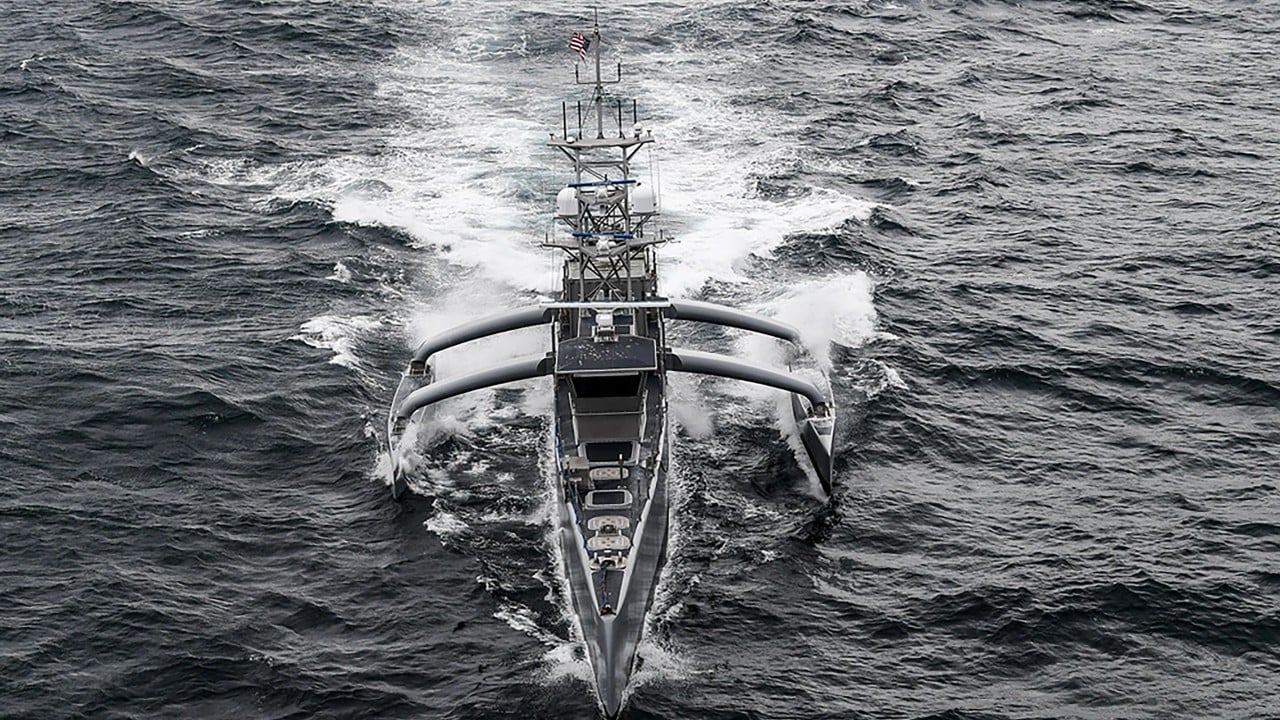
The US Navy has set up a dedicated command to turn its growing array of aerial, surface and underwater drones into an integrated fighting force – a capability US commanders have linked to disrupting a PLA attack on Taiwan.
The Robotic and Autonomous Systems Warfighting Development Centre, formally established on September 24 in Virginia, will develop doctrine and tactics for unmanned systems, train sailors to use them, and test whether they can keep operating under realistic conditions.
In a message marking the centre’s launch, Chief of Naval Operations Admiral Daryl Caudle said the navy had spent years developing and testing robotic systems, but much of that work had taken place separately across different warfighting domains.
“The next step is integration,” he said, adding that proving an individual system worked was not enough. “A prototype is not combat power.”
The gap between successful prototypes and a force able to use them at scale was also showing up in how the navy managed the programmes.
In June, the US Government Accountability Office found that robotic and autonomous systems remained divided by platform and operating environment, with unclear responsibilities and inconsistent leadership slowing progress. It recommended organising them as a “portfolio” to meet the navy’s objectives “across warfighting domains”.
The new centre is intended to address the operational side of that problem: how different unmanned systems should work together and be commanded, as well as how they should operate alongside conventional warships, submarines and aircraft.
Michael Bosack, head of the Parley Policy Institute, said the significance of the centre lay in its “centralisation and institutionalisation”, providing a hub to bring different efforts together and commit resources to a longer-term mission.
Peter Jones, a retired Royal Australian Navy vice-admiral and adjunct professor with the Naval Studies Group at UNSW Canberra, said the move partly followed Ukraine’s decision to create a separate branch of the armed forces dedicated specifically to unmanned systems.
He noted that bringing unmanned systems under one command could help transfer technology and lessons, simplify component supply chains, and give the navy a flag officer who could act as a “champion” for uncrewed system development and applications.
Despite these potential advantages, Bosack said the practical hurdles facing the new centre ranged from managing the frequency spectrum to adapting personnel to new systems and incorporating the capabilities into operational planning, decision-making and execution.
The organisation’s first commander, Rear Admiral Melvin Smith, said the centre would bring together the navy’s work on unmanned systems and develop combined tactics.
SCMP Plus is a new premium news platform that gives you an
all-inclusive edge to stay ahead on China news.
To access our exclusive content you’ll need to subscribe.
Already a subscriber?
LOG IN
“This is just day one,” he said. The navy has not announced when the centre will become fully operational.
One potential application of such an integrated force is a Taiwan contingency. US naval leaders have pointed to the “hellscape” concept as one possible model. The idea is to coordinate large numbers of unmanned systems to disrupt or slow a People’s Liberation Army amphibious assault across the Taiwan Strait. Admiral Samuel Paparo, now commander of the US Pacific Command, publicly outlined the concept in 2024.
This is part of a wider US push that includes the Pentagon’s Replicator initiative. Launched in 2023, it aims to field thousands of relatively low-cost autonomous systems across multiple domains to counter Beijing’s military build-up.
Jones said an inherent advantage of uncrewed systems was that they could be fielded in large numbers, which could make them a major source of casualties among invading forces.
But Caudle acknowledged in February that the navy had not yet worked out how such an unmanned force should be organised and commanded. He said commanders might ultimately need “packages” of unmanned capabilities to achieve specific mission outcomes.
Another challenge is keeping such a force operating when an adversary jams or disrupts its communications.
That is why the new centre will also test unmanned systems against realistic threats and in conditions where communications are degraded or denied.
This issue is not unique to the US Navy. Chinese military planners are also focusing on integrating unmanned forces with the wider force under heavy electromagnetic interference.
Beijing’s five-year plan covering 2026-2030 calls for faster development of “unmanned intelligent combat forces” and counter-drone capabilities, closer integration of combat systems and more realistic military training.
PLA Daily, the Chinese military’s official newspaper, reported in June that unmanned warfare required changes in technology, doctrine, organisation and command, with greater emphasis on manned-unmanned teaming and testing under electronic interference and cyberattack.
The Chinese navy is already testing elements of that approach. In a report published on September 21, PLA Daily said a special mission aircraft and several drones had linked up over the sea and exchanged information in real time. When simulated electronic interference disrupted the network, the force adjusted its communications and continued the exercise.
Bosack said the exercises were useful for stress testing systems and collecting data while reducing the risk of losing or damaging equipment.
He warned, however, that this was ultimately “different from having to learn and adapt under dynamic, real-world circumstances”.
KioskNews shows a cleaned-up reading view extracted from the publisher’s page — the original always lives on their site, not ours.