Houthis’ flagrant attacks on Saudi Arabia must be condemned globally — Phar Kim Beng
OCTOBER 12 — The repeated attacks by Yemen’s Houthis against Saudi Arabia have reached a dangerous threshold. They are no longer merely episodes in a prolonged regional conflict.
They represent a systematic assault on the sovereignty, economic security and civilian infrastructure of a country whose stability is indispensable to the Middle East and the wider international economy.
The deadly attack on King Khalid International Airport in Riyadh on October 10, which killed at least 12 people and injured more than 300, followed by another fatal attack the next day, demonstrates the gravity of the situation.
Such attacks must be condemned globally, unequivocally and without political qualifications.
Saudi Arabia is not merely another state caught in the crossfire of West Asian instability.
It is the custodian of Islam’s two holiest cities, a leading energy producer, an increasingly important diplomatic actor and a central pillar of regional economic stability.
Any sustained campaign to undermine its security carries consequences far beyond the Arabian Peninsula.
The Houthis, formally known as Ansar Allah, have developed formidable capabilities in asymmetric warfare.
Their experience in Yemen’s mountainous terrain, combined with access to increasingly sophisticated missiles and drones, has enabled them to challenge a state equipped with some of the world’s most advanced defensive systems.
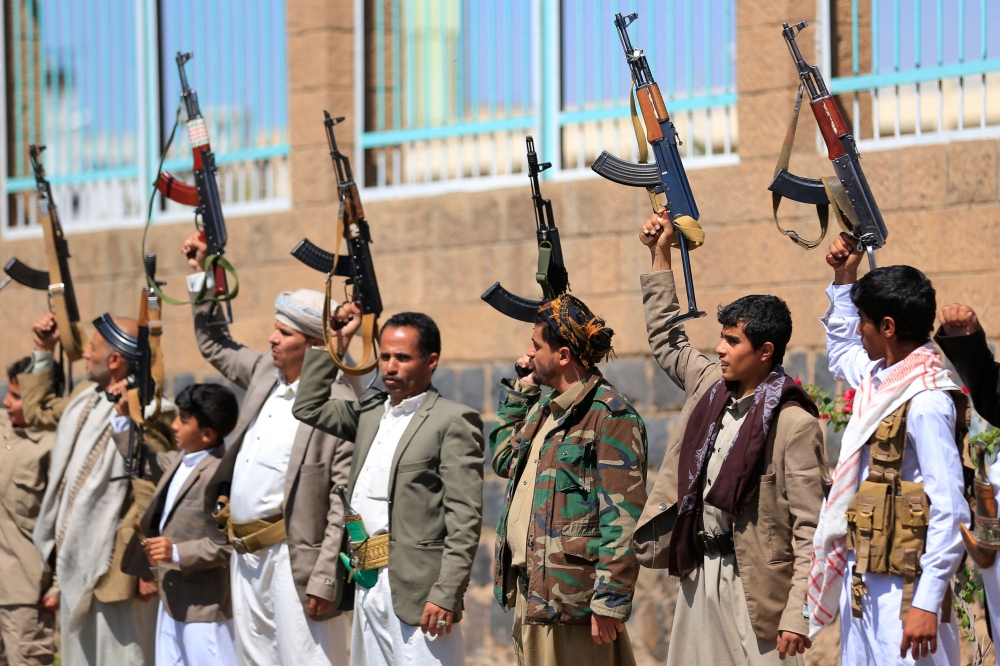
Fighters loyal to the Houthi authorities, take part in a rally to recruit more fighters, in Sanaa October 7, 2026. — AFP pic
Yet military ingenuity does not confer political legitimacy.
Attacking civilian airports, threatening commercial aviation and repeatedly striking energy infrastructure cannot be justified by invoking grievances arising from Yemen’s prolonged civil war.
International humanitarian law requires all parties to distinguish between military objectives and civilians. The same standards must apply to Saudi military operations in Yemen.
Civilian suffering on either side cannot legitimise further indiscriminate violence.
The inability of Saudi Arabia to intercept every incoming missile or drone should not be misconstrued as evidence of military weakness.
Saudi Arabia covers approximately 2.2 million square kilometres.
Defending its airports, oil installations, military facilities, urban centres and religious sites simultaneously requires enormous resources.
Even advanced Patriot and Terminal High Altitude Area Defence systems cannot guarantee an impermeable defensive shield.
The Houthis understand this strategic asymmetry.
They need only occasional successful strikes to inflict disproportionate economic and psychological damage.
This is precisely why their attacks are particularly dangerous.
The cumulative consequences can undermine investor confidence, disrupt aviation, increase insurance costs and jeopardise the economic diversification envisaged under Saudi Vision 2030.
More importantly, the Houthis are threatening an already fragile international energy system.
The Strait of Hormuz and Bab el-Mandeb are among the world’s most consequential maritime chokepoints.
Disruptions affecting both simultaneously could place enormous pressure on energy shipments, international trade and supply chains.
For Asean, the implications are immediate.
Malaysia, Thailand, Indonesia, Singapore, Vietnam and the Philippines are all exposed, albeit differently, to energy-market volatility and disruptions in maritime commerce.
Higher transportation and production costs can translate into inflation, diminished household purchasing power and slower economic growth.
The Houthis therefore cannot be regarded merely as a Saudi Arabian security problem. Their actions create systemic risks for countries thousands of kilometres away.
Equally important is the strategic relationship between Saudi Arabia, Türkiye and Pakistan.
Their emerging defence cooperation under the Mecca Pact offers an additional framework for deterrence and strategic coordination.
However, deterrence should not be confused with an automatic obligation to launch retaliatory attacks.
The value of such an arrangement lies in persuading potential aggressors that further escalation will carry increasingly serious consequences.
Türkiye possesses considerable military experience and defence-industrial capabilities.
Pakistan contributes substantial military resources and strategic depth.
Saudi Arabia provides economic weight and regional diplomatic influence.
Together, they can strengthen the credibility of collective security without necessarily precipitating a wider war.
Indeed, the most effective deterrence is one that prevents military confrontation rather than makes confrontation inevitable.
Iran must also recognise that its longstanding relationship with the Houthis carries strategic responsibilities.
Tehran should use whatever influence it possesses to discourage attacks against civilian and economic infrastructure.
At the same time, Saudi Arabia and the international community must preserve avenues for negotiating a durable settlement to Yemen’s conflict.
Condemnation and diplomacy are not mutually exclusive.
They are complementary instruments of responsible statecraft.
Malaysia has rightly condemned the attacks, with Prime Minister Anwar Ibrahim expressing solidarity with Saudi Arabia while urging diplomacy to prevent further escalation.
Asean should similarly articulate a collective position against attacks on civilian infrastructure and threats to international maritime security.
Such a position would be consistent with Asean’s longstanding commitment to sovereignty, peaceful dispute resolution and regional stability.
The United Nations, Organisation of Islamic Cooperation and major powers must reinforce the message that attacks on civilian aviation and other protected infrastructure are unacceptable.
Ultimately, the Houthis must understand that asymmetric warfare cannot become an unlimited licence to endanger innocent lives.
Saudi Arabia has legitimate security concerns.
Yemen’s population also deserves peace, reconstruction and freedom from perpetual warfare.
Neither objective can be achieved through an endless exchange of missiles, drones and retaliatory airstrikes.
The international community must therefore combine unequivocal condemnation of attacks on civilians with credible deterrence, diplomatic pressure and renewed negotiations.
Otherwise, the Houthis risk transforming an already devastating Yemeni conflict into a wider geopolitical confrontation whose economic and humanitarian consequences will be felt across the Middle East, Asean and beyond.
The security of Saudi Arabia is no longer simply a regional concern. It is an essential component of global stability. The world must respond accordingly.
* Phar Kim Beng, PhD is the Professor of Asean Studies at International Islamic University of Malaysia and Director of Institute of International and Asean Studies (IINTAS).
** This is the personal opinion of the writer or publication and does not necessarily represent the views of Malay Mail.
KioskNews shows a cleaned-up reading view extracted from the publisher’s page — the original always lives on their site, not ours.