Lobbying, lawyers and a media blitz: the fight to kill the Church of England’s £100m slavery compensation fund
“This is virtue signalling,” said Nigel Biggar. “These are elites who are trying to demonstrate that they are being progressive.”
The target of his scorn was one that has obsessed him for years: the movement to pay reparations for the slave trade, and specifically the Church of England’s plan to spend £100m atoning for its involvement.
“I’ve got north of 100 parish churches in my constituency, many of them crumbling,” added Katie Lam, an up-and-coming Conservative MP and immigration hardliner.
Lord Biggar, a retired professor, Conservative peer and Anglican priest, was speaking alongside Lam last September on a Spectator podcast named after his latest book, Reparations: Slavery and the Tyranny of Imaginary Guilt.
Since the church’s commissioners – who manage the church’s endowment – announced in 2023 that they would set up the Fund for Healing, Repair and Justice to make amends for the church’s involvement in the transatlantic slave trade, Biggar has led the backlash.
In doing so he has gone from fringe voice to one of the most widely published proponents of revisionist theories about colonialism and the British empire.
Dozens of articles have been published against Project Spire, as the fund is known in the church, many by Biggar and people who share similar views, in publications including the Spectator, the Daily Telegraph, the Daily Mail and the Times.
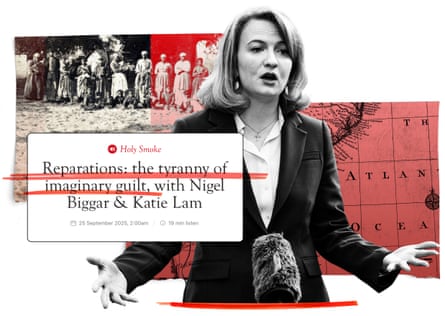
Lam has led opposition in the House of Commons, asking questions of ministers and in December coordinating a letter from 27 MPs and peers to the incoming archbishop of Canterbury, Sarah Mullally, accusing the church of “legally dubious vanity projects”.
The media blitz has paid off so far, paralysing the church and stalling the fund well beyond its planned launch date of 2024. The church admitted in July it also faces a legal challenge – which could add years more delay.
Yet little attention has been paid to the lobbying campaign against Project Spire – and how it has become a cause célèbre within the broader rightwing ecosystem. The Guardian can reveal how some of Britain’s wealthiest financiers, including Sir Paul Marshall, are linked to the man at the heart of the campaign to kill the church’s fund.
The multimillionaire co-founder of the hedge fund Marshall Wace has given Biggar and his movement a powerful platform via his stable of media outlets, which spans the Spectator magazine, the broadcaster GB News and the comment website UnHerd.
A devout Christian, Marshall also funded several rightwing lobbying groups and organisations linked to Biggar to the tune of hundreds of thousands of pounds.
It all appears part of the libertarian financier’s significant efforts to reshape the Church of England – and wider society – in line with his own worldview.
A moral reckoning
In 2007 Dr Rowan Williams, the then archbishop of Canterbury, set in train a reckoning for one of Britain’s most venerable and staid institutions when he said the church should consider slavery reparations for its historical role in the slave trade.
It signalled Lambeth Palace’s determination to atone for those failings – from its distant past to the present day.
His successor, Justin Welby, reaffirmed that commitment. “I’m ashamed of our history and I’m ashamed of our failure,” said Welby, a former oil executive turned priest, in 2020. “There is no doubt when we look at our own church that we are still deeply institutionally racist.”
In 2019, the church commissioners ordered research into the endowment fund’s origins and links to the slave trade. Its initial findings, published in 2022, revealed the funds partly originated in Queen Anne’s Bounty.
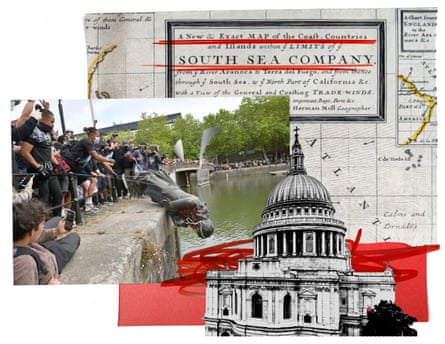
Queen Anne’s Bounty, which was founded in 1704, invested significant sums in the South Sea Company, which traded in enslaved people – trafficking about 34,000 enslaved Africans. The South Sea Company also received numerous benefactions from individuals such as the slave trader Edward Colston, who were linked to, or who profited from, transatlantic chattel slavery and the plantation economy.
Subsequent work by historians on the newly digitised Register of British Slave Traders has revealed how C of E clergymen financed the Royal African Company (RAC), which trafficked more African men, women and children than any other single organisation in the history of the slave trade.
In January 2023 the commissioners published a 25-page report on the endowment fund’s links to the slave trade, employing forensic accountants at Grant Thornton. It declared its intent to set up a £100m fund to invest and generate returns to support communities most affected by African chattel enslavement. Money would come from the church’s endowment, now valued at £11.6bn.
An independent oversight group was formed to steer the Fund for Healing, Repair and Justice, which the commissioners hoped would attract external investment to grow to a £1bn pot. “It is now time to take action to address our shameful past,” said Welby.
Bishop Rosemarie Mallett, the chair of the oversight group, said: “We believe that, like the mustard seed of the parable, the fund will grow from small beginnings towards an expansive future, inspiring imitation and constructive atonement for enduring evils.”
It was part of a wider examination into Britain’s links to slavery: the statue of Colston had been toppled into Bristol harbour in 2020, and institutions from the Bank of England and insurance market Lloyd’s of London to the royal family were delving into their past.
But the church was not ready for the backlash that the fund would provoke.
“The church commissioners always anticipated pushback,” said a source connected to Project Spire. “But it was unprepared for the intensity and persistence of the campaign waged by critics and media associated with wealthy City hedge fund executives.”
‘Wokery is a Christian heresy’
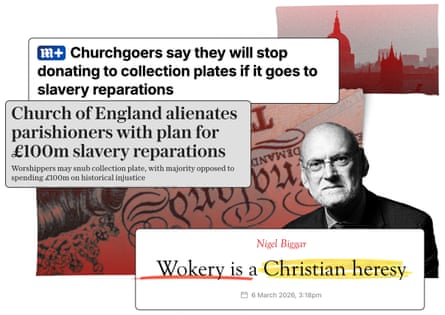
Among the first opponents was a Church of England vicar who appeared on GB News days after the fund was announced in January 2023, to say it would put parishioners off donating to the church. “We keep hearing that there is no money left,” he said.
“And now suddenly, they’ve found £100m down the back of the sofa, to pay for this. You can imagine how I felt.”
A torrent of similar views has followed, with significant coverage in media organisations that are owned or backed by Marshall.
The Spectator, which Marshall bought in 2024 for £100m, has hosted repeated criticism, including one piece by Biggar entitled “Wokery is a Christian heresy”, and another by its assistant editor Madeleine Grant, which described the fund as “deeply unpopular, based on questionable history and law”.
GB News, the TV channel that Marshall co-owns with the Dubai-based fund Legatum, hosted Biggar for an interview in which he labelled the C of E’s plan “completely irrational and wilful self-flagellation”. Biggar, the former regius professor of moral theology at the University of Oxford, has been at pains to state that “racial prejudice is wrong”, and slavery is “abhorrent”. But his criticism of Project Spire has been unrelenting.
UnHerd, the commentary website Marshall co-founded in 2017 with former Times journalist Tim Montgomerie, has run pieces with headlines such as “The Church of England’s reparations plan is unchristian”. Marshall’s son, Winston Marshall, has hosted Biggar twice on his YouTube show, with episodes such as “The Inconvenient Truth About Reparations and the Slave Trade”.
Other rightwing publications and organisations have also weighed in. The Critic, a magazine founded by the hedge fund tycoon and Brexit backer Jeremy Hosking, has run seven articles critical of Project Spire, including by Biggar and Lam. None have been supportive.
In 2025 Policy Exchange, the right-of-centre thinktank, published a 58-page paper titled The Case Against Reparations: Why the Church Commissioners for England Must Think Again. Again, Biggar was one of the authors.
Critics claim parishioners are similarly opposed to Project Spire, citing a poll of 500 churchgoers by Merlin Strategy that received widespread coverage in January. An initial story in the Sunday Telegraph reported a key finding: that 61% might withhold donations if the fund went ahead and money was “unavailable for the support of parishes”. The story was widely followed up, including by the Daily Mail and BBC.
But the coverage failed to mention the results of another similar question in the poll: “If the national church decided to commit £100m of its endowment to slavery-related ‘reparative justice’, would this increase or decrease the amount you would normally con[tribute?]”
This time 61% said they would either maintain or increase their contributions, compared with 34% who said they would reduce their contributions.
Nor did the stories mention who paid for and commissioned the poll: Biggar. Merlin said it sent the results of the poll to Biggar but had no further involvement in its dissemination. Biggar declined to answer questions about the poll.
The Guardian understands the Telegraph story was based on a press release sent by Lam that omitted details including Biggar’s involvement and the finding that 61% would maintain or increase their donations. Lam did not respond to repeated requests for comment.
The church has said money for Project Spire will not be diverted from parishes, and that funding for churches and clergy has risen by 36% to £1.6bn for its current three-year period, versus the prior period.
Financial links
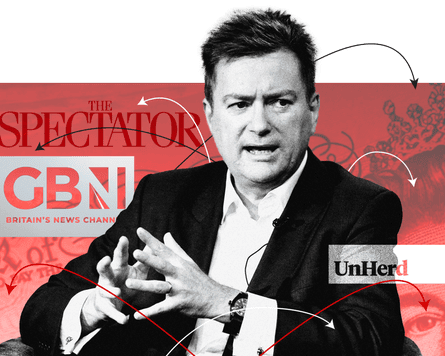
Marshall, who was a substantial donor to the Brexit campaign, has become one of Britain’s most prolific philanthropists. Armed with almost £490m in assets, the Sequoia Trust, a charitable trust he supports and chairs, backs a range of causes close to his heart, including in the Church of England.
The Guardian recently revealed how he has given at least £13m to Holy Trinity Brompton (HTB), an evangelical church in Knightsbridge in central London that seeded the popular Alpha course, and the Church Revitalisation Trust (CRT), via Sequoia, between 2018 and 2025.
He also provides significant support to organisations where Biggar is heavily involved, many of which are on the frontline of the culture wars.
In May last year the hedge fund tycoon delivered a 48-minute lecture at the University of Oxford on his reflections as an “accidental media owner”. The event was organised by a little-known charity, the Pharos Foundation, which Biggar co-founded in 2023 and of which he is a trustee. It funds the work of young academics “pursuing civilisational or heterodox research in a climate of free inquiry”.
Biggar founded Pharos with another academic, Prof David Abulafia, and the fund manager and Conservative party donor Neil Record. Record has described Pharos as part of a “resistance movement” in academia, fighting back against the “cancellation” of debate around subjects such as “DEI/EDI; climate change; the genetic role in intelligence; trans rights; and colonial history”.
Pharos are “innovators and disruptors, and you fight the fight for freedom”, Marshall told the Oxford audience. “Therefore you do everything I like and want to support”.
Accounts for Pharos show that Sequoia gave it £700,000 in 2024 and 2025. At least 10 Marshall Fellows appear on Pharos’s website, studying subjects including the British empire and ancient Greece.
Biggar, who is a paid “fundraising ambassador” for Pharos, declined to say how much he receives for the role.
Another prominent City figure, George Robinson, the co-founder of the hedge fund Sloane Robinson and a Conservative party donor, is also a trustee of Pharos, and charitable trusts linked to him have given it at least £500,000.
Robinson said he was “not aware” of the campaign against Project Spire and is not involved. He said that Biggar’s opposition to the church’s fund was done in a personal capacity and “has nothing to do with Pharos, which is an educational charity”.
Biggar was also a speaker at the recent Alliance for Responsible Citizenship (Arc) conference in London, which brought together rightwing voices from across the globe. Marshall funded the launch of Arc in 2023 with a £1m donation, followed by £2m last year, and he co-owns it with Legatum. Biggar is a director of a subsidiary, Arc Research, for which he said he receives no payment.
Sequoia also gave £890,000 to Policy Exchange between 2020 and 2023.
Culture warriors
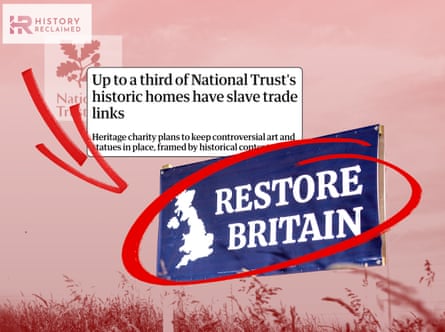
Biggar was involved in a similar storm that engulfed another British institution several years ago. In 2020 the National Trust published a 115-page report that unravelled its properties’ links to slavery and colonialism. Biggar was reportedly the inspiration for a lobbying group called Restore Trust which was set up to oppose the charity’s so-called “wokeness”.
Pharos backer Record was also linked to Restore Trust, appearing on its “meet the team” page until his resignation in 2024. Record, a veteran City currency trader, is also a prominent backer of anti-net zero organisations, chairing Net Zero Watch.
Biggar mentored James Orr, the influential Christian academic and former adviser to Reform UK leader Nigel Farage, who was recently caught in a funding scandal. Orr told a Jordan Peterson podcast in 2021 that they spent a “few happy years” together at the University of Oxford’s McDonald Centre for Theology, Ethics and Public Life, which Biggar founded and Orr joined in 2014.
Biggar also has links to the hard-right party Restore Britain. It cited Biggar’s writing on rights and the legal system in a 2025 paper justifying its flagship policy of mass deportations. He was among the people thanked in the acknowledgments “for trusty friendship or helpful conversations”. Biggar said that he has “no formal relationship” with Restore and is a member of the Conservative party.
Biggar has written repeatedly for the website History Reclaimed. It was founded by academics including Robert Tombs in 2021. Tombs said that it “exists to correct historical errors and falsehoods, and that is why we criticise Project Spire”. History Reclaimed says none of its authors are paid and it receives “no financial support from any political party or organisation”.
Legal quagmire
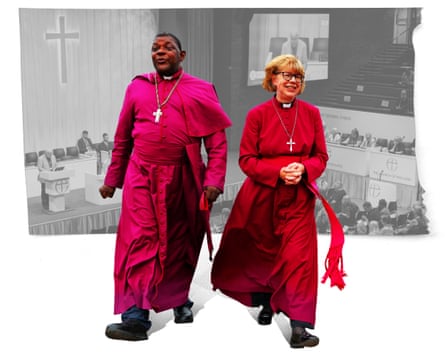
Uncertainty now shrouds the fund. Mullally has reaffirmed the church’s commitment to it, including on a trip to Ghana in July when she expressed “lament” for the Church of England’s involvement in transatlantic chattel slavery.
Members of the church’s General Synod, who gathered in York in July, heard that commissioners had faced “some of the most vile abuse and correspondence” over Project Spire.
The threat of a judicial review has further delayed an application to the Charity Commission to establish the fund in a new arm’s-length body.
No further details were given on the legal threat, but the Guardian understands it is being led by Bijan Omrani, a Daily Telegraph columnist and barrister, who has repeatedly criticised Project Spire. It is understood to centre on the church commissioners’ authority to disburse the money and whether it corresponds with its duty to support the Church of England and its parishes, and whether it allows the commissioners to spend its funds abroad. Biggar said he is not involved in the legal challenge.
Biggar said: “Given the universality of slave-trade and slavery – especially among Africans – up until the 19th century some Anglican and British involvement is unremarkable. What is remarkable was the unprecedented campaign to abolish both, led by evangelical Anglicans from the 1780s. Project Spire tears the Church of England’s role out of its historical context, exaggerates its guilt, and ignores its abolitionist leadership.”
Paul Marshall said: “I am not funding the anti-Spire campaign but I would be happy to do so. I believe the reparations project is naive and ill-judged and that the money would be better spent looking after the needs of the global Anglican Communion, including the many parishes in the UK struggling to make ends meet. And I think the majority of churchgoers would agree with that.”
Winston Marshall, Record, Hosking, Orr, Omrani, Policy Exchange and the Pharos Foundation did not respond to requests for comment.
A C of E spokesperson said: “Addressing our historic links to African chattel enslavement is an act of Christian repentance, responsible investment and credible witness.”
KioskNews shows a cleaned-up reading view extracted from the publisher’s page — the original always lives on their site, not ours.