Best case, Korea gets nothing from a Hormuz deployment. Worst case, it loses everything.
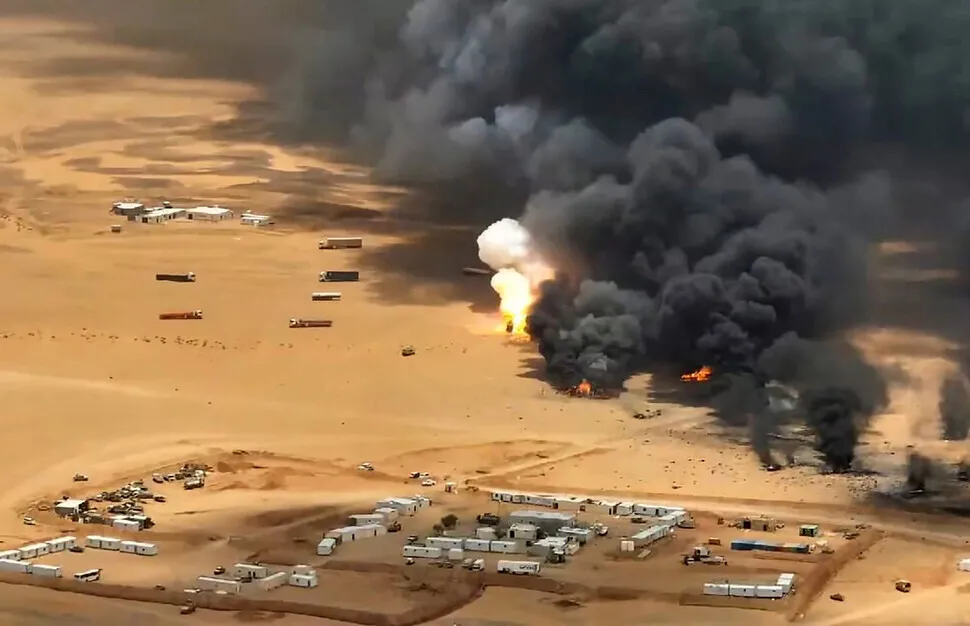
Smoke rises from trucks at a camp of the Saudi-backed government forces following an alleged Houthi missile strike in the eastern province of Hadramout, Yemen. (UPI/Yonhap)
Korea has kicked the hornet’s nest by mulling the option of deploying forces to the US’ war with Iran. The Blue House claims that “nothing has been decided,” but its moves are carefully orchestrated.
On Sept. 8, the Korean Ministry of National Defense announced it had sent a survey team to the United Arab Emirates to review the situation in the Middle East.
Since the outbreak of the current conflict, the UAE is the Gulf State that has been most at odds with Iran. The survey team’s judgment is sure to be colored by the representations made by the UAE.
Despite moving briskly ahead with preparations for a deployment, the Blue House insists it hasn’t made a “final decision.” Is it testing the waters? The whole affair is a farce.
A war of aggression under the UN Charter
The US and Israel launched their campaign against Iran on Feb. 28, 2026. The only pretext they could offer was eradicating what they described as Iran’s imminent nuclear threat.
But the CIA and other American intelligence bodies have said several times that Iran has not sought to develop nuclear weapons since 2003.
Under international law, the US and Israel’s military actions constitute illegal aggression, as the following discussion will make clear.
The UN Charter states in Article 2, Paragraph 4, that “All Members shall refrain in their international relations from the threat or use of force against the territorial integrity or political independence of any state, or in any other manner inconsistent with the Purposes of the United Nations.”
There are two exceptions to this rule. The first exception, as stipulated in Article 51, is “the inherent right of individual or collective self-defence [against] an armed attack.”
The second is when military action has been authorized through a resolution of the UN Security Council.
Article 39 authorizes the Security Council to “determine the existence of any threat to the peace, breach of the peace, or act of aggression and [. . .] make recommendations, or decide what measures shall be taken [. . .] to maintain or restore international peace and security.”
When such recommendations and provisional measures (Article 40) or sanctions and severance of diplomatic relations (Article 41) are deemed inadequate, the Security Council “may take such action by air, sea, or land forces as may be necessary to maintain or restore international peace and security” (Article 42).
Iran did not carry out an armed attack on the US or Israel. In fact, it was Iran that suffered 12 days of air strikes on its nuclear facilities in June 2025. Thus, the US and Israel’s attack on Iran cannot be regarded as an exercise of self-defense.
On six occasions between 2006 and 2010, the UN Security Council passed sanctions resolutions over Iran’s past nuclear activities, including its enrichment of uranium.
But after Iran agreed to a freeze on its nuclear program and other restrictions in a deal reached with the P5+1 countries (the US, Russia, China, the UK and France) in July 2015, the Security Council lifted those sanctions with the adoption of Resolution 2231.
The Iran nuclear deal included a “snapback” mechanism, by which the previous sanctions could be automatically reimposed, without an explicit agreement by the Security Council, if Iran violated the agreement.
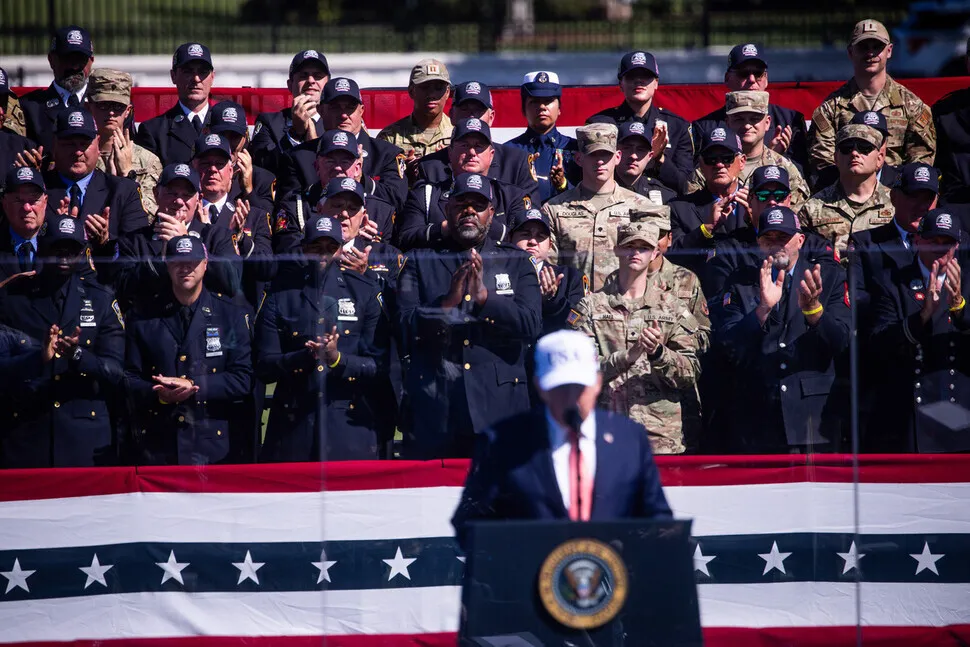
US President Donald Trump delivers remarks during Steel Across America at the Ellipse in Washington, DC, on Sept. 8, 2026. (UPI/Yonhap)
Violating the Constitution and walking into a trap
In May 2018, US President Donald Trump, then in his first term, announced that the US was withdrawing from the Iran nuclear deal, arousing fierce objections from Tehran.
The Iranians and Europeans made a joint effort to preserve the framework of the deal, but conditions got progressively worse. In September 2025, after the US and Israel’s Twelve-Day War with Iran, the Security Council reimposed sanctions on Iran for its nonperformance of the agreement.
Nevertheless, the Security Council did not permit military action against Iran under Article 42. Indeed, it is not Iran, but the US and Israel, that ought to be chastised “to maintain or restore international peace and security” (in the words of the UN Charter).
In its preamble, the Constitution of the Republic of Korea states that “the people of Korea, proud of a resplendent history and traditions dating from time immemorial [. . . seek] to elevate the quality of life for all citizens and contribute to lasting world peace and the common prosperity of mankind.”
In short, contributing “to lasting world peace and the common prosperity of mankind” is the spirit of the Constitution underlying Korea’s foreign policy.
That spirit is further elaborated in Article 5, Paragraph 1: “The Republic of Korea shall endeavor to maintain international peace and shall renounce all aggressive wars.”
According to its own Constitution, therefore, Korea is obliged to renounce the US and Israel’s campaign against Iran.
Article 69 of the Constitution stipulates that the president swears to observe the Constitution in the first sentence of their oath of office upon inauguration. As such, according to the Constitution, Lee must denounce the US and Israel’s war against Iran. Taking part in a war of aggression is unconstitutional.
Paragraph 2 of Article 60 also specifies that the National Assembly has the right to consent to the dispatch of armed forces to foreign states, which means that, if the Blue House pushes for deployment, the National Assembly has the responsibility to prevent violations of the Constitution from taking place.
The Blue House kicked the hornets’ nest, and now Korea is paying the price.
“Iran and Korea’s relationship spans over 64 years, and bilateral relations have developed under mutual respect,” Esmaeil Baqaei, a spokesperson for Iran’s Ministry of Foreign Affairs, wrote in a post written entirely in Korean on X on Sept. 7.
“If any other party either participates in operations or has an active military presence in the Persian Gulf and the Strait of Hormuz, we have no choice but to interpret that as direct support for the aggressor, which will lead to serious consequences,” he warned.
“Risky choices come at a cost,” he said.
The US and Iran agreed on a 14-point memorandum of understanding on June 14, 2026, which came into effect three days later after being signed by the leaders of the two countries. The two parties were to reach a final pact within 60 days of the signing, but the deal fell apart as the MOU expired on Aug. 16. Even though Trump predicted during the early stages of the war that it would only last for four to six weeks, it has now dragged on for more than half a year.
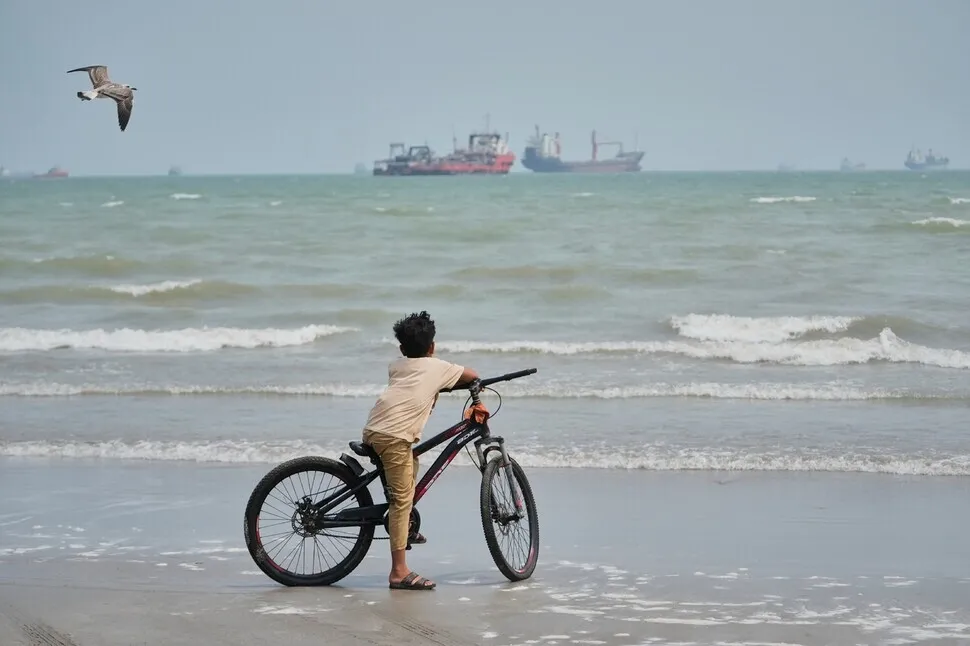
A boy stands with his bicycle on a beach overlooking commercial vessels anchored in the Strait of Hormuz off Bandar Abbas, Iran, Sept. 7, 2026. (AP/Yonhap)
The delusion of deploying non-combat units, the illusion of thawing inter-Korean relations
Even now, the US and Iran are still at war. The Strait of Hormuz remains resolutely closed. To make matters worse, Yemen’s Houthis and Saudi Arabia appear to be on the brink of entering a full-blown war over passage through the Strait of Bab al-Mandab, a chokepoint that, with the Mediterranean to its North and the Indian Ocean to its south, utilizes a waterway as important as the Strait of Hormuz — the Suez Canal.
As such, the notion of deploying non-combat units is nothing short of delusion.
According to one national security expert who served in a senior role under a previous administration, Lee’s foreign policy is “being swayed by diplomatic officials who prioritize US relations.”
“During the Roh Moo-hyun and Moon Jae-in administrations, diplomatic officials would play major roles when making foreign policy, but they never grabbed control of the reins. However, in the current administration, former diplomats are guiding the direction of foreign policy,” the former official explained.
“As a rule, these people are used to saying ‘yes’ to everyone in the US Department of State, and when they return to Korea, they tend to exaggerate the comments made by the US,” they went on.
“The Coupang case serves as a prime example. Both the issues of deploying troops to Iran and recovering wartime operational control would not have cropped up out of nowhere. It appears that the president has not been correctly notified as timelines have been delayed and conditions have changed,” they said.
“Both issues involve multiple ministries, yet there is absolutely no policy coordination between the foreign affairs and national security ministries. I understand that the National Security Council is not functioning properly either,” they explained.
Some suggest that South Korea has no choice but to send troops if it wants to thaw ties with North Korea.
“Deploying troops to Iran amounts to South Korea officially declaring to the international community that it has given up on attempting to use peace to solve international disputes,” said Koo Kab-woo, a professor at the University of North Korean Studies.
“While no one is saying this outright, it appears that some believe that deploying military troops to Iran will help promote North Korea-US relations. A North Korea-US summit will inevitably be the starting point for multilateral negotiations, and since Trump has broached the topic, some appear to believe that sending troops is the ‘cost’ we must pay to make it happen,” Koo explained.
“But will deploying troops really alleviate inter-Korean tensions? The status of North Korea-US relations is something for those two countries to worry about. There is no room for us to butt in,” he said. “There is no way that sending troops will thaw inter-Korean relations.”
“The only way that the two Koreas will be able to engage in dialogue in this current climate is as ‘two separate nations.’ China is the wild card. Like South Korea, China is heavily dependent on crude oil supplies passing through the Strait of Hormuz. As seen in past four-party and six-party talks, the key to resolving the Korean Peninsula issue lies in US-China cooperation,” he went on.
“If Seoul-Beijing relations deteriorate because South Korea sends troops to Iran, will China participate in multilateral negotiations regarding the Korean Peninsula? Beijing will condemn Seoul. Then, it will ask us to elaborate on what we meant when we said we wanted to pursue an inclusive, peaceful coexistence,” he predicted.
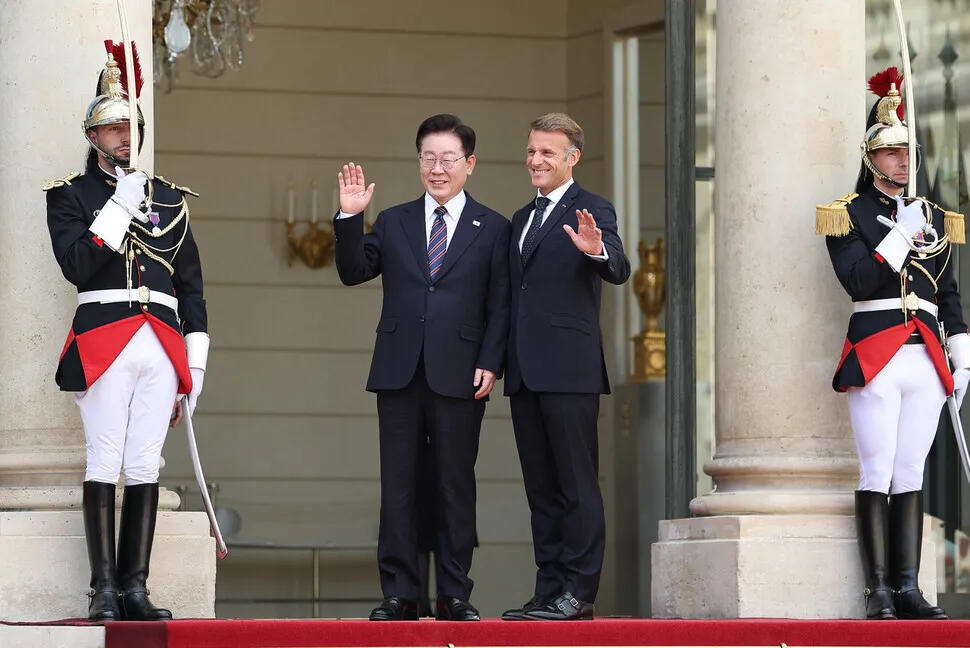
President Lee Jae Myung of South Korea and President Emmanuel Macron of France greet the press upon meeting at the Élysée Palace in Paris on Sept. 8, 2026. (Yonhap)
Will a one-to-one exchange with the US be possible?
“The free passage through the Strait of Hormuz is vital for our national interest,” a senior Blue House authority stressed during a Sept. 4 briefing. Amid escalating tensions between the US and Iran, the situation in the Strait of Hormuz and the Strait of Bab al-Mandab is deteriorating, causing international oil prices to fluctuate once again.
On Sept. 10, the price of North Sea Brent crude futures surged to US$101.21 per barrel, the highest level in about four months. Will the situation change if Korea deploys troops to Iran?
“As international waters, the Strait of Hormuz should be completely open. However, both the US and Iran are blockading the waterway,” said Lee Hea-jeong, a professor of political science at Chung-Ang University.
“Neither the US nor Iran is acting appropriately. In this situation, there is nothing that Korean troops can do after they are dispatched to the region,” he said.
“If the US could have used military force to open the Strait of Hormuz, it would have done so already. It is acting the way it is because it lacks military options. The US claims that it has cleared the Strait of Hormuz of all mines and that it has complete control of the region. If we wholeheartedly trust the US, there is no reason for our troops to go,” the professor went on.
The argument that Seoul should deploy troops for the sake of the Korea-US alliance makes even less sense, according to Lee.
“Must we do whatever the US wishes?” he asked.
“The Lee administration has championed pragmatic diplomacy centered on national interest. How would sending troops benefit us? Some say that we are experiencing intense pressure on the trade front. Regarding our US investment package, we have already said that it depends on commercial rationality. Will the US stop putting trade pressure on us if we send troops?” he went on. “It won’t.”
“This begs the question: what will we get from the US in exchange for deploying troops? Nuclear-powered submarines? That is nothing more than a promissory note,” he said.
“Aiding the US’ illegal war of aggression means that we are deliberately putting ourselves in an irreversible situation from which there is no turning back. The UK, France and Japan are not deploying troops. Deciding to deploy troops is a foreign policy of bloc alignment even more extreme than the Yoon administration’s,” he went on.
“This choice ultimately comes down to one question: the alliance or the people? The administration must discard this ‘add-on’ diplomacy where the alliance is always prioritized while national interest is tacked on like an afterthought. This does nothing more than condemn us to be forever dependent on the US,” he urged.
“We are no longer the country we once were,” the professor said. “An alliance should be a means, not an end.”
KioskNews shows a cleaned-up reading view extracted from the publisher’s page — the original always lives on their site, not ours.