The EU is its own worst enemy
Beijing has told Brussels not to “fantasise” that pressure will extract concessions. This came after China made a goodwill gesture in the recent hybrid-car trade deal. The European Union responded by doubling down on a proposed trade “kill switch”.
The instrument follows a Franco-German proposal. It would let the bloc swiftly restrict single-market access in response to economic coercion. EU chief Ursula von der Leyen says all 27 leaders back it. Chemicals and machinery are priority sectors. French President Emmanuel Macron wants to add plastics and ferroalloys. German Chancellor Friedrich Merz and others want a tougher, unified line on Chinese trade practices, currency depreciation and critical dependencies. The formal proposal is expected in December.
Unanimity among 27 leaders is itself a rare thing. It is usually reserved for communiques about how much everyone values unanimity. At a time when a proxy war with Russia, a likely trade war with China and acrimony with the United States are pushing the cost of living and livelihoods of ordinary Europeans to the brink, this is starting to look like a case of collective madness, a communal death drive. But China is the least of its problems.
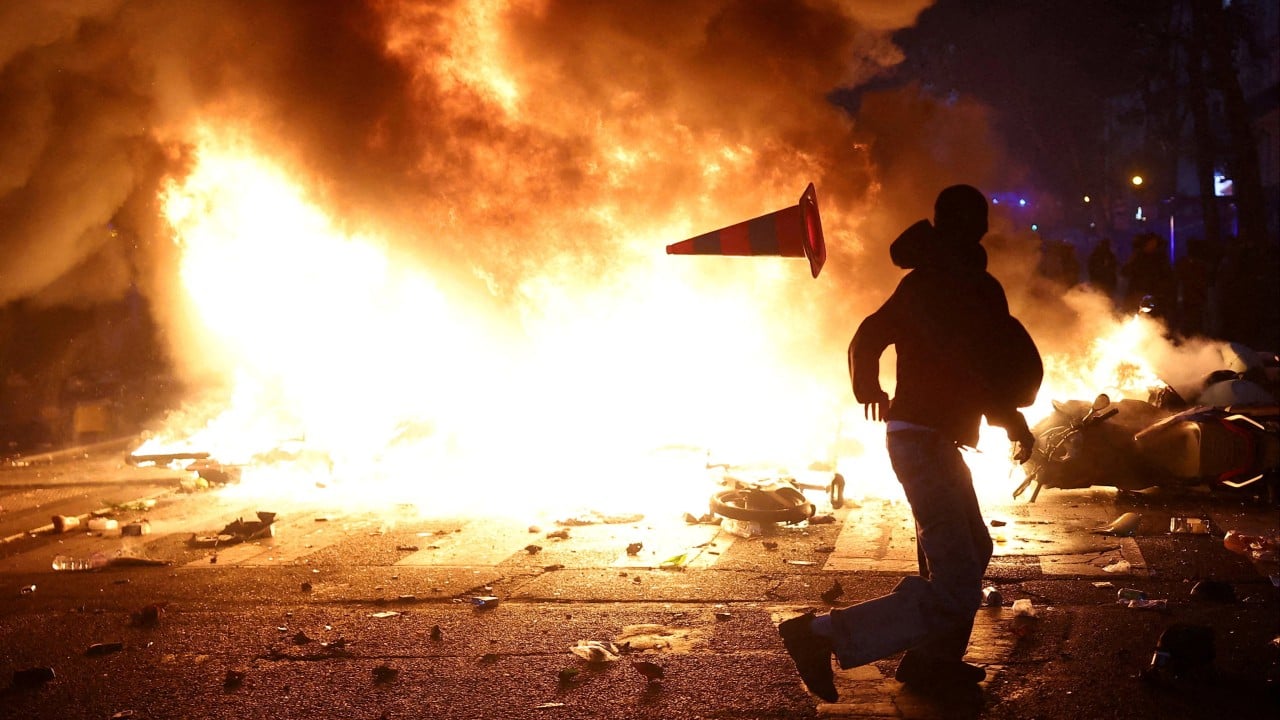
The union faces what may be its most precarious moment. Its leaders are deeply unpopular, and its economy is sluggish. No wonder angry Europeans are hitting the streets. I have read a description of a “European Autumn”, with citizens turning on their rulers in one capital after another, much like the Arab Spring. Could Europeans become as fed up with incompetent and arrogant leaders as Arabs did?
But when in trouble, von der Leyen and foreign policy chief Kaja Kallas do what they always do: escalate on every front.
02:05
Emboldened EU readies China company ‘kill switch’ as Beijing warns Brussels not to ‘fantasise’
In this context, it’s instructive to turn to an address last week by American economist Jeffrey Sachs at the European Parliament, where he summed up the madness. Its title was “How to Make Peace in a Crazy World”. It was, of course, duly ignored.
Sachs called the war rhetoric now dominating Europe “shocking and extremely dangerous”. He said the US is in a deep political crisis, and he described his president in terms not exactly suitable for polite society. His message to Members of the European Parliament was that Europe is on its own, but its leaders are not helping by picking fights everywhere, most of all with China.
His big picture started with Asia. In 1820, he said, it produced about 60 per cent of world output. By 1950, after a century-and-a-half of imperial plunder, war and chaos, that share had sunk to 20 per cent. Today it is back to about 50 per cent. Sachs, who has worked in China and India for decades, called this one of the great achievements of the past half-century. Four billion people are better off. Washington and much of Europe’s political class see only a threat in that. His explanation was that China committed the crime of refusing to stay poor.
He argued that Russia committed a similar offence. He cited the historian John Howes Gleason’s study of how Britain went from ally to enemy of Russia within about 25 years after Napoleon’s defeat, apparently because Russia had grown large enough to frighten London. He called today’s Ukraine war a “second Crimean War” and “our war,” not simply Putin’s.
It is an old argument, but still true. Nato expanded despite Western assurances in 1990. Washington quit the Anti-Ballistic Missile Treaty in 2002. The 2008 Bucharest summit promised Ukraine and Georgia eventual membership over Angela Merkel’s private objections, and he said Merkel’s own memoir describes how Moscow interpreted that. Sachs called 2014 a coup in Kyiv, described the Minsk II agreement as sabotaged, and recalled telling Joe Biden’s security adviser Jake Sullivan in December 2021 to treat Moscow’s draft security proposals as an off-ramp. Sullivan, he said, cited Nato’s open-door policy.
Europe continues to defer to Washington. Was it silent when the US and Israel attacked Iran? Sachs said he watched European ambassadors at the UN Security Council condemn Iran’s response but say nothing about the strike that provoked it.
He proposed a straightforward ending, though it is unlikely to be heeded in European capitals. Nato should declare that it will not expand to Ukraine or Georgia, and then negotiate an armistice line in Ukraine. Merz should simply pick up the phone and call Moscow. The German leader, of course, has just called for escalation.
Sachs praised former German leaders Willy Brandt, Helmut Schmidt and Helmut Kohl, who talked to adversaries, because that was what diplomacy is. Sadly, their successors prefer war-war to jaw-jaw, to paraphrase Winston Churchill.
KioskNews shows a cleaned-up reading view extracted from the publisher’s page — the original always lives on their site, not ours.