EXPLAINER: What sparked the mass protests in France?
During a riot on Saturday, a 140-year-old town hall in Limoges, France, was set on fire, causing parts of the structure to collapse. The historic establishment was allegedly torched by rallyists amid the mass protest.
Earlier reports described the Saturday unrest as some of the worst violence France has witnessed in decades.
Clashes between law enforcement personnel and protesters intensified, forcing police to disperse crowds with tear gas and grenades.
Meanwhile, establishments of luxury brands were likewise targeted and ransacked, urging other businesses to bolster their security measures.
So, how did this mass protest begin?
Unrest
In September, high school students from the working-class suburbs of northern Paris started a protest against teacher shortages, dilapidated school facilities, and overcrowded classrooms.
The students’ protest also called out long school hours that could stretch from 8 a.m. to 6 p.m., and opposed a ban on the use of mobile phone in schools.
What initially sparked just as a protest among learners eventually expanded into broader issues raised by demonstrations, including high prices of basic commodities and fuel, as well as the decline in the quality of public services and social inequality.
For the protesters, daily living expenses continue to rise while improvements in public services remain lacking.
The movement also became an expression of frustration toward the administration of French President Emmanuel Macron.
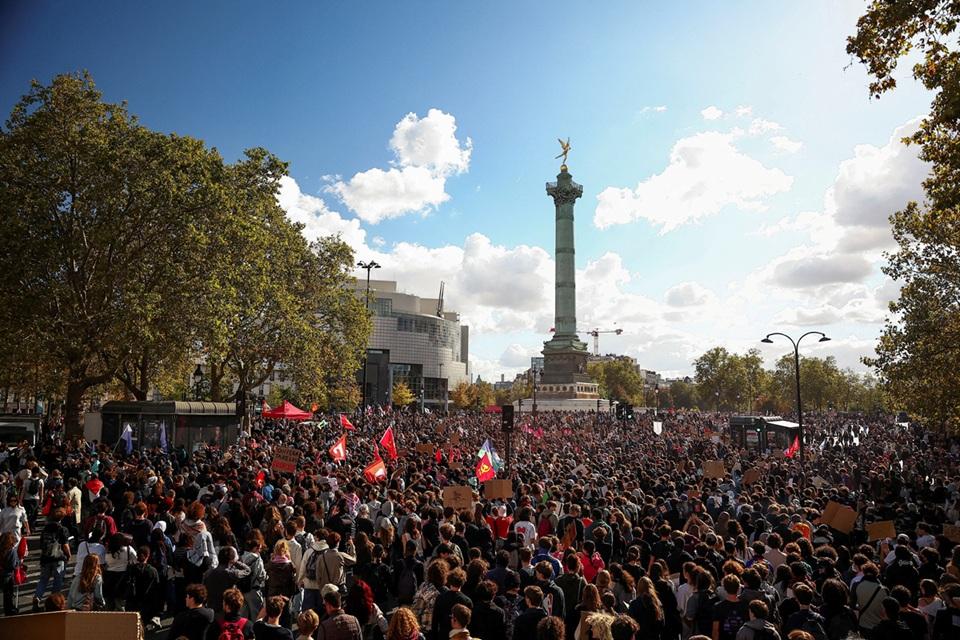
During the protests, several individuals held placards opposing Macron, the police, and the wealthy.
Some protesters in Paris wore high-visibility vests commemorating the Yellow Vest movement of 2017 to 2018, which was a major protest against Macron’s policies during his previous term.
On October 17, authorities recorded around 550,000 individuals participating in protests across various parts of France.
Meanwhile, estimates by the CGT labor union were higher, stating that the number of protesters reached 800,000.
Government response
Amid the public unrest, which resulted in several incidents of rioting, Macron appealed to the public, called for peace, and urged protesters not to make the situation worse.
Macron said he understands everyone's anger and dismay over what happened, and acknowledged the legitimate grievances of the protesters.
However, the French President said that nothing justifies the destruction and looting that occurred amid the riots, and promised that those responsible will face justice.
"We will all stand united against the sowers of chaos, who only seek to undermine our institutions and prevent those who peacefully express their demands from doing so," Macron wrote in a post on X.
According to the French Interior Ministry, arrests reached an estimated 2,400 on October 17.
Meanwhile, the Philippine Embassy in France said that no Filipinos were reported dead, injured, or arrested in connection with the protests.
Other Demonstrations
Aside from France, unrest was also triggered in other European countries due to rising costs of commodities and the cost of living, and other issues citizens face.
In Belgium, hundreds of people, mostly youths, protested against rising education costs and reforms feared to make college admission even more difficult.
Meanwhile, in Portugal, thousands marched in Lisbon to protest housing prices and other living expenses.
Malacañang said it does not expect similar extreme protests in the Philippines, nor does it anticipate them, as the government is continuously taking measures to mitigate and resolve issues, including looming price hikes for basic commodities.
“Nakita naman po ng ating mga kababayan, ‘yung naniniwala sa ginagawa ng gobyerno, na lahat po ng programa, lahat po ng pwedeng maibigay na ayuda sa ating mga kababayan ay ginagawa po ng ating Pangulo at ng administrasyon at ng concerned agencies,” Palace Press Officer Under Secretary Claire Castro said.
(Filipinos who believe in what the government is doing can see that all programs and all possible assistance that can be provided to our people are being implemented by our President, the administration, and the concerned agencies.)
The Palace noted that the effects of El Niño and the Middle East crisis were beyond the government's control. — BAP, GMA News
KioskNews shows a cleaned-up reading view extracted from the publisher’s page — the original always lives on their site, not ours.