Why Rs 190 crore post-flood Loss and Damage Fund payout to Nepal matters
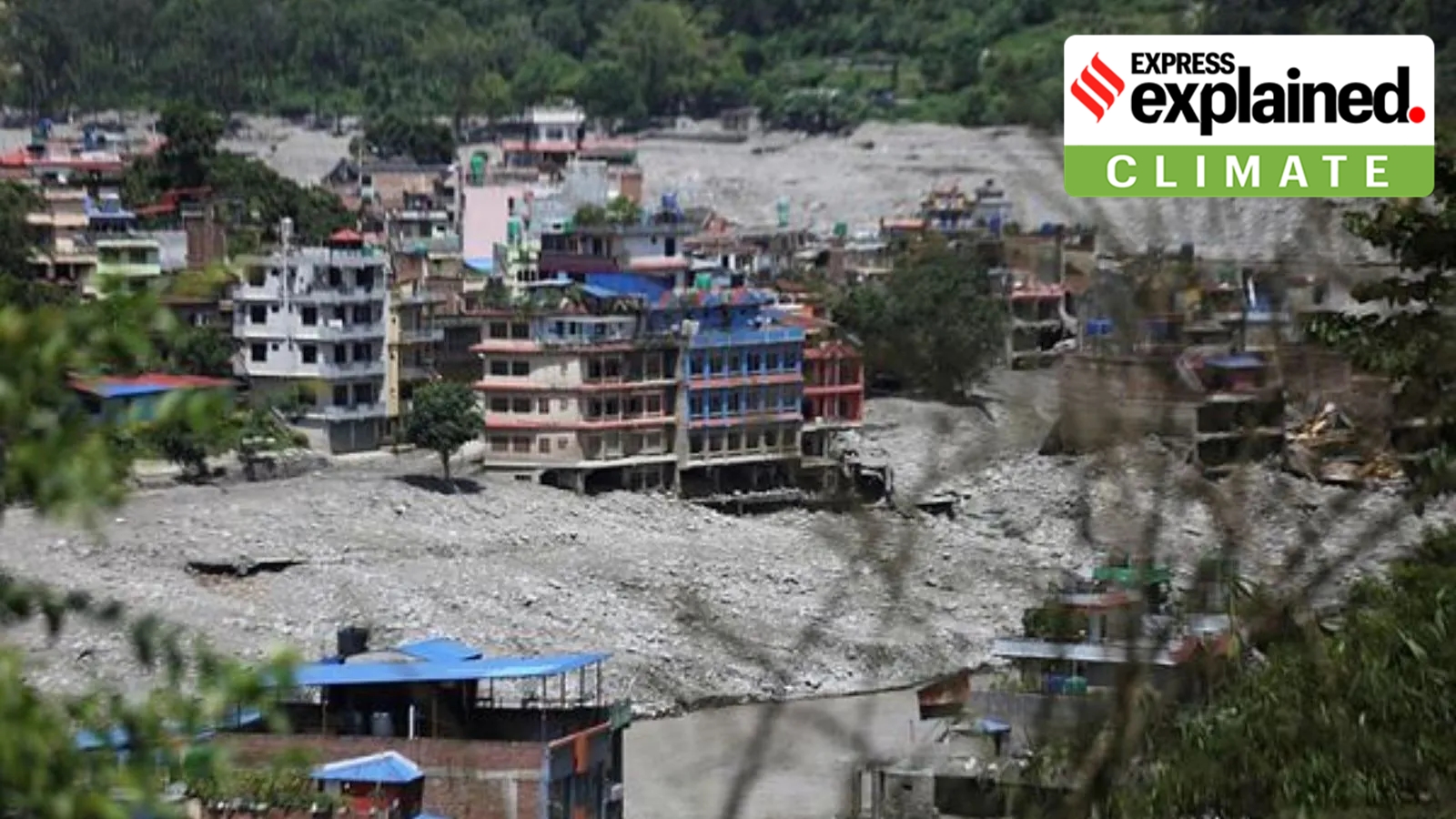
A month after it raised a request, Nepal has been promised a sum of $20 million (around Rs 190 crore) to help it recover from the devastating flash floods in August this year. Though the amount is extremely small compared to an estimated need of about $4.75 billion (around Rs 44,600 crore) in recovery and reconstruction costs, it marks the beginning of the implementation of a new international regime on loss and damage. This system seeks to provide financial assistance to developing countries affected by climate events.
The allocation is a first from the Fund for Responding to Loss and Damage (FRLD), a new international financing instrument created in 2022 to address a long-pending demand from developing nations, particularly those small and vulnerable countries that face the maximum risk from climate events. These countries have contributed negligibly to creating the problem of climate change because of their extremely low emissions footprint, yet they disproportionately suffer its consequences.
Developing countries also have fewer resources and happen to be among those least equipped to deal with major climate-related disasters.
The allocation for Nepal, which still has to undergo some procedural formalities before being released, is by no means commensurate with the extent of damage inflicted by an event assessed to be triggered by climate change. But its importance lies in acknowledging the need for quickly mobilising financial resources. The decision to earmark $20 million for Nepal was taken at an emergency board meeting of the FRLD, following requests from Nepal and several other countries that supported it.
Emergency allocation
The money for Nepal is an out-of-turn allocation by the FRLD, and essentially its first decision on applications made by countries. Operationalised in 2023 after receiving the first round of contributions from donor countries, the FRLD made its first call for applications during the annual climate conference in Brazil last year (COP30). By the time the window for applications closed on June 15 this year, 119 countries had submitted 176 funding requests.
The total amount requested by countries added up to $2.8 billion — over three times what it currently has. The fund has so far received only $822 million from donors, and much of it is currently only at the commitment stage, with the actual amount yet to be delivered. Clearly, the fund has no capacity to accept every request even after capping each request at $20 million.
As a result, the fund will have to prioritise these requests. A decision on these requests is scheduled for December, although Nepal’s case is a separate one. The flooding incident, in which more than over 1,300 people were killed and over 5,000 continue to be missing, happened in August, and an extraordinary request was made in September. Its acceptance underlines the need to provide emergency financial assistance to countries following a large-scale climate disaster.
Story continues below this ad
The success in disbursing funds to Nepal quickly, even though the amount is nominal, is likely to become a template for many such requests in future. Countries struck by a disaster would insist on immediate consideration of their request and quick access to money, which is how this mechanism was envisaged to work.
Huge demand, limited supply
Most of the current requests made to the fund are of a slightly different nature when compared to Nepal’s case. They pertain to both economic and non-economic loss and damage arising out of climate-induced extreme weather events or slow-onset events like glacial melt, sea-level rise, biodiversity loss and desertification.
Reconstruction of damaged infrastructure and restoration of essential services like health, transport, energy and education services are a small part of expenditures for which money from the fund is being sought.
The countries’ demands are generally associated with building resilience, setting up early warning systems, institutional strengthening, including the capability to assess the contribution of climate change in causing an event, insurance mechanisms, livelihood restoration, and even addressing mental health and providing psychosocial support to affected populations. India, too, has made three requests to the FRLD, totalling slightly more than $52 million.
Story continues below this ad
The range of financial needs presented by the countries before the FRLD highlights the inadequacy of climate finance available to developing countries. Under the global climate change architecture governed by the UN Framework Convention on Climate Change (UNFCCC) and the 2015 Paris Agreement, developed countries are mandated to provide financial assistance to developing countries to help fight climate change.
But just as they have been lacking in meeting their greenhouse gas emission reduction targets, developed countries have not fulfilled their financial obligations either.
Between 2020 and 2025, they had offered to mobilise $100 billion every year, but could never deliver on it. In 2024, the developing countries presented their requirements for climate finance, which added up to $1.3 trillion every year. Still, developed nations agreed to increase their commitment to only $300 billion a year, and that too from 2035 onwards.
Important beginning
This reluctance of developed nations to put money on the table has affected the loss and damage fund as well. Initially, these countries had stalled the creation of the fund for years, before finally giving in to sustained pressure in 2023.
Story continues below this ad
But the actual contributions to the fund have been minuscule. Consider the fact that a total of 27 donor countries have together pledged $822 million. Of them, only three countries — Italy, France and the United Arab Emirates — have made a commitment over 100 million each. The FRLD does not have any target to mobilise funds, and countries are encouraged to contribute as and when they can.
Nepal’s case is a small but important beginning. It opens up the possibility that immediate financial assistance could be provided to small, resource-scarce countries to respond to a major climate disaster. But over the long term, as climate-related disasters increasingly become more frequent and cause greater devastation, the effectiveness of FRLD would remain severely constrained unless developed nations put more money into the fund.
KioskNews shows a cleaned-up reading view extracted from the publisher’s page — the original always lives on their site, not ours.