How Middleton’s revival could be grist to the mill for Britain’s struggling towns

The former England footballer Paul Scholes and the actor Steve Coogan stare out from beside a fish and chip shop in Middleton, near Manchester. Looming over a mural of the pair – and the whole town – is an enormous former cotton mill that powered its economy a century ago.
The deafening looms and spindles of Warwick Mill fell silent decades ago, replaced in recent years by TikTok “urban explorers” who share videos of themselves crawling through its abandoned shell.
Yet the old building may have life inside it yet: last month Rochdale council wrestled Warwick Mill out of the hands of its absentee owner, a millionaire Chinese businessman, under whom it had been derelict for years.
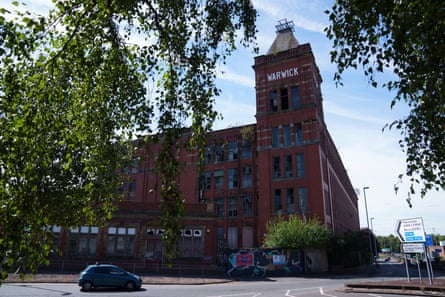
Now the Grade II-listed site is at the centre of plans Andy Burnham believes could turn Middleton, where he was once a trainee journalist, into a blueprint for the future of Britain’s struggling towns.
“It used to be good,” said Dorothy Kersh, in the town square with her husband, Ernie, both 83. “In the 70s we had a cinema, we had banks. It’s lost character and we’ve hardly got any shops. We haven’t even got a bank now – I never thought NatWest would leave Middleton. It’s just going downhill.”
A few miles between Manchester and Rochdale, Middleton is typical of the existential crisis suffered by most British towns.
A decade or so ago, locals could find virtually everything they needed in its neat square of grocers, butchers and banks. But a giant Tesco has hoovered up the cash since it opened in 2013, compounding the rise of online and out-of-town shopping.
The town of about 50,000 people has lost all its banks and, days before Burnham became prime minister, the remains of its post office were closed by Modella Capital, the new private equity owner of WH Smith.
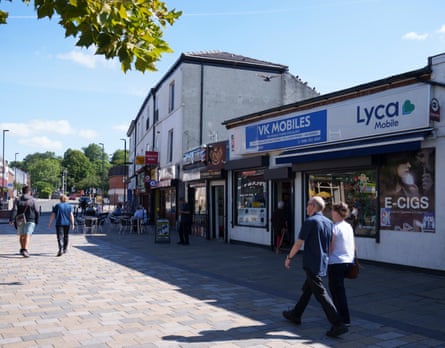
Now the shopping precinct offers little more than bookmakers, vape stores, pawnbrokers and fast-food outlets.
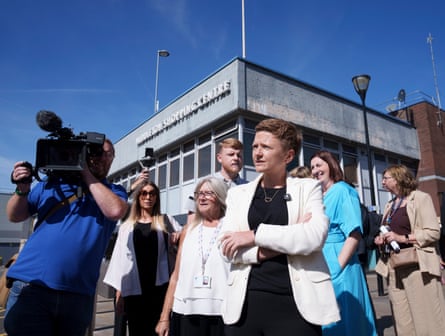
Even its geographic identity feels muddled. Middleton was historically in Lancashire but the town has a Manchester postcode and dial code, although residents pay their council tax to Rochdale. The region’s lauded tram network does not stop here.
“It’s really a dying town,” said Tim King, outside a large post office branch that closed down years ago. “We’ve only got one cash machine and that’s at Tesco, and there’s never any money in it. We’ve lost out on the trams. We haven’t got anything down here, to be honest.”
But six miles from the birthplace of the modern co-operative movement in 1844, a community fightback is under way.
Months before he departed for Downing Street, Burnham launched a mayoral development corporation for Middleton, giving local leaders power to set lower business rates, acquire underused land and property, and build 1,500 new homes.
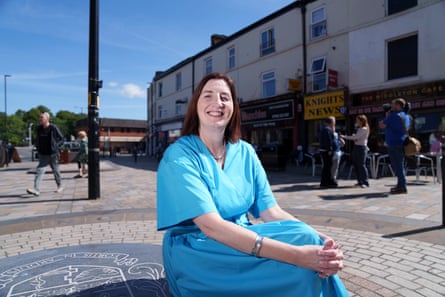
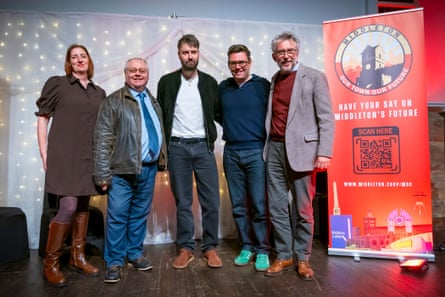
The body is led by Coogan, the Bafta-winning creator of Alan Partridge, and Rose Marley, the chief executive of Co-operatives UK. Crucially, residents and business owners will have a seat at the table: a survey of 2,000 Middletonians is shaping the agenda of this new mayoral body – with Warwick Mill and other empty buildings identified by locals as an immediate priority.
Wearing a hard hat and hi-vis vest during a tour of Warwick Mill last month, Coogan said the Middleton of his childhood was a “thriving” town but that “over the last 35 years there has been a kind of a bank ride” by firms registered in the British Virgin Islands, China and the US: “All that money has been extracted but very little has been put back into the infrastructure.”
Coogan said the project was about more than attempting to revitalise his home town. It was a chance to reverse the political and economic malaise that has seen former Labour voters shift to rightwing populist parties such as Reform UK in post-industrial areas across Britain.
“There’s a problem in this country which is post-industrial neglect,” he told the Guardian. “The idea, the Blairite approach: it’s called multinationalism, there is nothing we can do, throw your hands up, you’ve just got to see what happens, we can’t help these people.
“Leaving that vacuum will mean that the extremists, populist extremists, will fill that gap. That’s the problem with top-down, well-meaning, but disempowering, philanthropic, centralised socialism. People don’t want to receive charity, they want to be empowered.”
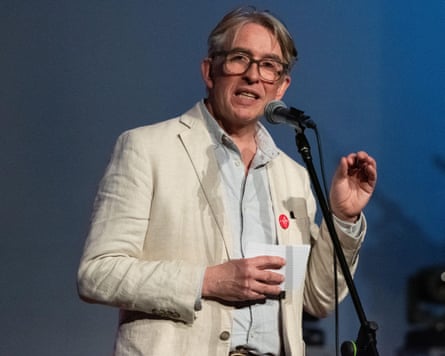
Coogan is part of a group called Middleton Co-operating, which aims to “rewire the whole of the economy locally” by taking infrastructure and everyday essentials into public control.
Its plans include using renewable energy, like solar panels and small wind turbines, to help power a secondary school and a hospice. A trial involving heat pumps and solar panels on a terrace of Edwardian homes is also being put together.
Banks could soon return too, with plans for a banking hub where Lloyds, NatWest and others could open on different days of the week, alongside financial advisers.
The group, which was backed by Burnham when he was mayor and in June won £4.5m funding from the national lottery’s solidarity fund, wants to expand into food production, early years support, mental health provision and adult social care.
“These are all things that have the biggest impact on people’s day-to-day lives and they’re generally all owned by big business and private equity – they cost too much and are a cause of a lot of stress in the community,” said Mark Fraser, a founder of Middleton Co-operating.
Earlier this year, an arts venue run by Middleton Co-operating was forced out of the town’s sprawling shopping centre – which was owned by two London-based real estate companies and incorporated in the British Virgin Islands – as it could not afford the £43,000-a-year rent and service charge demanded by the landlord. In its place a pawnbroker moved in on a 10-year lease.
“It was a bit of a sickener,” said Fraser. “It was a lesson in that they were saying they loved what we were doing for the community, but when it came to it what counts is the bottom line.”
Even with Coogan’s star power and the prime minister’s backing, the scale of the challenge is huge.
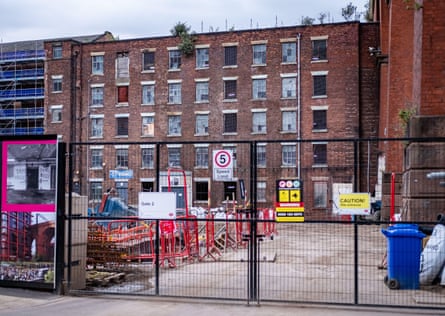
Warwick Mill is an utter wreck and could cost tens of millions of pounds to bring back to life. To Fraser, it is a symbol of a town where people feel “neglected and forgotten”, and most had lost hope in its future.
“The cost of rescuing and converting something of that size is colossal,” said Tim Heatley, the co-founder of property firm Capital & Centric, which specialises in turning unloved old buildings – such as former mills and even multistorey car parks – into sought-after homes.
It was a 7pm telephone call from Burnham that turned Heatley on to Warwick Mill in January this year.
The then mayor told Heatley he had seen Capital & Centric’s renovation of the dilapidated Weir Mill in Stockport and asked him to take a look at the Middleton site.
As it happened, Heatley had already been in contact with Kam Lei Fong, the Macau-based developer who owned Warwick Mill. But with Burnham on board, the project accelerated.
“For me, the opportunity is much bigger than doing a nice conversion of an old mill,” he said. “Warwick is absolutely colossal and has loomed over Middleton for more than a century. If we can fill it with life again, it has the potential to become an anchor for the town … and give confidence for investment to follow around it.
“The challenge now is turning all that momentum into an actual place, getting Warwick fixed up, full of people and properly part of Middleton again. Ideally before Andy’s next career move leaves us needing to find somebody else to cut the ribbon.”
KioskNews shows a cleaned-up reading view extracted from the publisher’s page — the original always lives on their site, not ours.