New Zealand poised for one of its closest elections
New Zealand was poised for one of the closest elections in its history yesterday, the final day of a campaign dominated by the cost of living and an economy hammered by the war in the Middle East.
Kiwis are struggling to make ends meet — the price of basic goods remains stubbornly high and unemployment at its highest in more than a decade.
The last day of voting is today and polls suggest that neither the ruling National Party nor the opposition Labour have offered a program compelling enough to win the seats needed to govern by themselves.
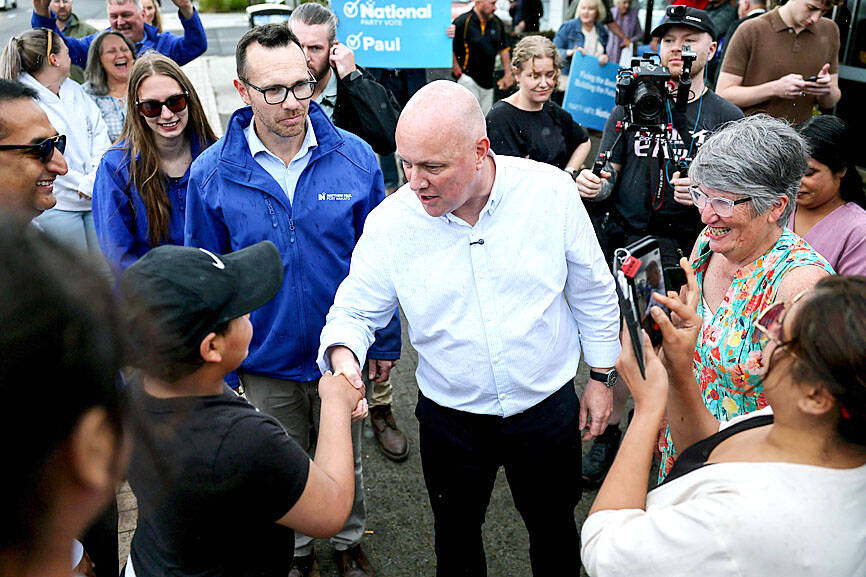
New Zealand Prime Minister Christopher Luxon, center, greets supporters during a National Party campaign visit to Pokeno yesterday.
Photo: AFP
New Zealand Prime Minister Christopher Luxon has hoped promises of no new taxes can help his right-wing coalition cling to power after three fractious years in office, two failed bids by his own party to oust him as leader and an economy in the doldrums.
Pushing to replace him is his opposition leader and former New Zealand prime minister Christopher Hipkins, whose Labour has proposed a sweeping package of measures to help relieve the economic pressure on Kiwis.
However, with polls so close, attention has turned to New Zealand’s minor parties — in particular the upstart centrist Opportunity Party.
On the streets of Wellington, many Kiwis said they were struggling to get by and thinking twice about paying for things they had once taken for granted.
“The prices are really high,” cultural adviser Jay Ikaua said. “I have to make conscious decisions. Do I buy that? Do I not buy that?”
“And it’s the things we need — public transport, food,” Ikaua added.
Public servant Rachel Shardlow said the cost of living was “shocking.”
“All I’m doing is paying my rent and my bills, and I’m struggling to put money into savings and save for my future,” Shardlow said.
A final poll released yesterday put Labour just ahead of the National Party with 30 percent of the vote.
Under New Zealand’s mixed-member proportional representation system, voters must tick two options — a general party list as well as an individual member to represent their electorate.
And the ruling party could still clinch more seats thanks to a so-called “overhang” — in which more lawmakers are returned to parliament than the usual 120.
Polls also put the Opportunity Party on more than 5 percent — guaranteeing them seats in parliament, the first time in New Zealand’s history a minor party with no links to the two main factions has done so.
The party is led by former KPMG consultant Qiulae Wong, who has pledged to work with either of the two parties if elected.
“I think New Zealanders are really tired of politicians’ name-calling, the bickering, the political point-scoring,” she said. “They want something different, and they really want some hope and optimism for the future.”
KioskNews shows a cleaned-up reading view extracted from the publisher’s page — the original always lives on their site, not ours.