BHEKISISA: Could a coat of paint help South Africans sleep better as the planet heats?
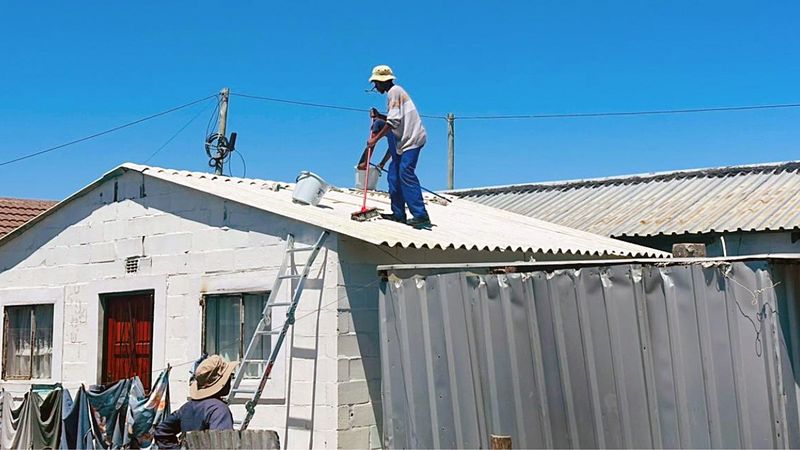
A coat of cool, reflective, white paint on the roof of a shack could help protect the people who live there from dangerous heat – and give them a better night’s sleep.
In South Africa and Ghana, researchers are testing whether this simple solution could improve people’s health as climate change makes our nights hotter. The UCT-led study; Heat Adaptation Benefits for Vulnerable groups in Africa or Habvia is funded by the Welcome Trust.
In Khayelitsha, Cape Town, and Mphego village near Thohoyandou in Limpopo, scientists are painting roofs with a special coating that reflects sunlight instead of absorbing it.
It’s a small-scale experiment with a potentially big impact – and the kind of practical solution that could help millions of people as world leaders gather in Antalya, Turkey, for COP31, the United Nations’ annual climate change conference, which began on 9 November and runs until 20 November.
Health is high on this year’s agenda: the summit opened with a dedicated Health Day, and the World Health Organization is pushing countries to do more to protect people from the growing health threats of climate change.
The idea behind the roof-painting project is simple: stop homes from becoming unbearably hot during the day so that people can sleep more comfortably at night.
Early, yet to be published findings from the project suggest that the paint can reduce indoor temperatures by about 3°C to 5°C during the hottest part of the day.
The researchers have already painted 120 roofs as part of a study involving 240 households. The trial, which started in 2022, is expected to finish at the end of 2027.
But why does a cooler home matter so much?
Heating up: How climate change works
Climate change is making the Earth hotter because burning coal, oil and gas releases gases such as carbon dioxide into the atmosphere. These gases trap heat that would otherwise escape into space, warming the planet.
That means hotter days and warmer nights.
And warm nights are bad for sleep. To fall asleep, our bodies need to lower their internal temperature. When our surroundings stay too hot, that becomes harder, so we take longer to fall asleep and wake up more often.
A 2022 study, which analysed more than seven million sleep records from 68 countries, found that rising nighttime temperatures are already reducing how long people sleep, particularly in poorer countries.
Most adults need between seven and nine hours of sleep a night. But good sleep isn’t just about the hours: it also means falling asleep without too much difficulty, staying asleep and waking up feeling rested.
While we sleep, our brains process memories, our bodies repair themselves and our immune systems help fight disease. Regularly sleeping badly increases our risk of conditions such as high blood pressure, diabetes, heart disease and depression.
According to the 2025 Lancet Countdown report, South Africans experienced an average of 13 heatwave days in 2024. Climate change was responsible for about eight out of every 10 of those days – without it, the country would have experienced far fewer heatwaves.
But in one of the world’s most unequal countries, escaping the heat isn’t equally easy. People who can afford air conditioning or fans have ways to cool their homes. But what about those living in shacks with corrugated-iron roofs that absorb the sun’s heat?
According to Stats SA’s 2022 census, about 1.4 million households – 8.1% of all households – live in informal dwellings.
University of Cape Town epidemiologist Lara Dugas, one of the scientists leading the roof-painting study, says the project has changed how she thinks about research.
Unlike many health problems that take years to address, she says, painting someone’s roof can make their home cooler almost immediately.
I spoke to Dugas for Bhekisisa’s TV programme Health Beat and asked her how the heat makes us lose sleep. Here is an edited print version of the interview.
Mia Malan (MM): You’ve studied sleep in many countries, including South Africa. How do our sleep patterns compare with those of other countries?
Lara Dugas (LD): We measured sleep in five different populations, which included Jamaica, the United States, Ghana, the Seychelles and South Africa. We used sleep monitors that people wore on the wrist.
We found South Africans love to sleep, but [often] don’t sleep well. People in Khayelitsha, for example, are in bed on average for 11 hours per night. But the quality of their sleep is terrible. Where you live and how you live impacts your sleep. In Ghana and Jamaica people sleep on average six-and-a-half to seven-and-a-half hours per night, which is normal.
MM: Why is that?
LD: People in Khayelitsha, who live in informal settlements, have very fragmented and disrupted sleep. They appear to go to bed early, at 8 or 9pm. That’s often because they live in unsafe environments. During Cape Town’s winter months, it’s sometimes dark by 5 o’clock. People move into their shacks relatively early and lock their doors, so they’re safe. Their homes are small and there isn’t much to do. Many therefore try to go to sleep, but it takes them a very long time to fall asleep when they go to bed that early.
Participants’ wrist monitors showed they woke up many times during the night. It took them a long time to fall back asleep. The quality of their sleep was therefore very poor.
MM: Is it abnormal to wake up a few times during the night?
LD: It is absolutely normal. We could have a few sleep cycles per night. But what is happening in Khayelitsha is that people are not reaching restorative sleep cycles. [Restorative sleep is the deepest stage of our sleep cycle, when our bodies repair themselves, strengthen their defences against illness and restore energy. We usually spend more time in this stage during the first half of the night.]

MM: What happens if you don’t sleep well?
LD: When we sleep [the part of] our autonomic nervous system [that helps us rest becomes more active, allowing our heart to slow down] while our body recovers. [The autonomic nervous system is the part of your nervous system that controls things your body does automatically, without you having to think about them, such as breathing, your heartbeat and digestion. When you sleep, it helps your body slow down, rest and recover.]
MM: How does heat affect people’s sleep?
LD: Bedroom temperature needs to be between 18°C and 22°C [to get a good night’s sleep, although it varies between individuals]. In shacks or informal housing, our measurements reveal it’s sometimes as high as 30°C at night during summer months. Our data shows for every degree Celsius with which the temperature increases there’s a significant drop in the quality of people’s sleep. (This means people take longer to fall asleep, have shorter periods of restorative sleep, and wake up more often.)
MM: How do we make homes cooler?
LD: Our new work looks to see if we can change the environment. Can we cool the bedroom temperature down, using cool reflective roof paints? It looks like normal paint, but what it is doing, it’s reflecting the solar radiation from the sun. The paint is applied to the roof, and immediately reflects that radiation. That prevents a shack from warming up as much as one without a painted roof would.
On average, we’re finding that the temperatures are three to five degrees lower during the middle [hottest] part of the day, which is hugely significant. We’re also finding that shacks with painted roofs are cooling off very quickly at night. This project has been life-changing. We paint someone’s roof today, and the next day the internal temperature of their house is down and they can sleep better.
MM: How long does the paint last?
LD: It lasts between five and 10 years. Our project has been running for two years and we haven’t had to repaint any of the homes. We have, however, found that if roofs with rust are painted, it affects how long the paint lasts and it becomes very important to prepare the roof with primers.
MM: How much does it cost?
LD: About R2,500 to paint one dwelling.
MM: Are there other things that can be used or done inside a home in an informal settlement to lower temperatures?
LD: The type of houses that people live in, whether they have a carpet on the dirt floor, affects the internal temperature. The more carpets or couches, the more the house will retain heat.
We have to be really innovative to think: How do we generate wind and a draft, so that we can cool these houses? We’re investigating installing solar fans. We’ve also found that ceilings are very effective, and so if a shack has a ceiling, it acts as a buffer, and the little area between the ceiling and the roof of the shack will retain the heat, allowing it to be much cooler underneath.
We’ve been partnering with the City of Cape Town; they have an amazing heat resiliency programme. They’re interested in our data and we’re talking about partnerships with them. DM
Additional reporting by Jessica Pitchford, Anna-Maria van Niekerk and Jeannine Snyman.
This story was produced by the Bhekisisa Centre for Health Journalism. Sign up for the newsletter.
KioskNews shows a cleaned-up reading view extracted from the publisher’s page — the original always lives on their site, not ours.