A year to go - Australia's to-do list for ODI World Cup defence
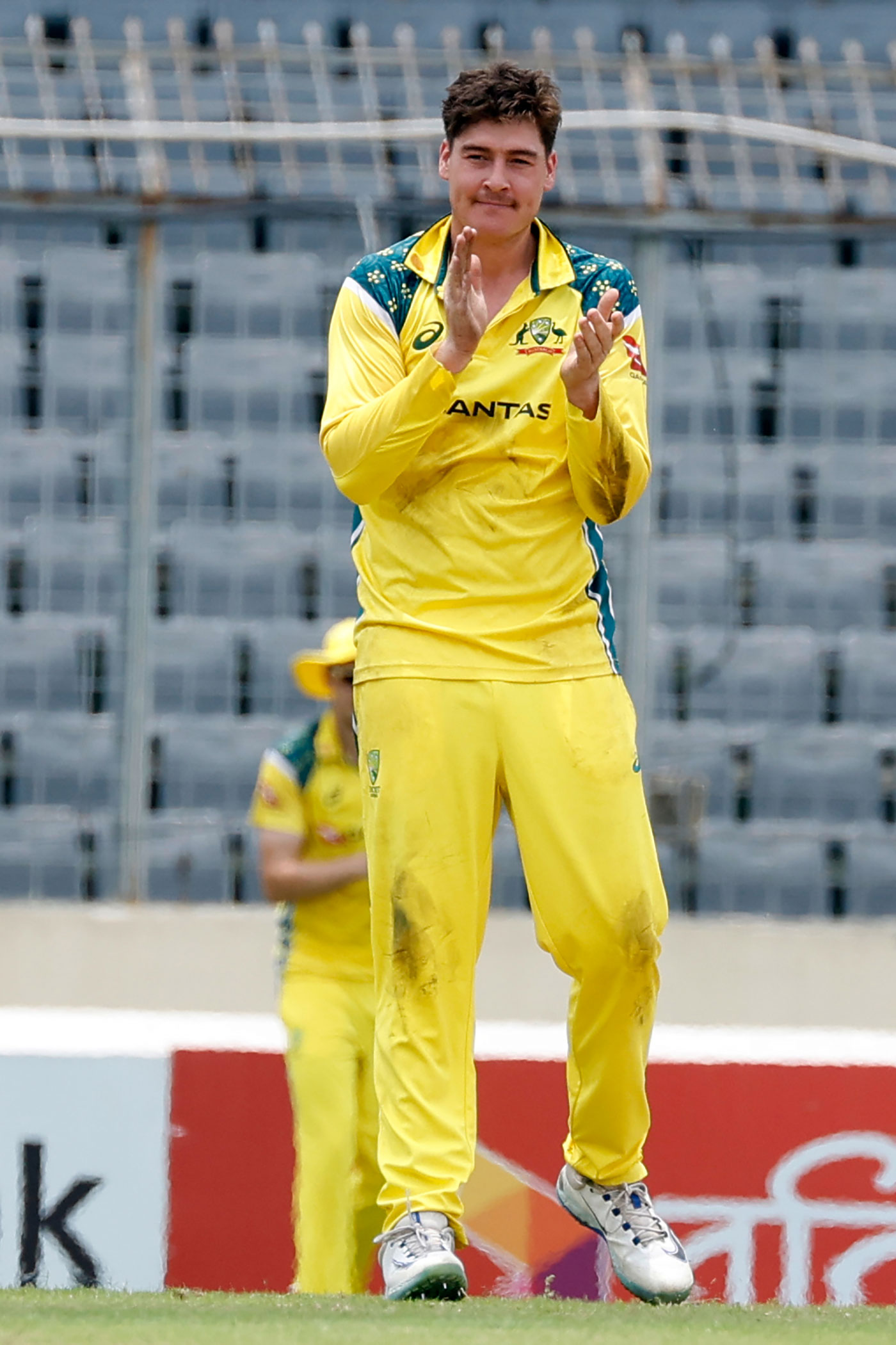
Australia's upcoming Test schedule is taking most of the attention but not long after next year's Ashes they will be defending their ODI World Cup title too. Over the next two weeks, they will play a pair of series against co-hosts Zimbabwe and South Africa, which will be a key stepping stone in their planning. Since the last World Cup, Australia have won 13 of their 28 ODIs and just three of their eight bilateral series, so there is a bit for them to work on.
The future of the middle order
Barring injury or a significant change of tactics, Travis Head and Mitchell Marsh appear locked in at the top of the order. Beyond that, it gets interesting. The absence of Steven Smith (retired) and Marnus Labuschagne (dropped) shapes as one of the significant changes from Australia's 2023 ODI World Cup make up, although there is a chance Labuschagne could be back in the frame come next year's tournament.
Related

Labuschagne dropped from ODI squad; Davies, Peake included
Australia selectors focus on 'important' stepping stone to ODI World Cup defence
Zimbabwe plot to topple Australia again with World Cup on horizon
For now, though, there is a priority to bed in the middle from No. 3 to No. 7 and with only 12 ODIs pencilled in to the calendar between now and the World Cup, that will likely come with a desire to allow players to get familiar with positions rather than have too much experimentation, although some moving parts are to be expected.
One key consideration will be identifying those with the skills to play the finisher roles at No. 6 and 7 that were previously played by Glenn Maxwell and Marcus Stoinis. Since the 2023 World Cup, only West Indies and Zimbabwe have a lower average for those batting at No. 7, while the strike rate sits very much mid-table. Green has the power but will probably be needed a little higher in the order. The same could apply to Inglis. Peake has shown glimpses of his composure but remains very early in his career.
Replacing Maxwell's all-round skills
The identity of those roles may become linked to the balance of Australia's side. In 2023, Maxwell was able to act as the second spinner in support of Adam Zampa meaning they had a line-up of effectively seven frontline batters. In the current squad, Zampa is again the one specialist spinner and it appears a likely route for the World Cup as well.
The role of a second spinner may be less significant than it was in India as Green will also be earmarked to have a considerable part to play with the ball as a fourth quick. From the current squad, Renshaw, Connolly, Head and Davies all provide spin options. Connolly wasn't available to bowl in Bangladesh due to a back injury but is now fit again. Renshaw's offspin, while not quite Maxwell's level, is more than serviceable, as is Head's, while left-arm spinner Davies has come into the frame despite just three List A matches.
Plan B for the quicks
Australia hope that the big three of Mitchell Starc, Josh Hazlewood and Pat Cummins will be able to play another World Cup together but such is their upcoming Test workload that nothing can be certain. Starc and Cummins will arrive for the South Africa matches on this tour but there's a chance they play very little more ODI cricket before the World Cup. In last year's Champions Trophy the pace attack did look light without them, which is not surprising given their combined 532 ODI wickets. They have played one ODI together since the 2023 final in Ahmedabad.
Even if all three do make it to next October, there will still be places for more quicks in the squad. Nathan Ellis, who missed out in 2023 due to a groin injury, should be secure of his place as next in the pecking order. He impressed with the new ball on the tours of Pakistan and Bangladesh earlier this year to show he is more than a death-overs or T20 specialist.
"That tour was an important one for me, taking the new ball and taking on a bit more responsibility within the team," Ellis told cricket.com.au in Harare. "I was nervous because I hadn't taken the new ball in a long time. I was always a new-ball bowler coming through [at grade and domestic levels] - but there's a lot of good new-ball bowlers around the country, so my role changed to a middle over to death sort of bowler.
This tour of Zimbabwe and South Africa presents a big opportunity for Spencer Johnson, long viewed as a Starc-like option, to build on his recovery from a back injury and show he can sustain the 50-over workload. Xavier Bartlett is a new-ball swing bowler who should enjoy southern Africa conditions.
Billy Stanlake, meanwhile, is emerging as an interesting figure across formats having made an ODI comeback earlier this year. Riley Meredith could be another to come into the frame. Sean Abbott, who was part of the 2023 squad, has drifted down the pecking order.
KioskNews shows a cleaned-up reading view extracted from the publisher’s page — the original always lives on their site, not ours.