What's in a name? How a trade war became a war of words
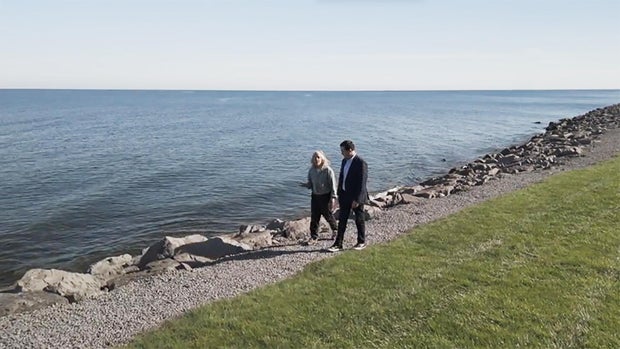
Biologist, sailor, and educator Susan Peterson Gateley has spent her life on Lake Ontario, a 7,300-square-mile body of water between Canada and the United States. It is the life blood of this part of New York State. "It has historic significance to the area, cultural significance, economic influences that are massive, that most people just overlook," she said.
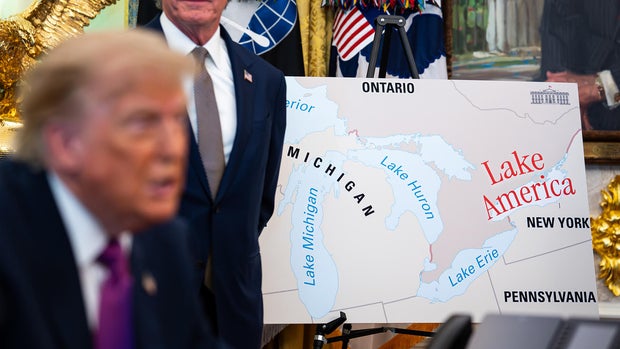
So imagine her surprise when President Trump announced last August that he was renaming the lake via executive order to "Lake America" – a salvo in his trade war with Canada.
"My first reaction was, it's kind of silly," Gateley said. "And my second reaction was, I wonder what Canada thinks of that?"
Asked how Mr. Trump's announcement has affected relationships of Americans with Canadians living around the lake, Gateley replied, "Well, I think we're pretty united in our reaction. So yeah, I think you could say we've bonded over it."
Reaction on both sides of the border has mostly ranged from ambivalence to anger. On the right, there has been some enthusiasm. Cable news commentator Sean Hannity said he identified with the idea of Lake America: "If that's what I identify with, that's what it should be," he said.
All this is just the latest in a series of changes Mr. Trump promised on Day One, when he announced that he was changing the name of the Gulf of Mexico to the "Gulf of America."
But who gets to decide on a name? The answer is complicated.
There is an actual Board on Geographic Names inside the Interior Department, which provides federal guidance, though the president can tell it what to do.
Past presidents have overseen name changes of their own. In 2015, under President Obama, the federal government changed its designation of Mount McKinley in Alaska to Denali. [Last year, President Trump changed it back.] In 1991, President George H.W. Bush signed into law a bill (sponsored by Sen. Ben Nighthorse Campbell) that re-named Custer Battlefield in Montana the Little Bighorn Battlefield.
But a president can't force anyone to use another name.
Former president J.C. Seneca, of the Seneca Nation, said, "I felt offended, really, and I was very disappointed. I just couldn't let it pass."
Seneca told "Sunday Morning" that Mr. Trump's name change could not go without a response: "These types of actions that this president has taken, to try to rename Lake Ontario something else, are opening old wounds that are still unhealed."
The name Lake Ontario traces back to the 1600s. "Ontario" is a word from multiple Native languages; it means "shining water."
Asked why it matters what we call the lake, Seneca replied, "The Indigenous people of this area were here long before the United States and before Canada. This is what they called it."
Seneca also argues the change is legally dubious, citing the Treaty of Canandaigua. It was signed in 1794 between the U.S. and Native people (including the Seneca Nation) and dealt with the lake, land boundaries, and rights.
"The provisions of that treaty also gave process to resolving disputes of any kind between the United States and the Seneca Nations and other Haudenosaunee nations," said Seneca.
Asked if he were ever consulted about the name change, Seneca replied, "No, no, never."
The Trump administration has defended the president's authority to re-name sites. An Interior Department spokesperson told "Sunday Morning": "Naming one of our Great Lakes after our great nation is a proud reflection of who we are as Americans."
Laura Barraclough, an American Studies professor at Yale University, said, "These things are patterned. This is not new. This has been going on for 400 years or more."
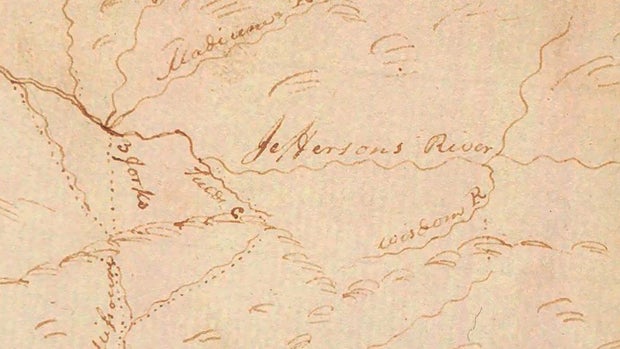
She showed us a map produced by William Clark shortly after he returned from the Lewis and Clark Expedition. "They talked to Native people who lived in those lands and asked those people to describe to them, 'What is this place that we are traveling through? What do you know about it?'"
While there are some Native names on Clark's map, there were also names of people who were important to him, including a river named for Thomas Jefferson. "Jefferson had never been there," Barraclough said. "Jefferson wasn't on the expedition, though he funded it and sponsored it."
And it wasn't just explorers like Lewis and Clark who picked early American names. In the 1800s, as railroads were built out west, they came up with names, too. "The railroads, as some folks may know, received enormous grants of land from Congress to develop not just the infrastructure of the railroads themselves, but also towns and homesteads alongside the railroad," Barraclough said. "In order to promote those, the railroad corporations very often just imposed or invented names on what seemed to them vacant land. If you look at historical maps, you will sometimes see fictitious towns or fictitious places that were named and invented, but never actually grew into anything. They're like ghost towns in a way."
Some names have changed, not from pressure from above, but to move on from the past, like Battle Creek, Utah, named after a massacre of Native people. "The name Battle Creek was getting in the way of a more positive, a more uplifting association for the community," said Barraclough. "And so, they changed the name to Pleasant Grove, which is the name it still has to this day."
Then and now, Barraclough sees reckonings, not merely with names, but with power: "In many cases there is an official name that has been imposed by the most powerful player in a certain struggle. But they are not the only ones. And many other people, communities, institutions have power, too, to continue using the names that are most meaningful to them."
Back on the lake, Susan Peterson Gateley continues to come to these waters nearly every day. For her, it is Lake Ontario … and home. "I think it has its own identity," she said. "I think we need to respect it as an entity. Take a page from the Indigenous thought and respect its spirituality. Water is life. And this is a lake like no other."
Story produced by Amol Mhatre. Editor: Carol Ross.
KioskNews shows a cleaned-up reading view extracted from the publisher’s page — the original always lives on their site, not ours.