Notes from Central Taiwan: From vaccines to drones: The anatomy of Taiwan’s political forgetting
A massive NT$1.06 billion procurement hoax unmasks the routine KMT strategy of weaponizing scandals against Taiwan-centered policies
By Michael Turton / Contributing Reporter


The Tzu Chi Foundation, the globally known Buddhist charity, announced on July 21, 2021 that it had signed a deal to purchase 5 million doses of the Pfizer-BioNTech (BNT) COVID-19 vaccine. It said that the vaccine doses would be donated to the government’s COVID vaccine program. In October the Centers for Disease Control (CDC) made a public announcement thanking the Buddhist foundation and others for the 889,200 doses of the BNT vaccine they had collectively donated.
FRAUD
Earlier this month, the public was stunned to learn that prosecutors had indicted former Changhua Bar Association chairwoman, Chen Yu-hsuan (陳昱瑄), and others on suspicion of defrauding Tzu Chi of over NT$1.06 billion by falsely claiming to have special channels for purchasing BNT vaccines. According to investigators, the suspects had neither the ability nor the means to obtain the vaccine as they had claimed.

Taichung prosecutors collect evidence in a false COVID-19 vaccine procurement case in an undated photograph.
Photo courtesy of the Taichung District Prosecutors’ Office via CNA
According to local media, prosecutors said that Tzu Chi had stated that the manufacturer’s quote was US$205 million (US$41 per dose), but Taiwan Semiconductor Manufacturing Co (TSMC, 台積電) and Hon Hai Precision Industry Co (鴻海精密, also known as Foxconn Technology Group, 富士康科技集團), who were also buying and donating vaccines, had a budget of approximately US$175 million (US$36 per dose). The difference was US$30 million, or roughly the equivalent of the NT$1.06 billion commission paid by Tzu Chi to the fraudsters.
The alleged fraudsters, posing as brokers, had apparently inserted themselves into Tzu Chi’s vaccine acquisition program. They told the charity that they could procure the vaccines, took the money on trust and did nothing because the vaccines were coming anyway through other channels. Incredibly, it seems Tzu Chi neither did due diligence when first approached, nor did it follow up to see whether any purchases had taken place on its behalf. It apparently remained completely unaware it had been victimized until investigators stumbled onto the scam while pursuing another case, according to media reports.
This story has blown up as a major political issue, particularly in the Taipei mayoral campaign, as it revisits a past of Chinese Nationalist Party (KMT) attacks on the Democratic Progressive Party (DPP) and its vaccine policies, including accusations of corruption and cronyism. These accusations have gone down the rabbit hole of political forgetting, though they follow the pattern of the KMT whenever the DPP makes a pro-Taiwan move instead of supporting the People’s Republic of China (PRC). That pattern of forgetting is also a feature of the public’s reception of KMT attacks on Taiwan and the DPP.

Staff from the Changhua County Public Health Bureau recall tainted oil products in an undated photograph.
Photo courtesy of the Changhua County Public Health Bureau
Readers may recall that during 2021 there were numerous donations of vaccines by Japan, the US and other countries. However, as a recent editorial recounts in the Liberty Times (the sister paper of the Taipei Times), political and business figures associated with the KMT and Taiwan People’s Party (TPP), began to promote the German-made BNT vaccine. The apparent attention of this program was to stop the use of any vaccines but BNT.
However, the “Greater China” distribution rights for BNT vaccine were obtained by Shanghai-based Fosun Group (復星國際). Though Taiwan secured a contract for 5 million doses of BNT in early 2021, the PRC halted the sale. (It is astonishing that the repeated betrayals of local KMT interests by the PRC never affects KMT willingness to support the PRC.)
To fill in the gap, private organizations stepped in. However, as the government observed at the time, private groups cannot bear the legal and compensation responsibilities if health problems with the vaccines should arise. Hence, the vaccines had to be given to the government. Private groups had to obtain government authorization and a special import permit to bring in vaccines. Because of these requirements, former Minister of Health and Welfare and then-head of the Central Epidemic Command Center, Chen Shih-chung (陳時中), a DPP appointee, repeatedly reminded these organizations that brokers who claimed to have procurement channels were likely scammers.
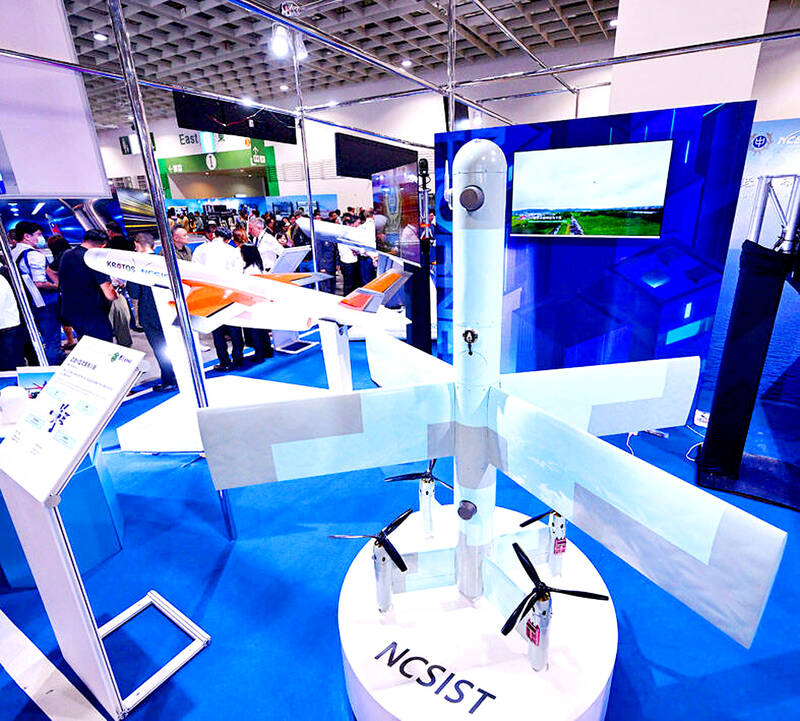
Attack drones Mighty Hornet III, front, and Mighty Hornet IV, back, are pictured at the Taipei Aerospace and Defense Technology Exhibition in Taipei on Sept. 18 last year.
Photo: Fang Pin-chao, Taipei Times
Politicians from the KMT and TPP camps attacked the DPP for “blocking vaccines” and killing Taiwanese. The Liberty Times recalled that then-chairman of the TPP, Ko Wen-je (柯文哲), said that “at the height of the pandemic, the government blocked BNT from entering the country in order to ‘protect high-end vaccines.’”
Indeed, Johnny Chiang (江啟臣), then-chairman of the KMT, sued Chen Shi-chung and the director of the Food and Drug Administration (FDA) for corruption, saying that they had profited from these high-end vaccines. The KMT also accused the DPP of using dangerous, untested vaccines on young people, since older people had priority for vaccines. As Brian Hioe pointed out at Taiwan Insight, the KMT was “hoping to make inroads with a demographic that has drifted away” from the party. The KMT also attacked the Astra-Zeneca vaccine, though major figures in the KMT quietly had themselves vaccinated with it.
Chiang’s complaints follow the typical pattern of KMT attacks. Chiang said that the KMT had always supported the development of domestically produced vaccines, but it supports “safe and effective” vaccines that adhere to international standards and acquire international certification, not vaccines whose growth is artificially accelerated.
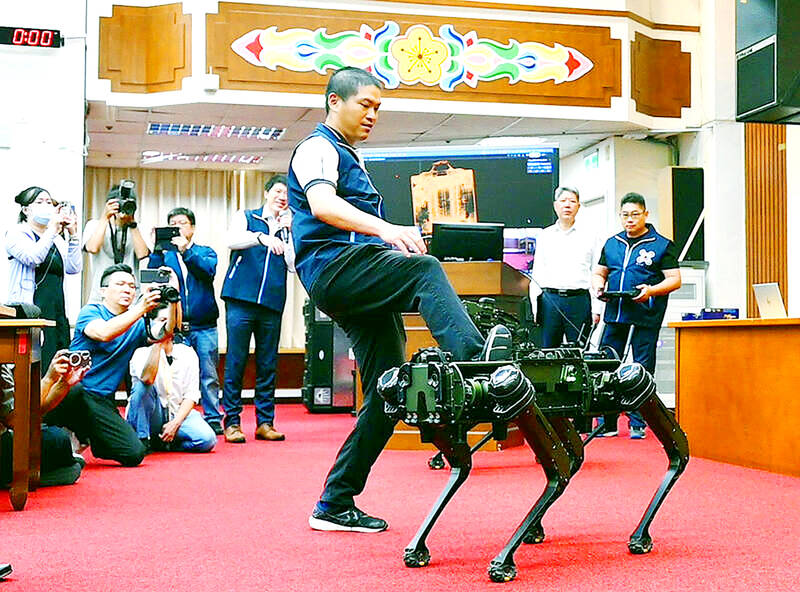
A technician on Wednesday kicks a robotic dog to demonstrate its capabilities at the Legislative Yuan in Taipei.
Photo: Tu Chien-jung, Taipei Times
DRONES
Sound familiar? Just substitute the word “drones” for “vaccines.” The KMT has one pattern of attack, which it always uses: accuse the DPP of corruption whenever it is doing something Taiwan-centered, say that the DPP approach is too expensive, while simultaneously putting its hand on its heart and piously proclaiming that it has always supported whatever program it is attacking. The last two decades offer many examples of this playbook.
For then-legislator and current Taipei Mayor Chiang Wan-an (蔣萬安), the vaccine issue became an important line of attack on the DPP. He said the DPP was “constantly blocking vaccines and protecting high-end vaccines,” and asked the public: “Do you believe Tzu Chi or the DPP?”, as if the two were in conflict.
The pro-China parties’ attack on the DPP thus accused it of killing people to make money for vaccine makers it was connected to, which the Liberty Times said had powerful effects on the 2022 local elections. The attacks continued into 2023, as a recent Taipei Times editorial observed, impacting the 2024 elections. A legislator at the time, Chiang Wan-an sat in on closed meetings on government vaccine procurement, and knew what was really going on.
As the Liberty Times pointed out, this was the same playbook that Chiang is now using in the tainted oil failure of the Taipei and Taichung city governments — accusing the central government of forcing people to consume toxic oil, when in fact KMT-led governments were responsible.
The brazen fraud against Tzu Chi has completely destroyed Chiang’s accusations from the COVID era and vindicated Chen Shi-chung’s warnings about fraud. DPP Taipei mayoral candidate Puma Shen (沈伯洋) has had a field day accusing Chiang Wan-an of hypocrisy and lies. A CMmedia piece last week said that the DPP hopes to use the KMT’s now-exposed vaccine attacks as leverage in the elections in Taipei, Hsinchu and Nantou.
Hopefully voters will finally make the connection between drones, tainted oil, vaccines and a hundred other items.
KMT politicians just this week were complaining that the public should have been better informed about the Internet slow down drills. KMT Legislator Ko Ju-chun (葛如鈞) said without better clarity the drills were essentially treating the public as “guinea pigs.”
Sound familiar?
Notes from Central Taiwan is a column written by long-term resident Michael Turton, who provides incisive commentary informed by three decades of living in and writing about his adoptive country. The views expressed here are his own.
KioskNews shows a cleaned-up reading view extracted from the publisher’s page — the original always lives on their site, not ours.