How animal products are powering India’s farm exports

Livestock and fisheries contribute roughly 40% to India’s agricultural GDP today, as against 30% just over a decade ago. That is now getting reflected in exports as well. Latest data from the Department of Commerce shows marine products and buffalo meat to be the country’s two biggest agricultural export items.
Overall farm exports during April-September, at $27.1 billion, were up 4.7% over the $25.9 billion for the same period of 2025. But marine products and buffalo meat exports grew at a much higher rate of 13.2% (from $4 billion to $4.5 billion) and 53.8% ($2.2 billion to $3.4 billion) respectively.
The value of marine products exports from India crossed an all-time-high of $8.4 billion in 2025-26 (April-March), which came despite US President Donald Trump’s tariff shock. Even as it led to a fall in exports to the US (from $2.7 billion in 2024-25 to $2.3 billion in 2025-26), that to other countries such as China, Vietnam, Japan, Thailand, Belgium, Canada, Spain, Italy, Russia, Malaysia, the United Kingdom, and Taiwan rose.
The current fiscal has seen exports to the US recover (from $1.3 billion in April-September 2025 to $1.5 billion in April-September 2026), alongside continued buoyancy in that to China ($659.3 million to $753.4 million), Japan ($219.8 million to $318.4 million), Thailand ($138 million to $172.2 million) and Russia ($85.7 million to $137.8 million).
Bullish on buffalo
More impressive, however, is buffalo meat exports, which had actually dropped from $4.8 billion to $3.2 billion between 2014-15 and 2022-23. That figure topped the $5-billion mark for the first time last fiscal and is well on course to exceed $6.5 billion in 2026-27.
There are two significant features of Indian buffalo meat exports.
The first is the remarkable diversification of markets. Out of the $3.4 billion exports during April-September, the major destinations included Vietnam ($526.3 million), Egypt ($465.3 million), Malaysia ($346.6 million), Indonesia ($301.2 million), Saudi Arabia ($255.5 million), the United Arab Emirates ($212.5 million), Jordan ($192.4 million), Uzbekistan ($188.7 million), Iraq ($183.2 million), and the Philippines ($104.7 million).
Story continues below this ad
Secondly, Indian exporters have also improved their value realisation per tonne. In 2022-23, the average value from every tonne of buffalo meat shipped from the country was only $2,716.8. That went up to $2,889.6 in 2023-24, $3,236.2 in 2024-25, and $3,591.4 in 2025-26. During April-September 2026, the average value realisation was $4,368.2 per tonne.
The higher unit value realisations indicate increased product acceptability of Indian buffalo meat in markets across Southeast, West and Central Asia; it is no longer perceived as a cheap number two alternative to regular cattle beef. This has also been enabled by government policy permitting exports to take place only from registered abattoirs and meat processing plants, which is conditional upon their meeting stringent safety, hygiene and infrastructure requirements.
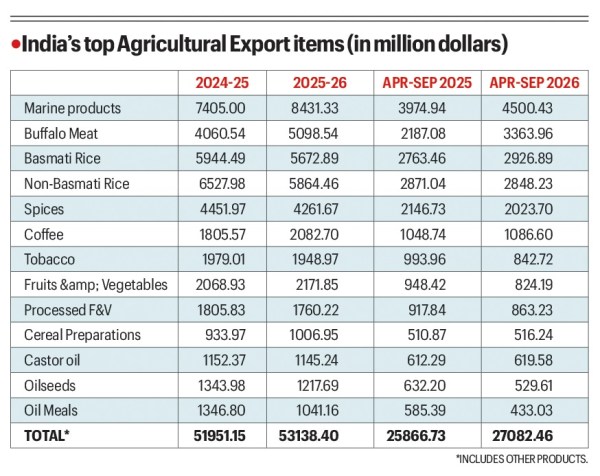 Table 1: Barring two animal product items, the growth in exports of all other farm commodities during the first half of this fiscal has been low or negative.
From Table 1, it can be seen that barring the two animal product items, the growth in exports of all other farm commodities during the first half of this fiscal has been low (basmati rice and coffee) or negative (non-basmati rice, spices, tobacco, fruits and vegetables, oilseeds and oil meals).
Trends in India’s agricultural imports
India’s agricultural imports have traditionally been dominated by two big-ticket commodities where domestic production has trailed demand: vegetable oils and pulses.
Story continues below this ad
The value of vegetable oil imports peaked at $20.8 billion in 2022-23 and by quantity at 169.4 lakh tonnes (lt) in 2025-26. Imports of pulses hit record levels in both value ($5.5 billion) and quantity (72.6 lt) terms in 2024-25. Imports of the two are unlikely to be anywhere near those highs in 2026-27, if trends for the first half are any indication (Table 2).
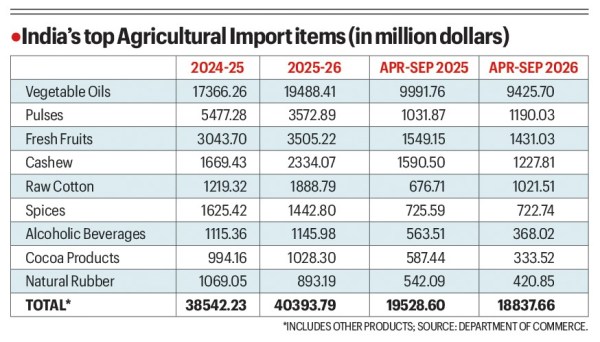 Table 2: India’s top agricultural import items.
That could, nevertheless, change with a poor crop on the back of an intensifying El Niño. The Narendra Modi government has already slashed the import duty on crude palm and soyabean oil from 16.5% to 11%, and from 16.5% to 5.5% on sunflower oil, with effect from September 24. The need to augment domestic supplies and check food inflation may lead it to further cut these in the coming months and also remove the duty on imports of masoor (red lentils), chana (chickpea) and yellow peas similar to that on arhar (pigeon pea) and urad (black gram).
The one import item to have registered a notable surge in recent times is raw cotton. India, not long ago, was a massive exporter of this natural fibre, with the value of its shipments topping $4.3 billion, $3.7 billion and $3.6 billion in the three successive years from 2011-12 to 2013-14.
In 2024-25 and 2025-26, the value of imports ($1.2 billion and $1.9 billion) overtook that of exports ($809.7 million and $560.7 million). Imports have soared by over 50% during the first half of this fiscal too and are set to end up at $2 billion-plus.
Story continues below this ad
Simply put, India has turned from a net exporter to an importer of cotton. Much of that is courtesy of stagnant, if not declining, domestic output due to no new yield-enhancing technologies after Bt cotton. The Modi government has allowed duty-free imports of cotton till December 31 and might extend that if this year’s crop turns out subpar due to drought in large growing tracts of Maharashtra, Gujarat, Karnataka, Telangana and Andhra Pradesh.
Another commodity where India could be a net importer this year — and possibly next — is sugar.
The government, on May 13, banned the export of all sugar from the country, following an unexpected production drop and projected stocks for end-September depleting to a 17-year-low. On August 21, it also approved the import of 10 lt of raw sugar at zero for mills to process into white or refined sugar and sell in the domestic market.
Like with cotton, any shortage of domestic cane available for crushing by mills because of dry weather conditions in Maharashtra and Karnataka can force an additional quantity of duty-free raw sugar imports.
Story continues below this ad
In all, one can expect the still unfolding El Niño to result in higher imports and reduced imports of farm commodities in the months ahead. That impact would, perhaps, be more on field crops and bulk staples than on animal products.
KioskNews shows a cleaned-up reading view extracted from the publisher’s page — the original always lives on their site, not ours.