Roughly 9 in 10 Korean seniors want to learn how to use AI
(Getty Images Bank)
Ahn Jeong-ok, a 61-year-old Korean woman who runs a business with her husband, has recently become enamored with artificial intelligence.
She finds joy in using AI to look up information like the weather at travel destinations and where the best restaurants are in that region. It has also given her confidence that, if she takes a more systematic approach to learning its mechanics, she will be able to draft formal documents, such as statements regarding fraud, without the help of a lawyer.
A recent survey revealed that the majority of seniors (defined as those between the ages of 60 and 74) in Korea are AI curious. Ahn is one such example of an AI-curious senior — someone who has a high level of acceptance of AI technology and a strong desire to learn.
The Hankyoreh commissioned polling firm Opinions to conduct a mobile web survey of 532 men and women nationwide aged 60 to 74 to gauge their perceptions regarding the spread of AI technology. The survey took place from Aug. 21 to Aug. 25.
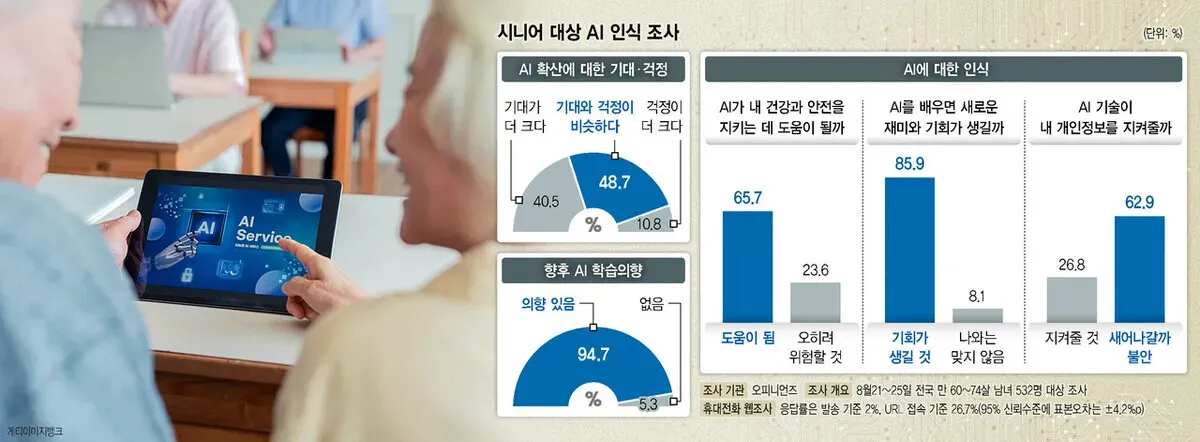
More than 4 in 10 respondents (40.5%) said they expected significant benefits from the growing use of AI in daily life — nearly four times the share who expressed serious concerns (10.8%). Meanwhile, 48.7% said their expectations and concerns about AI were roughly balanced.
Additionally, 34.4% of respondents said they were eager to learn how to use AI, while another 60.3% said they would be open to learning. Combined, that means an overwhelming 94.7% expressed an interest in learning how to use AI.
The largest share of respondents (55.2%) said their optimism about AI stemmed from the expectation that it would make everyday life more convenient. This was followed by 25.5% who believed AI could improve health and safety, and 9.4% who saw it as a potential way to ease loneliness.
On the other hand, among those who expressed significant concerns about AI, 30.1% said they viewed it as a burden because of the difficulty of learning how to use it. Another 26.6% worried that AI could reduce human employment and weaken interpersonal connections, while 15.1% were concerned about machines malfunctioning.
The survey demonstrated how AI has already become an integral part of the lives of seniors. Nearly 3 in 10 (28.9%) respondents stated that they regularly use AI chatbots such as ChatGPT, while 39.8% stated that they have used it. Another 29.4% said they were aware of AI chatbots, but they had never used them. Only 1.9% stated they had never heard of such technology.
“AI is not a technology that requires the operation of unfamiliar devices. In fact, it is a technology that can blend naturally with our daily lives,” noted You Jae-youn, the head of social affairs at the Presidential Council on National Artificial Intelligence Strategy. “AI will be highly useful if seniors make good use of it when accessing public services and managing their health.”
By Lee Ju-hyun, Hankyoreh Human and Digital Research Institute staff writer
KioskNews shows a cleaned-up reading view extracted from the publisher’s page — the original always lives on their site, not ours.