Lee rules out Korean troops joining US operations in Strait of Hormuz
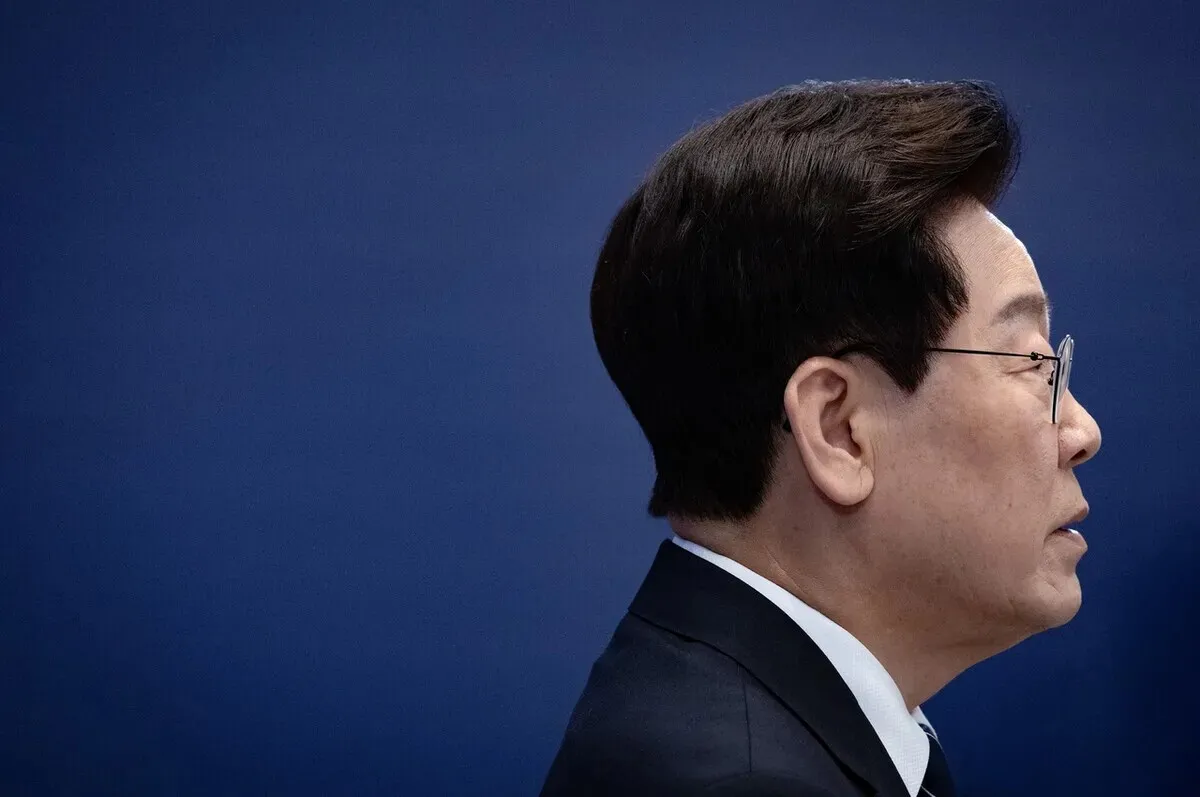
President Lee Jae Myung speaks at a press conference held at the Blue House guest house on Sept. 18, 2026. (pool photo)
Emphasizing that Korea would make “no deployment to a war,” President Lee Jae Myung said Friday that Seoul will not deploy troops to the Strait of Hormuz to intervene in the fighting there, while signaling that the government is considering expanding the operations of its Cheonghae naval unit in the region.
“Let me clearly reiterate that there will be no deployment to a war,” Lee said in a press conference held at the Blue House’s state guest house on Friday morning.
“We’ve so far upheld the principle of noninvolvement and nonintervention in war, and will continue to do so in the future,” he added.
At the same time, Lee said that Korea “clearly must also take the minimum steps necessary to protect our merchant vessels, oil shipping lanes, and the lives and safety of our nationals just as other countries do.”
The president noted that the public appeared concerned about “the potential for the boundary to be blurred.”
“As many are aware, the Cheonghae Unit is already on assignment [in the region], and our military is preparing to respond to piracy and other threats to our ships, our shipping and our citizens. We’re seriously considering how to strengthen those efforts,” he said.
“Many appear to be worried about Korean service members being placed under the command of foreign militaries and put in harm’s way. Let me clearly reiterate that there will be no deployment to a war,” the Korean president said.
By declaring that Korean troops will not be deployed to a war or placed under the command of a foreign military, Lee was essentially saying that he will not assign Korean troops to an American command if that means their involvement or intervention in the US’ ongoing war against Iran.
The debate over a potential deployment to the Strait of Hormuz included rumors that the Korean government was mulling the deployment of maritime patrol aircraft, combat support ships and minesweepers.
Since maritime patrol aircraft are involved in finding targets on the surface and underwater, that would mean direct intervention in the war. Combat support ships, which would carry fuel and other supplies that enable the US to keep prosecuting the war, would also involve Korea in the war.
Maritime patrol aircraft and combat support ships would have to enter the US military’s chain of command in order to carry out missions in the Strait of Hormuz, where the war is underway. Considering this, Lee’s refusal to place Korean troops under the command of a foreign military means he will not allow joint operations designed to support US military operations in the strait.
Since Iran regards aiding the US military as hostile involvement in the war, Lee’s rejection of foreign command of Korean forces implies that Korea will not engage in hostilities against Iran during the war.
Also notable is Lee’s comment about taking “the minimum steps necessary” to protect Korean merchant vessels, oil shipping lanes, and the lives and safety of Korean nationals “just as other countries do.”
That suggests that Lee plans to join countries including the UK and France in contributing militarily to a multinational force in the Strait of Hormuz after the hostilities have ended.
KioskNews shows a cleaned-up reading view extracted from the publisher’s page — the original always lives on their site, not ours.