Swiss-born Jerusalem artist Ariane Littman spreads her wares across the nation
Life proffers numerous opportunities for a change of direction at various junctures along our meandering, undulating pathway on terra firma.
Some may be more obvious than others. But the question is whether we (a) discern them and (b) reach out and grab them by the horns and see how they play out.
Ariane Littman appears to be particularly adept at both.
The Swiss-born sixtysomething multidisciplinary artist from Beit Zayit maintains a strong presence in the national arts arena, with solo exhibitions and spots in several group shows currently dotted around the country.
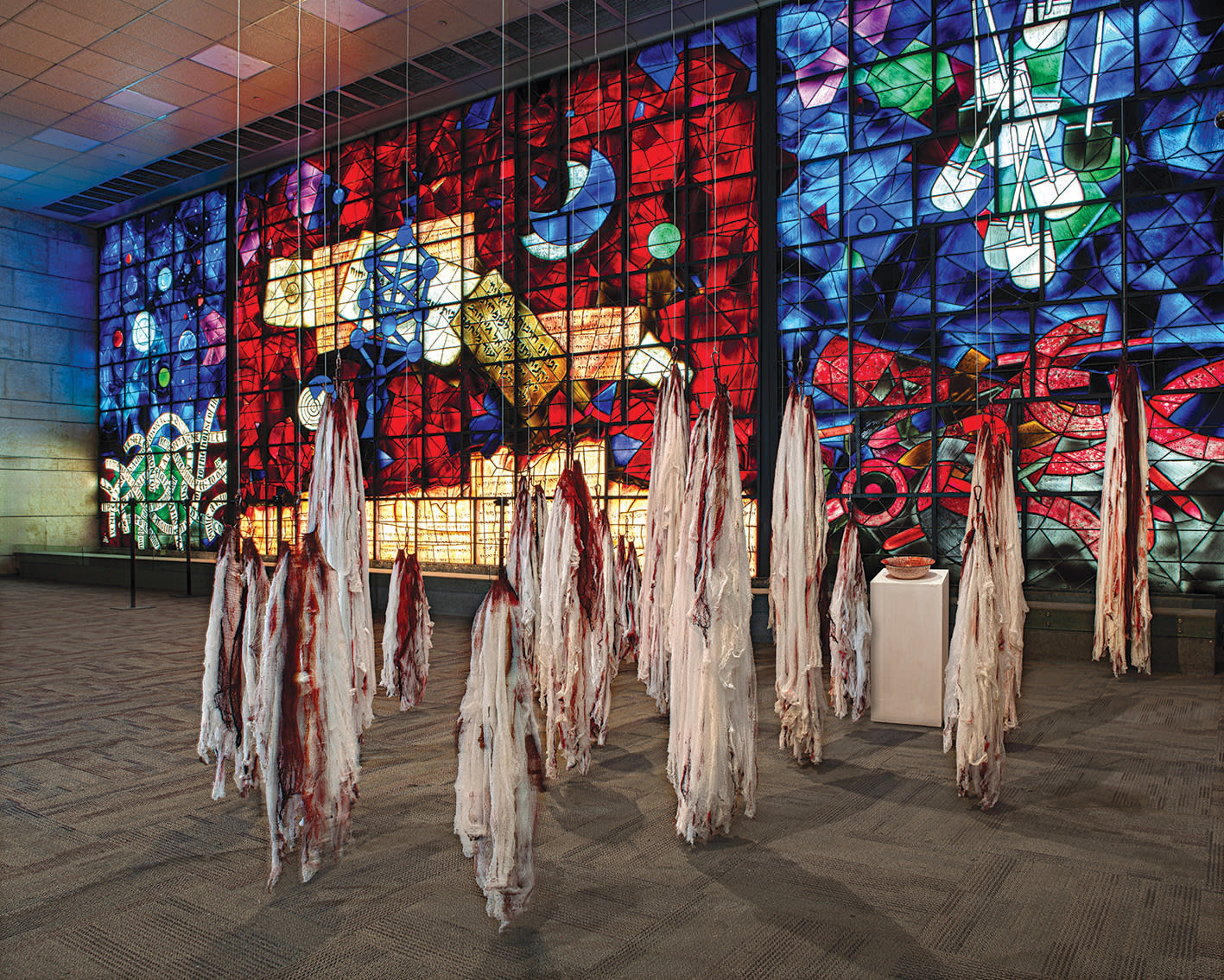
Her latest run-out is on display at the former National Library of Israel building on the Givat Ram campus of the Hebrew University, within the framework of the Jerusalem Biennale.

It is a dramatic work which goes by the evocative title of Sanguine Fields, and forms part of the Reflected Light: An Active Vision set that feeds off the monumental stained-glass window triptych, Isaiah’s Vision of Eternal Peace, created over 40 years ago by Mordechai Ardon.
The biblical prophecy of beating swords into plowshares and finally dispensing with the need for military action is both emotive and thought-provoking. Sadly, it remains pertinent today, as politically festered violence continues to claim lives and cause anguish at all sorts of flash points across the globe.
On the domestic front, Littman’s work references Oct. 7 and its convoluted aftermath, including the long, drawn-out hostage situation.
If that wasn’t clear from the clutch of red-tipped elongated white gauze drapes suspended from butcher’s hooks, the enamel bowl placed near the amorphous medical fabrics spells it all out. The vessel alludes to incantation bowls used by Jews, Christians, and other cultures such as the Mandaean to ward off evil spirits.
Littman’s piece has that fateful date – 7.10.23 – inscribed on both the interior and exterior surfaces, dozens of times, in very small, compactly spaced numerals.
Bandaging the wounds
“I took hundreds of bandages and opened them up,” Littman explains. “I get them from a hospital supplier.”
That fits the wounded collective and personal bill. The white clusters hang airily, yet densely and somehow concretely, in a manner that seems to defy gravity.
The ethereally leaning posture also suggests a flame-like entity reaching for higher domains.
“It is not a static work,” she adds, a mite needlessly.
That creative and curative endeavor followed in the emotional and immediate temporal wake of the Hamas attack.
“I was paralyzed for six weeks. I was simply incapable of doing anything [artistic],” she recalls. “The only thing I managed to do was to mark that date.” It was to become a lengthy process. “I did that for a year,” Littman continues.
That was an instinctive move, mostly the result of a desperate need to assuage some of her pent-up distress at the doomsday scenario that was playing out down South, and the pain of the families of the dead and those taken into captivity in Gaza. “I didn’t know about the Babylonian origin [of incantation bowls], so I went to take a look at some [in a museum].
The work began to take corporeal and impassioned shape. The bowl at Givat Ram contains a telling blood-red dried residue.
“What you have here is gauze bandages soaked in red, which dripped all night into the bowl,” Littman says.
She had originally meant to place a receptacle beneath each gauze assemblage, but wisely ultimately opted not to subject the public to sensory overload.
Gauze bandages have been a leitmotif of her oeuvre since 2009, when she and her family went through a trying episode. Her then nine-year-old daughter, Kalia, was on a fourth-grade field trip and sustained third-degree burns when a large pan of boiling water and oil spilled all over her.
That was, naturally, an emotional game changer for Littman, but it also provoked some new aesthetic thinking, as the bandages she helped apply to her daughter’s mutilated limbs became an integral tool of her craft.
I got evidence of that change of substance tack at Littman’s studio in deepest Talpiot. It is a capacious workspace with plenty of light. The large, high-ceilinged main room, and entrance corridor, are jam-packed with past creations and images thereof.
Gauze upper strata partly mask Israeli flags and roughly delineated excerpts of our national map. Some incorporate yellow thread, suggesting surgical repairs, while one has yellow thread spots dotted around Gaza. “That marks the locations, roughly, where the hostages were being held. The color of the twine references the yellow ribbons used as a symbol of solidarity with the Israelis incarcerated in Gaza,” Littman enlightens.
She studiously followed post-Oct. 7 events.
“I was glued to the TV set for some time,” she says. “I didn’t fight in the war, and I didn’t go to the South to volunteer. But the least I could do was listen to what the relatives of the victims and the hostages were saying. It was like listening to Holocaust testimony.”
That eventually found its way into her creative continuum, allowing her to distill some of her sentiments through her hands-on pursuit and, hopefully, set her emotional house a little in order.
Littman did not initially set her sights on art as an all-consuming occupation.
After making aliyah from her home in Switzerland, in the French-speaking region near Geneva, in the 1980s, she took a degree in Middle Eastern studies and international relations at the Hebrew University.
Perhaps that was something of a throwback to her English-born father’s – David’s – clandestine participation in a Mossad operation, in 1961, to get Jewish children out of Morocco to Switzerland and thence to Israel. He was an archaeologist who spent time here on excavations.
Her mother is a now 93-year-old writer who goes by the nom de plume of Bat Yeor, deftly alluding to her birthplace of Egypt. Yeor is the biblical name for the Nile.
Culture abounded in the Littman household, and the artist recalls being taken to museums around Europe, which sowed the seeds for her eventual choice of profession.
Death leads to a new life
There is plenty of quotidian drama to Littman’s bio, which naturally informs her art. It was, in fact, a seismic family event that shuffled the emotional pack and set her on her artistic path.
Her world turned upside down when her brother, Daniel, committed suicide at the age of just 23.
“After that, I said to myself: ‘Life is short. I have to do what is really important.’ I applied to Bezalel [Academy of Arts and Design] and was accepted. That changed my life.”
That new – and ongoing – lease of life was sparked, tragically, by a life cut far too short.
The decision to try a different line of study and, thereafter, professional interest had, it seems, been percolating for some time. It was also part of Littman’s heartfelt desire to find an alternative means of getting her ideas and feelings out there.
“I always thought that, despite everything, art is a different means of communication compared with communicating through war or fighting.”
There’s no argument there.
“There are all sorts of artists and art forms. But at the end of the day, it is about communicating. People may connect with one work or another, and that’s fine. For me, it is a better form of communication.”
Littman has a point, and we would do well to bear that in mind if we ever come across, say, a piece of avant-garde music or conceptual art that may appear nightmarish or simply rubbish to more conservative minds.
As far as we know, relatively few people have been killed because of their artistic output. Yes, the Nazis banned what they called Entartete Kunst – degenerate art – which was generally modern forms of art, or works created by non-Aryans. Similarly, various other totalitarian regimes have persecuted artists who did not toe the party line. But if we add up all the millions killed in wars over the centuries, the number of the former pale almost into insignificance.
If it is true, as the clichéd wisdom has it, that artists need to go through some emotional mill in order to create, sadly Littman qualifies there, big time.
“There is my brother, and my daughter’s terrible accident, and I have a sister, just one year older than me, with special needs. It hasn’t been easy.”
Her determination to follow her heart and stick to what is really meaningful for her, in the wake of Daniel’s suicide, had knock-on effects in other areas of her life, too.
“I also decided to get married,” she says.
Many years later, she got divorced, but she has three charming daughters, as she maternally and proudly puts it. There was more than a whiff of naches in there.
Going out on a limb
Littman’s CV is a multilayered affair, but if one thread runs through it all, it is her drive to jump in at the deep end and see things through.
She served as a photojournalist during the dangerous Second Intifada times, learning to take pictures as she went along. This was before digital cameras were readily available, and she says she milked her fellow snappers for professional tips on the fly.
She also got some help from someone close to home, literally. “Rina Castelnuovo, the great New York Times photographer, was a neighbor of mine. She took me to all sorts of places. I used my dad’s old Leica,” she chortles.
You could put Littman’s dynamic artistic trajectory down to the great reserves of energy and joie de vivre she exudes. That certainly helps. But she also imparts a robust desire to meet life head-on and see what she can possibly make of it.
“At the end of the day, as an artist, I can decide that I only create within the confines of my studio, or I can decide that my studio is also out there, in the field. It is there that you can understand more.”
That entails ingesting the myriad stimulants that everyday life proffers, rather than holing up in cloistered surroundings and focusing on one’s inner world.
There are arguments to be made for both approaches, but Littman is clearly the outgoing type. She, presumably, would go along with celebrated exiled Chinese artist Ai Weiwei’s succinct observation: “Life is art. Art is life. I never separate it.”
“I have always chosen not to be in the Kantian place of disinterestedness. I chose to be in the place of the emotion and exploration,” she declares.
“I think my approach [to art] also came from my lack of understanding and the desire to understand – even if, in the end, I realize I don’t understand anything. One has to try to touch on something and understand it.”
As a keen cyclist, Littman also appreciates the value of the journey, and not just the satisfaction of achieving one’s goal, of arriving at the planned or sought-after destination.
Taking the mother’s healing perspective
Oct. 7, 2023, continues to reverberate across Littman’s daily life and her work. She seeks solace through her art, and also strives to generate some comfort to others.
That line of thought and feeling spawned In the Eye of the Storm, an audiovisual installation with Lake Kinneret (the Sea of Galilee) and its healing powers at its core.
Motherhood is also a central element of the work, in which Littman encounters two bereaved mothers, Liat Friedman and Layla Abbas, whose sons, Shahar Friedman and his commander, Jamal Abbas, were killed in Gaza in an attempt to save their comrades in arms.
It is a suitably moving piece, which also features gauze bandages, which the mothers wrap around Chana Orloff’s iconic Mother and Child sculpture at Kibbutz Ein Gev.
In the Eye of the Storm is currently on show at the Yigal Alon Centre at Ginosar, on the northwestern corner of the Kinneret.
The installation is part of Littman’s ongoing series Wounded Land.
The act of bandaging works of art, monuments, and trees is a powerful gesture of healing.
She even once bravely allowed herself to be completely swathed in bandages, to the point of not being able to move any part of her body, and pushed out onto the gently lapping waters of the Dead Sea.
“That was scary,” she recalls. “I had to make sure I didn’t tilt too much; otherwise, I would have capsized.”
They say that, to be a true artist, you have to go out on a limb or two. Littman certainly makes the grade on that score.
As an olah keen to feel at home here, Littman quickly gained fluency in Hebrew and developed a preoccupation with maps and geographic spots, relating to their human and political characteristics.
That, as we all keenly and corporeally know in this part of the world, can be a highly contentious issue. But Littman appears to be made of sterner stuff, a prerequisite for making headway through the minefield of insecurity that is the lot of many an artist, particularly in the state support-starved cultural field.
She maintains a more-than-steady working pace, and also has several works on show at the Haifa Museum of Art at the moment. And there is a new book in the offing, called “Art in A Time of War After Oct. 7, Wounded Land 2023-2026.”
Notwithstanding her ever-expanding portfolio, and her almost ubiquitous presence at art repositories across the country, including as a member of the Agripas 12 collective now based at Givat Ram, Littman continues to grapple with the whys and wherefores of her craft.
“I wondered whether there was any value in creating art,” she confesses. “With all this violence, and people being killed, how could art help? Do we need art at all?”
The answer came from without, from foreign climes.
“I went to Paris, to the Picasso museum, and I saw artworks that were made in times of war by all sorts of French and Italian artists, in addition to Picasso. I realized that they moved me, that they meant something to me, all these years later.”
Judging by her exhibition success to date, Littman’s own creations appear to be having an effect in real time, but she is still hopeful that several years down the road they will continue to convey her healing, stimulating message.
And who knows? Perhaps they – and art in general – will make a difference for the better.
For more information:
ariane-littman.com, www.hcm.org.il, and yigal-allon-centre.org.il
KioskNews shows a cleaned-up reading view extracted from the publisher’s page — the original always lives on their site, not ours.