Netanyahu’s Likud accused of election fraud cover-up as Israel probes Arab parties’ record 19-seat victory
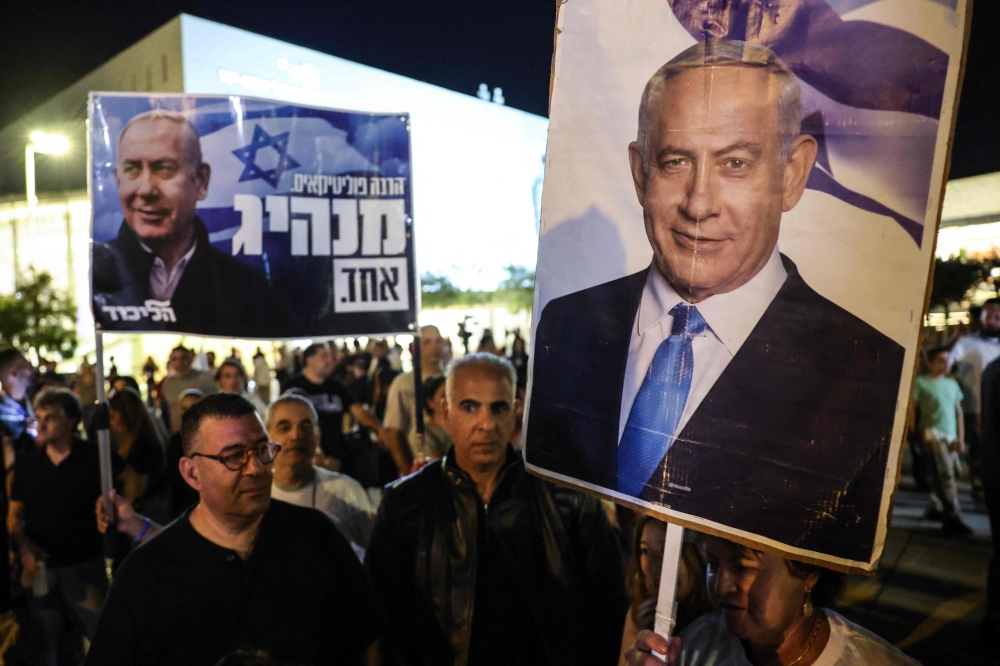

Right-wing protesters hold portraits of Israeli Prime Minister Benjamin Netanyahu during a rally in Tel Aviv on Oct 31, 2026, following Israel’s general election. — AFP pic
First Published: Wednesday, 04 Nov 2026 8:57 AM MYT
HERZLIYA, Nov 4 — Israel’s attorney general asked the intelligence services to submit progress of a probe into alleged poll fraud involving Arab parties, as Prime Minister Benjamin Netanyahu’s party accused her of covering up “manipulation” ahead of the official results yesterday.
President Isaac Herzog is due to receive the official results of the October 27 elections, which produced no clear majority, at midday.
He will then begin meeting with the political parties.
Yesterday evening, the electoral commission said the publication of results would not be delayed as demanded by Netanyahu’s Likud party, which wants to wait until the investigations launched by the Shin Bet intelligence services are completed.
Likud and Netanyahu have in recent days flooded social media with accusations against the Arab parties, which won a record 19 seats in parliament.
“If the Shin Bet or any other authority holds evidence that would justify opening an investigation, it is invited to present it,” attorney general Gali Baharav-Miara said, according to a statement.
The statement came after media reported that the head of Shin Bet, David Zini, a close associate of Netanyahu, had requested to question the leaders of the Arab parties as part of an investigation into suspected electoral fraud.
Pogrom against democracy
“Anyone who needs to be questioned will be, but no one will be investigated without evidentiary grounds,” added Baharav-Miara, who accused Shin Bet of failing to pass on material from the investigation to the special investigation team under her supervision.
Likud in turn accused her of “obstructing” and “covering up this serious case of manipulation of the electoral process by foreign actors.”
“In their distress, Likud and Netanyahu are trying to carry out a veritable pogrom against democracy and the rule of law,” opposition leader Gadi Eisenkot wrote in Hebrew on X.
“They are seeking to drag us all into a dangerous constitutional crisis.”
The Arab parties again rejected the accusations outright.
The opposition bloc led by Eisenkot pledged Tuesday to form a government quickly but remained unclear on how, with divisions over whether to ally with Arab lawmakers.
The five opposition party heads consulted on strategy at a hotel in Herzliya, the tech industry hub north of Tel Aviv where former military chief Eisenkot lives.
In a joint statement, the party leaders said their goal was forming a government “as quickly as possible and preventing Israel from being dragged into another election”.
They stood by four benchmarks set out by Eisenkot including that any parties in the government recognise Israel as a Jewish state and denounce Hamas as a terrorist group—conditions that could exclude some Arab lawmakers.
Unsourced Israeli media reports said the leaders put more emphasis on forming an alliance with Orthodox Jewish parties, traditional backers of Netanyahu, than with Arab parties.
Arab lawmakers could bring Eisenkot a majority which neither bloc now holds.
Arab-majority parties won 19 seats last week in the 120-member parliament on the back of anger over hard-right Netanyahu government’s rhetoric towards Arab citizens of Israel.
Eisenkot’s diverse opposition bloc won 48 seats, while Netanyahu’s camp secured 53, of which 27 are from his Likud party.
Despite their diverging views on various issues, including the role of Arab lawmakers, all opposition bloc leaders in Eisenkot’s bloc have said they would back him to form the next government.
Political reality
Public opinion polls conducted before the election showed that Jewish Israeli opposition supporters are divided over including Arab parties in government while right-wing Israelis are adamantly opposed.
Yousef Jabareen, the head of the largest Arab-majority party in the next parliament, told AFP that the opposition needed to accept “political reality” and team up to remove Netanyahu.
Arab-Israelis are descendants of Palestinians who remained after Israel’s creation in 1948 and account for around 20 percent of the population today.
The only opposition leader to openly back an alliance with Arab parties is Yair Golan, head of the left-wing party the Democrats, who said it was racist to exclude the Arab minority.
Netanyahu spent the campaign painting Arab parties as untrustworthy and stoking fears of a Palestinian state.
On Monday, Netanyahu called for a “broad national government” and said he should lead it as his Likud, while losing ground, remained the single largest party.
He ruled out a coalition with Arab-majority lists, alleging that the parties “support terrorism and deny the existence of the Jewish state”.
Leaders of Arab-Israeli parties have unanimously condemned the October 7 attack by Hamas, without describing the Palestinian Islamist movement as a terror group. — AFP
KioskNews shows a cleaned-up reading view extracted from the publisher’s page — the original always lives on their site, not ours.