Chiang, Shen neck-and-neck in Taipei, poll suggests
By Lin Che-yuan / Staff reporter


A poll released yesterday suggested that Taipei Mayor Chiang Wan-an (蔣萬安) of the Chinese Nationalist Party (KMT) and Democratic Progressive Party (DPP) Legislator Puma Shen (沈伯洋) are neck-and-neck in the Taipei mayoral race.
The poll asked Taipei residents: “With just more than two months remaining before the Taipei mayoral election, six candidates have reportedly registered to run. If the election were held now, who would you most likely vote for?”
The results showed that 41.7 percent said they would vote for Chiang, 40.5 percent for Shen, 0.7 percent for Kuo Hsi (郭璽) of the Taiwan Mahjong Greatest Party, 0.6 percent for Tang Hsin-min (唐新民) of the Three Forces Unity Promotion Alliance, 0.5 percent for Hsiao Wen-chien (蕭文乾) of the MiLinguall Party and 0.3 percent for independent candidate Lin Chih-cheng (林志成). On the other hand, 5.2 percent said they would not vote or would cast an invalid ballot, while 10.6 percent gave no answer.

Taipei Mayor Chiang Wan-an, front, second right, signs an autograph during a visit to a traditional market in Taipei’s Wanhua District yesterday.
Photo: CNA
Through cross-analysis, the results suggested people aged 50 or above tended to support Chiang, while those aged 20 to 49 tended to support Shen.
In terms of political leaning, 96.1 percent of KMT supporters said they intended to vote for Chiang, compared with 88.5 percent of Taiwan People’s Party supporters, the poll showed.
Meanwhile 89.4 percent of DPP supporters said they would vote for Shen.
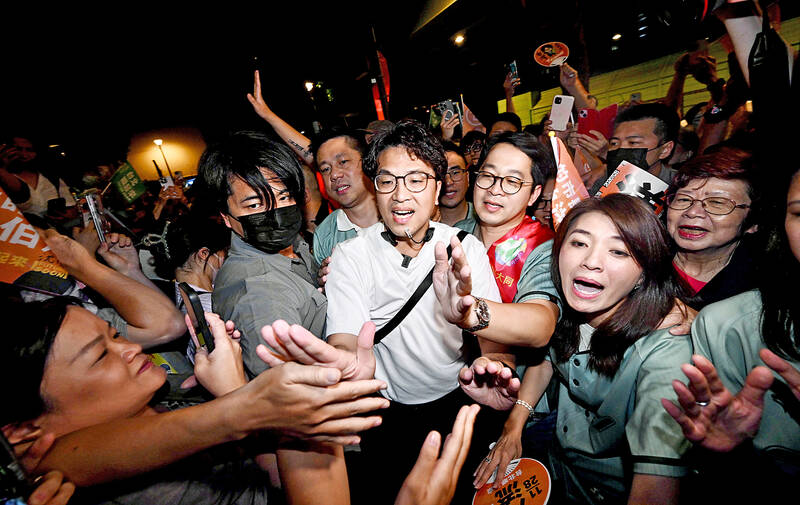
Democratic Progressive Party Legislator and Taipei mayoral candidate Puma Shen, center, high-fives with supporters at Yanshan Night Market in Taipei last night.
Photo: Lo Pei-de, Taipei Times
Among politically unaffiliated voters, 31.7 percent said they would back Chiang and 25.9 percent said they would vote for Shen, while 12.1 percent said they did not plan to vote and 27.4 percent remained undecided or declined to give an answer, the poll showed.
A gender breakdown of the figures suggested male voters favored Shen at 43.3 percent to Chiang’s 41.0 percent, while Chiang held a decisive lead among female voters, capturing 42.3 percent support over Shen’s 38.1 percent, a 4.2 percentage-point margin.
The poll was commissioned by the Taipei Trust in Democracy Association, designed and analyzed by polling expert Tai Li-an (戴立安), and conducted by Beacon Market Research from Wednesday to Friday last week.
It surveyed 1,076 people aged 20 or older, with 752 interviews conducted via landline and 324 via mobile phone. It has a margin of error of 3.0 percentage points.
Chiang yesterday said that “any numbers are merely for reference,” adding that the municipal team’s top priority remains steadily advancing city affairs.
Shen expressed confidence in Tai’s long-established credibility.
“If anyone wants to question the validity of a poll, they should simply present scientific evidence,” Shen said.
“Slapping labels on it arbitrarily is meaningless. It is crucial that we stick to professional standards,” he said, referring to criticism over the association’s alleged ties to United Microelectronics Corp founder Robert Tsao (曹興誠), who had donated to the civil defense organization Kuma Academy founded by Shen and worked closely with Shen during the recall campaign against KMT lawmakers last year.
Association founder and chairman Huang Ching-lung (黃清龍) yesterday said he cofounded the organization with like-minded friends, adding that the poll was directly commissioned and funded by the association.
Tai said that having conducted polling for organizations across the political spectrum, the key lies in maintaining complete transparency by publicly disclosing the survey’s methodology, design and authorship.
Taipei City Councilor Liu Tsai-wei (柳采葳) of the KMT voiced doubts about the survey’s sampling structure, calling the heavily green-leaning skew — 37.5 percent pan-green versus just 28.4 percent pan-blue — an anomaly.
“Everyone knows Taipei’s political landscape has long tilted blue over green. Yet to give Shen a shot in the arm and boost his momentum, this poll deliberately sampled nearly 10 percentage points more greens than blues in Taipei just to cook up a close result for self-consolation,” she said.
DPP Taipei City Councilor Ho Meng-hua (何孟樺) said the reasons behind the results showing a close race between Shen and Chiang are plain to see.
Shen comes across as warm, humble and willing to confront challenges head-on, she said.
In contrast, Chiang relies on robotic political platitudes and ideology-driven rhetoric, using die-hard supporters’ support to play down his administration’s mounting municipal failures, she said.
“For a city government relying on good looks to cover up its administrative flaws, public patience is rapidly wearing thin,” she said.
Additional reporting by Sun Wei-jung, Liu Wan-lin, Kan Meng-lin and Ho Yu-hua
KioskNews shows a cleaned-up reading view extracted from the publisher’s page — the original always lives on their site, not ours.