Taiwan to activate NSF amid stock rout
PLUMMETING: The TAIEX plunged 3,737.67 points in early session yesterday, the largest intraday drop in history, and closed down 1,873.08 points due to AI data center concerns
By Chen Cheng-hui / Staff reporter


The government yesterday authorized the activation of its NT$500 billion (US$15.26 billion) National Stabilization Fund (NSF) to support local shares, as the stock market experienced significant fluctuations while uncertainties in the international political and economic situation continue.
The NSF’s steering committee may use the fund to intervene in the market to prop up local shares, the Ministry of Finance said in a statement.
Once the fund is activated next week, it would be the 10th time the NSF has intervened in the market.
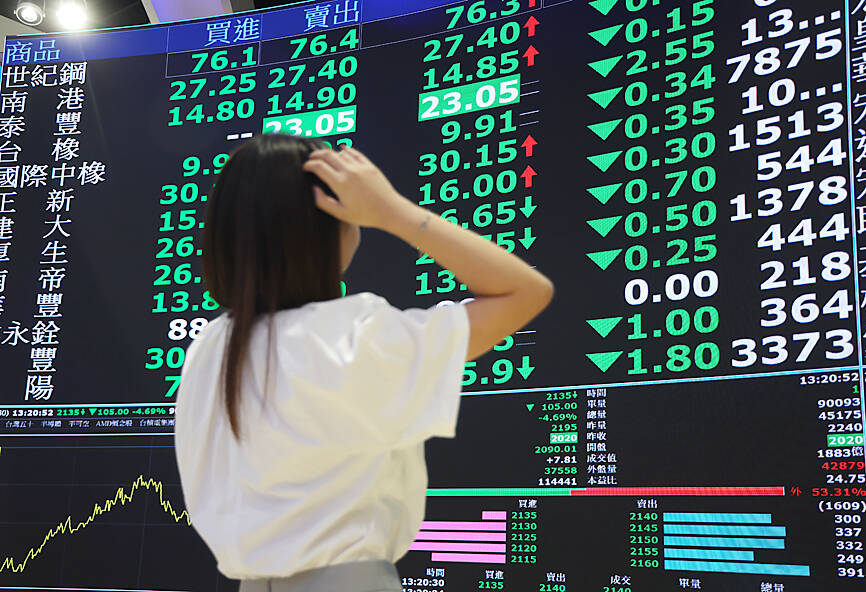
A woman looks at an electronic stock board at the Taiwan Stock Exchange in Taipei yesterday.
Photo: CNA
Separately, the Financial Supervisory Commission (FSC) yesterday announced temporary curbs on short selling shares and other measures to help maintain stock market stability, with the rules to take effect on Monday.
The volume of intraday securities lending to short sell a stock is to be lowered to 3 percent of the stock’s average daily trading volume over the previous 30 sessions, down from 30 percent, the commission said.
The amount of money an investor must deposit to borrow securities is to be raised from 90 percent to 130 percent of a stock’s value, it said, showing the commission’s intention to effectively increase the cost of short selling.
The FSC also encouraged listed companies to buy back their shares on the open market to help restore investor confidence, it added.
The government’s moves came as the TAIEX plunged 3,737.67 points in early-session trading yesterday, the largest intraday drop in history, before paring losses to close down 1,873.08 points, the fourth-largest single-day points loss, at 39,701.64 amid growing concerns about a slowdown in investment in artificial intelligence (AI) data centers.
Along with the continued sell-off by foreign institutional investors and a significant lack of confidence in the market, the committee allowed the fund to carry out market stabilization tasks, the ministry said.
The TAIEX dropped a total of 5,510 points, or 12.19 percent, this week and has fallen 10,267.28 points, or 20.55 percent, from this year’s high of 49,968.92 on Oct. 6, entering bear market territory.
That prompted Premier Cho Jung-tai (卓榮泰) to tell reporters ahead of a legislative meeting yesterday that he had directed financial regulators to monitor stock market developments closely and respond flexibly.
While Taiwan’s economic fundamentals are sound, the local stock market, dominated by high-tech stocks, is closely correlated with the Philadelphia Semiconductor Index and tends to show a synchronized movement.
The TAIEX’s 12.19 percent decline this week is second only to the Philadelphia Semiconductor Index’s 15.7 percent drop, the ministry said.
Furthermore, foreign institutional investors net sold NT$994.316 billion of local shares last month, marking a record high for a single month, the ministry said.
The net selling continued this month and reached NT$524.4 billion as of yesterday, further exacerbating the downward trend in the local stock market, it added.
KioskNews shows a cleaned-up reading view extracted from the publisher’s page — the original always lives on their site, not ours.